


























Views
Downloads
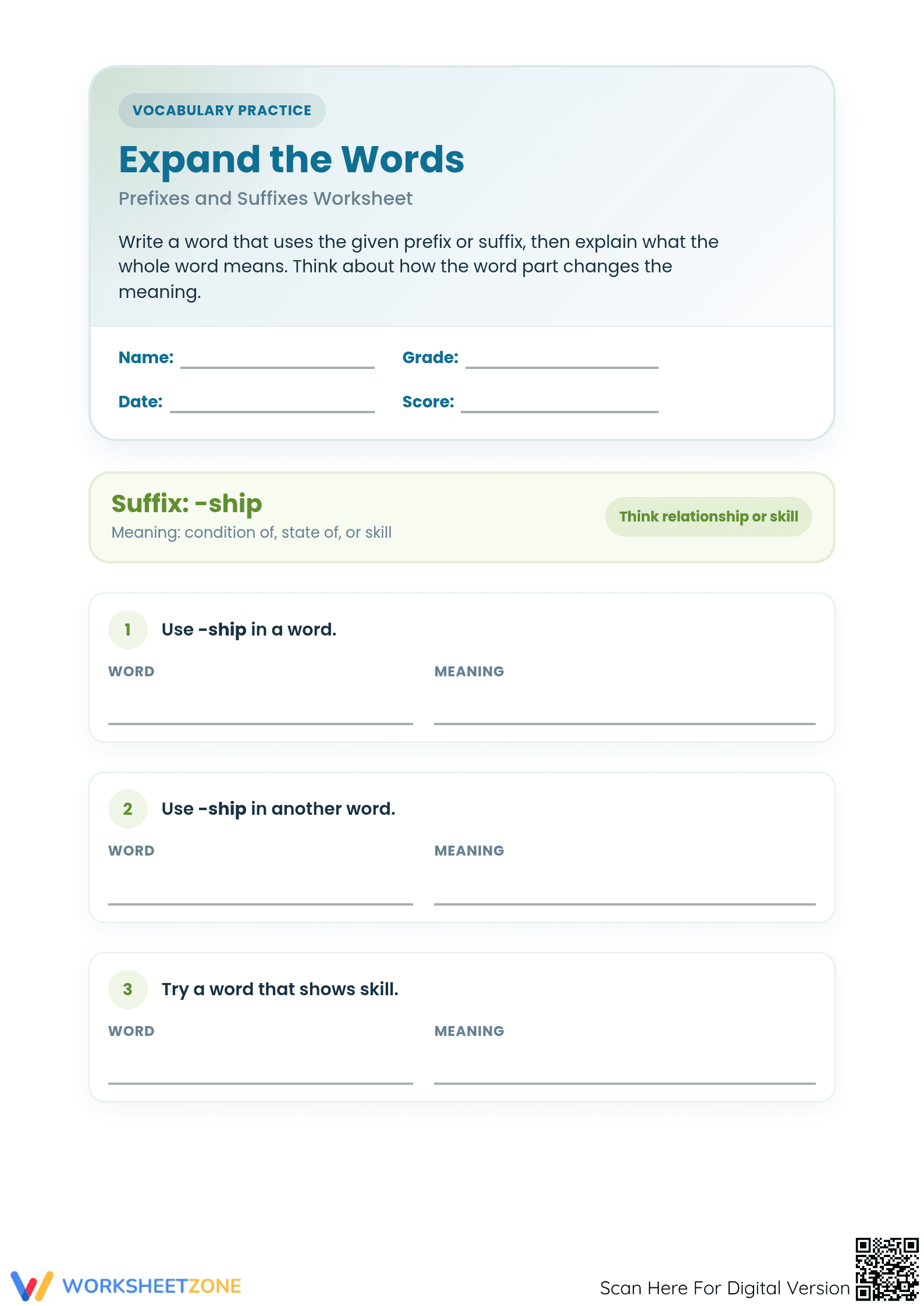
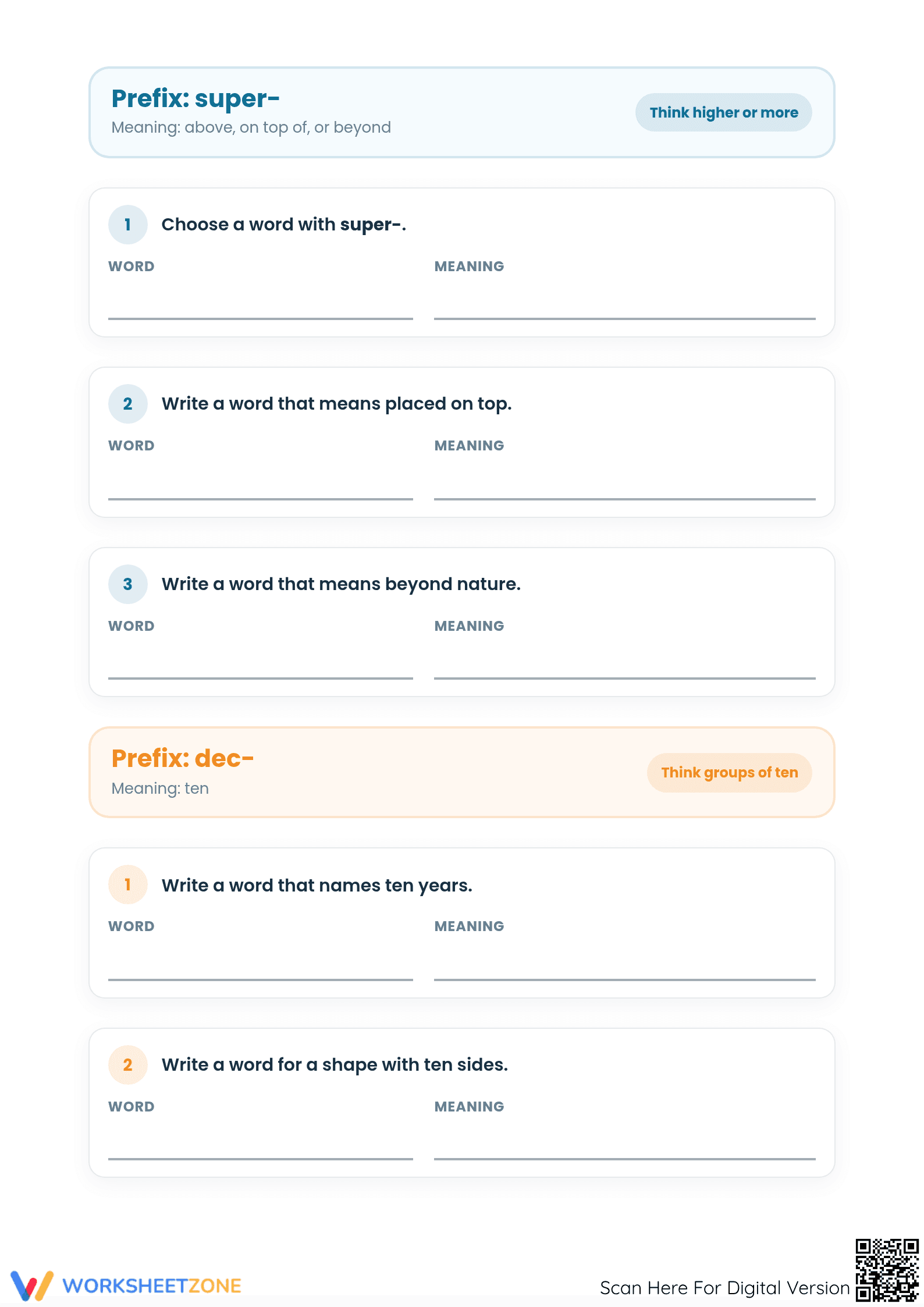
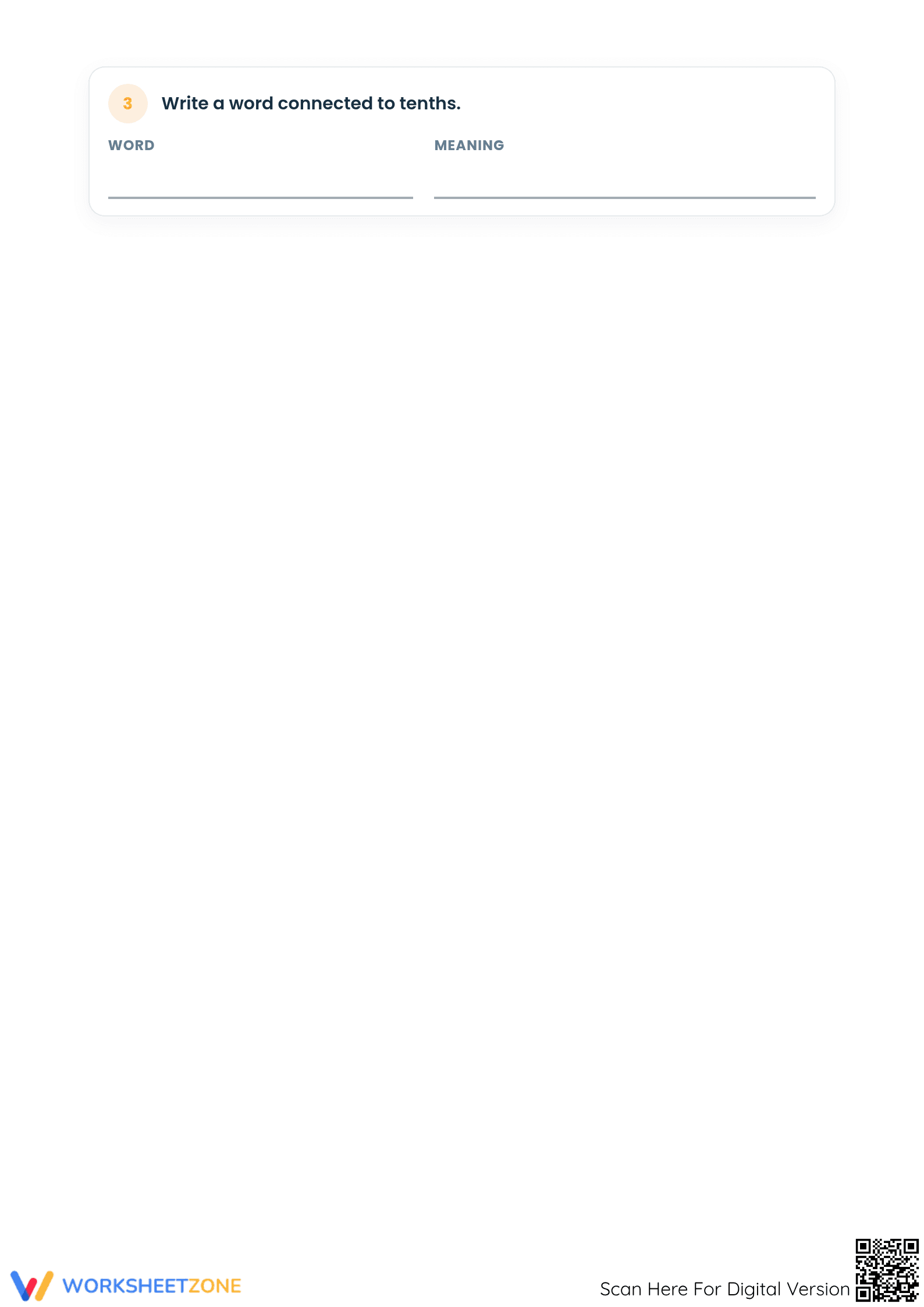

Essential Prefixes and Suffixes Worksheet | Grades 3-5
Paste this activity's link or code into your existing LMS (Google Classroom, Canvas, Teams, Schoology, Moodle, etc.).
Students can open and work on the activity right away, with no student login required.
You'll still be able to track student progress and results from your teacher account.
Strengthen student vocabulary and morphological awareness with this comprehensive three-page practice set. This resource helps learners decode complex words by identifying how specific prefixes and suffixes alter the meaning of a root word. By practicing word construction and definition writing, students build the linguistic foundation necessary for reading fluency and advanced comprehension across all subject areas.
At a Glance
- Grade: 3-5 · Subject: English Language Arts
- Standard:
CCSS.ELA-LITERACY.L.3.4.B— Determine the meaning of the new word formed when a known affix is added- Skill Focus: Affix identification and application
- Format: 3 pages · 9 problems · Answer key included · PDF
- Best For: Independent practice or literacy centers
- Time: 15–20 minutes
Inside this packet, you will find three dedicated pages focusing on high-frequency affixes: the suffix "-ship" and the prefixes "super-" and "dec-". Each page provides a clear definition of the word part and a helpful "think" prompt to guide student reasoning. The layout includes spacious lines for students to write their chosen words and provide original definitions, ensuring they process the relationship between the affix and the base word. A complete answer key is provided to facilitate quick grading or student self-correction.
Zero-Prep Workflow
- Print (1 minute): Select the specific affix page you are teaching or print all three as a comprehensive packet for a sub plan or weekly homework.
- Distribute (30 seconds): Hand out the sheets during your word study block; the built-in definitions mean no additional anchor charts are required for the activity.
- Review (1 minute): Use the included answer key to check for understanding or project it on a screen for a whole-class review of word meanings.
This resource is aligned to CCSS.ELA-LITERACY.L.3.4.B, which requires students to determine the meaning of the new word formed when a known affix is added. It also supports CCSS.ELA-LITERACY.L.4.4.B and CCSS.ELA-LITERACY.L.5.4.B as students progress toward more complex Greek and Latin roots. These standard codes can be copied directly into lesson plans or district curriculum mapping tools.
Use this worksheet as a formative assessment after a direct instruction lesson on morphology. For example, assign the "-ship" page after discussing nouns that describe states of being. Observe if students can distinguish between literal and figurative uses of the affix. This activity typically takes 15 to 20 minutes, making it an ideal choice for morning work or a transition activity between literacy rotations.
This worksheet is designed for students in grades 3-5. It is particularly effective for English Language Learners (ELLs) who benefit from explicit instruction in word parts to expand academic vocabulary. Pair this resource with a classroom word wall or a root word dictionary to provide additional support for students who struggle to brainstorm examples independently.
Research by Fisher & Frey (2014) emphasizes that morphological awareness is a significant predictor of reading comprehension. By teaching students to break words into prefixes, suffixes, and roots, educators provide a generative tool for decoding unfamiliar words. This worksheet applies these principles by requiring students to identify the affix and explain the semantic shift it creates. Students who demonstrate mastery of structural analysis are better equipped for the lexical demands of middle school texts. CCSS.ELA-LITERACY.L.3.4.B serves as the anchor for this development, bridging the gap between basic phonics and advanced vocabulary acquisition.


