


























Views
Downloads

Dissect the Words: Essential Affixes Worksheet | Grade 4
Paste this activity's link or code into your existing LMS (Google Classroom, Canvas, Teams, Schoology, Moodle, etc.).
Students can open and work on the activity right away, with no student login required.
You'll still be able to track student progress and results from your teacher account.
This Grade 4 vocabulary worksheet helps students master word construction by breaking down complex terms into their foundational parts. By identifying prefixes, suffixes, and roots, learners build the morphological awareness necessary to decode unfamiliar academic language. This resource ensures students understand how specific affixes alter word meanings and functions across various contexts.
At a Glance
- Grade: 4 · Subject: ELA
- Standard:
CCSS.ELA-LITERACY.L.4.4.B— Use common affixes and roots as clues to determine word meanings- Skill Focus: Morphological Analysis
- Format: 2 pages · 12 tasks · Answer key included · PDF
- Best For: Vocabulary development and word study centers
- Time: 20–30 minutes
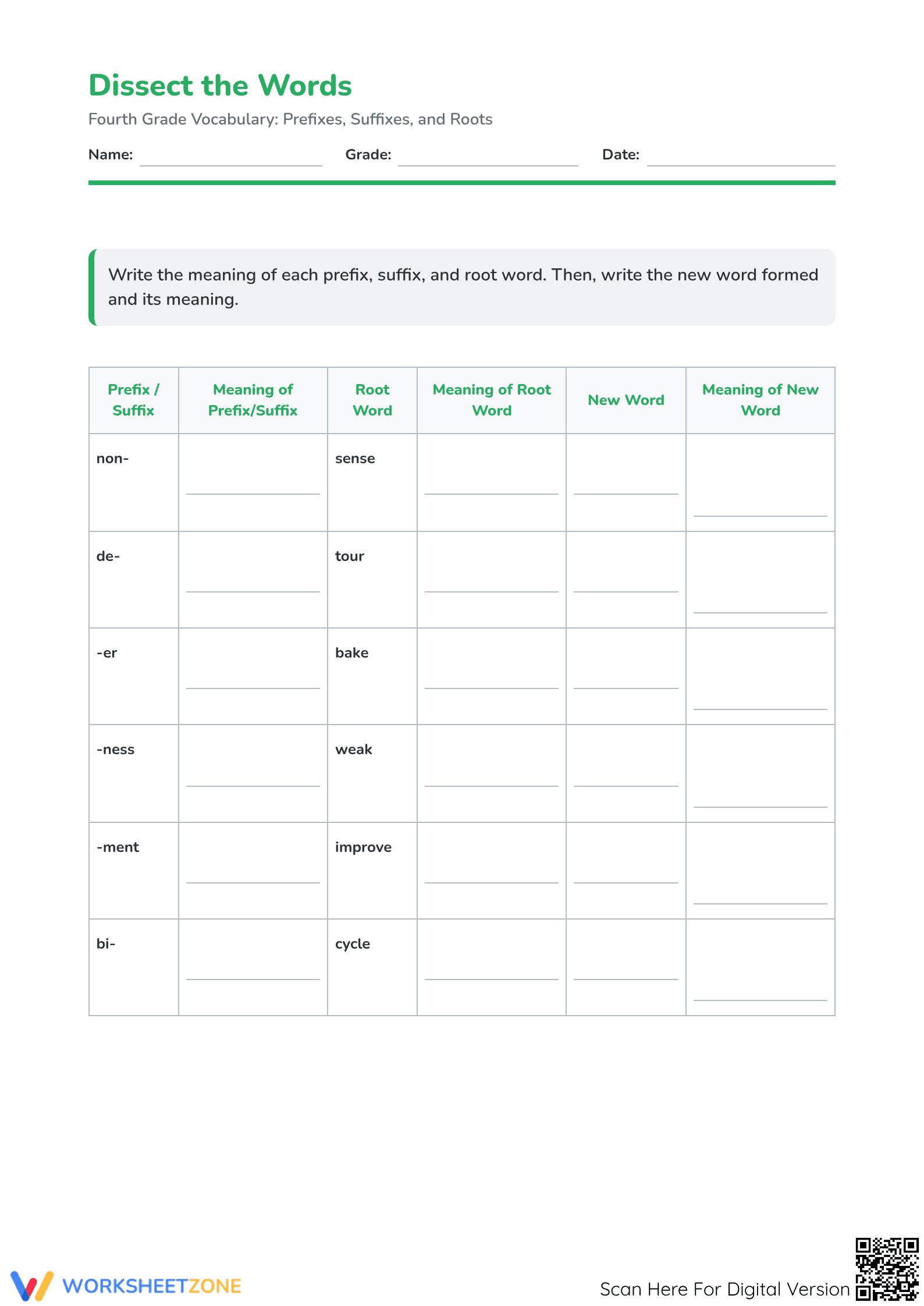
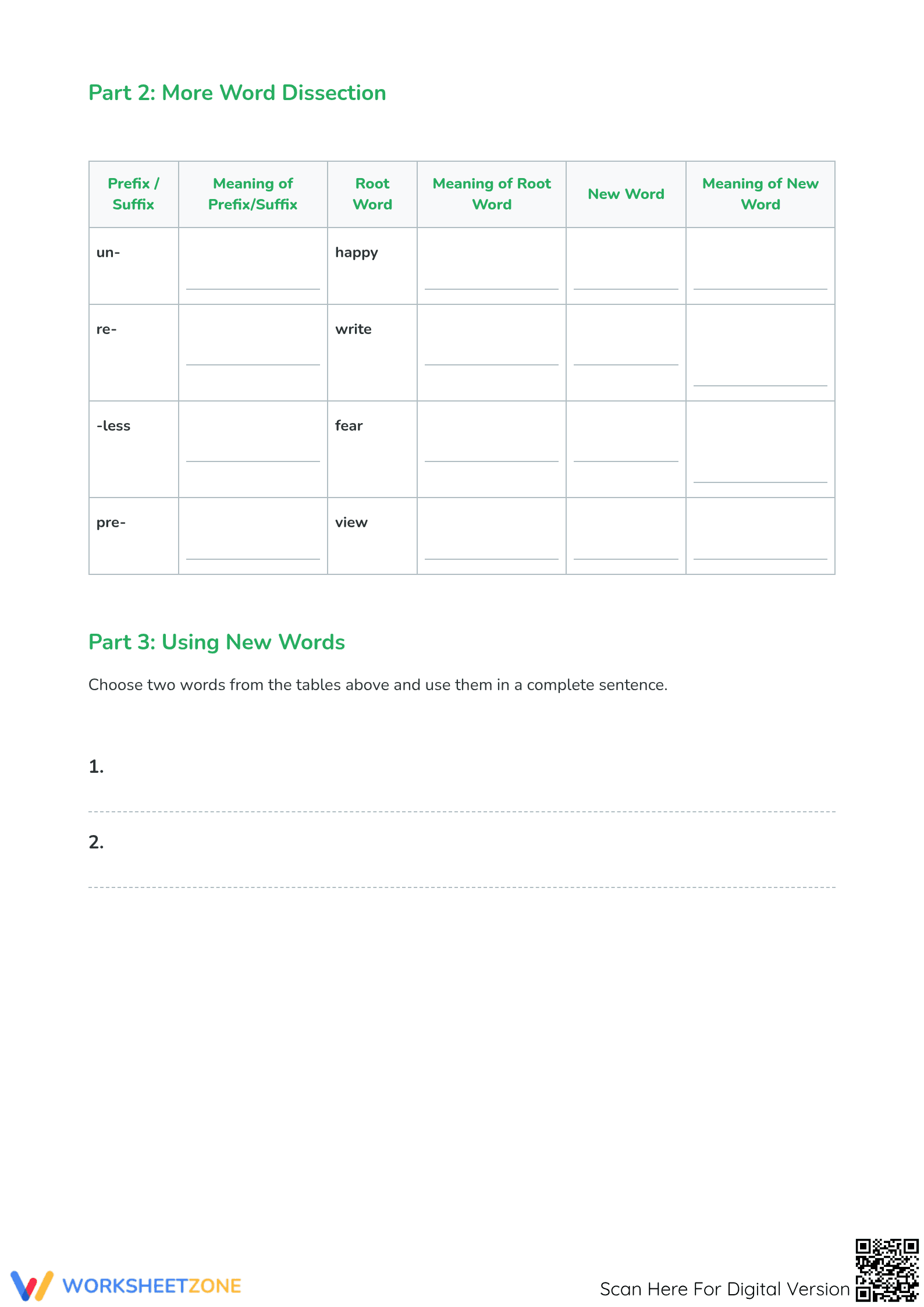
Inside this two-page PDF, you will find a comprehensive word dissection table featuring 10 high-frequency words. Each entry requires students to define the affix, define the root, and then synthesize a complete definition for the newly formed word. The second page includes a sentence-writing section to ensure students can apply their new vocabulary in original compositions.
Skill Progression
- Guided Practice: The first three rows focus on common prefixes like "non-", allowing students to practice basic decomposition with familiar roots.
- Supported Practice: Seven additional rows introduce complex suffixes such as "-ment", requiring analysis of how parts of speech change.
- Independent Application: Two concluding tasks require students to use their analyzed words correctly within original, context-rich sentences.
This sequence follows a gradual-release model, moving from structural identification to functional usage.
Standards Alignment
This resource is specifically designed to meet `CCSS.ELA-LITERACY.L.4.4.B`, which requires students to use common, grade-appropriate Greek and Latin affixes and roots as clues to the meaning of a word. It also supports general vocabulary acquisition strategies found in Grade 3 and Grade 5 frameworks. Both standard codes can be copied directly into lesson plans, IEP goals, or district curriculum mapping tools.
How to Use It
Assign this during the "We Do" phase of a morphology lesson to model structural analysis. As a formative assessment, observe if students can explain how a suffix like "-less" changes a word's meaning. Completion typically takes 20 to 30 minutes. It works well as a standalone center activity or a guided small-group task.
Who It's For
This activity is ideal for Grade 4 students, but provides excellent reinforcement for Grade 5 learners or enrichment for Grade 3. It serves as a perfect pairing for an anchor chart on common affixes or a direct instruction lesson on Greek and Latin roots. It is also suitable for English Language Learners building academic vocabulary.
According to research by Fisher & Frey (2014) on word-solving strategies, teaching students to decompose words into meaningful parts—prefixes, suffixes, and roots—is a high-leverage practice for vocabulary acquisition. This worksheet directly addresses CCSS.ELA-LITERACY.L.4.4.B by requiring students to analyze the semantic contribution of each morpheme. By identifying that "non-" means "not" and "sense" refers to meaning, students synthesize the definition of "nonsense" through structural analysis rather than rote memorization. This morphological awareness is a significant predictor of reading comprehension in the upper elementary grades, as it provides a generative framework for decoding unfamiliar academic language. The inclusion of sentence-level application ensures that students move beyond isolated identification toward functional literacy. Utilizing this structured approach allows educators to provide targeted intervention for students struggling with complex texts, ensuring they have the linguistic tools necessary to access increasingly difficult vocabulary across all subject areas.


