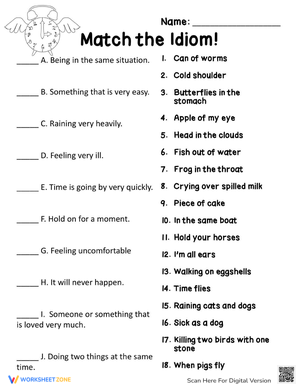
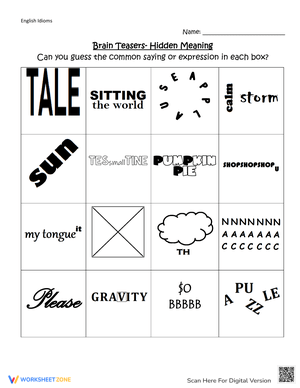
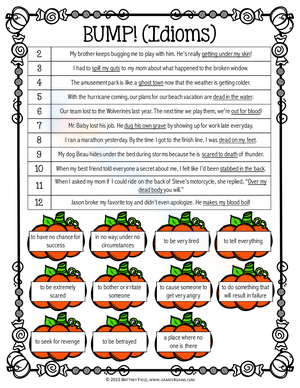
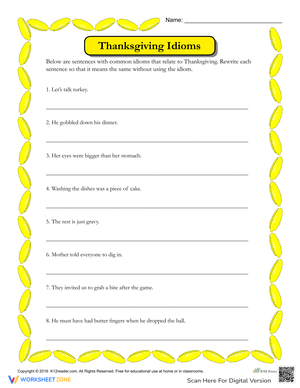
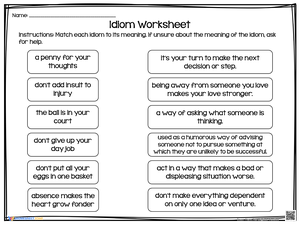
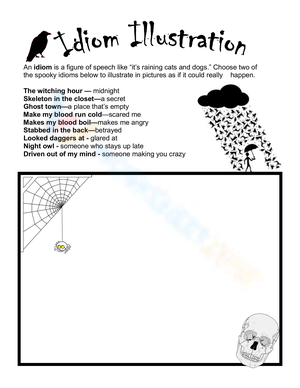
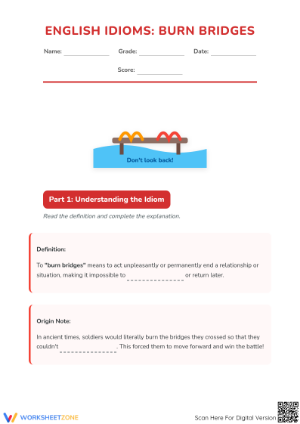
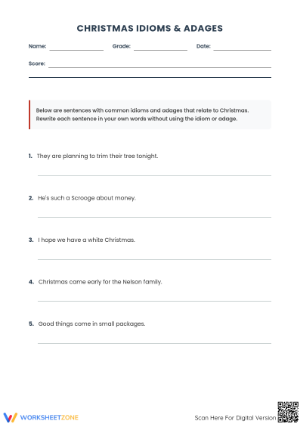
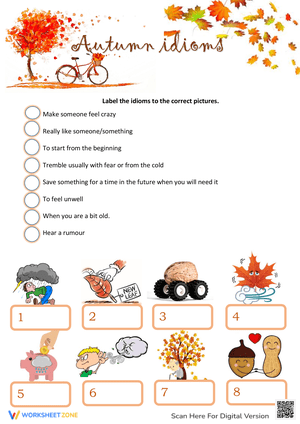
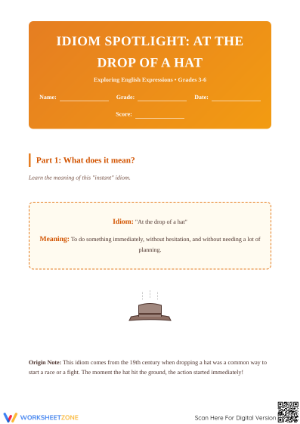
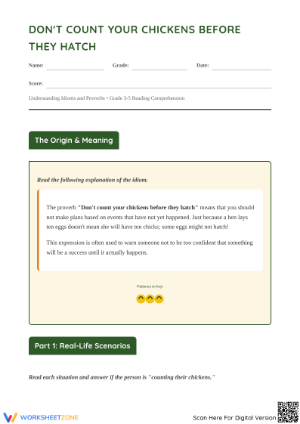
These idioms printable worksheets for 5th grade give teachers a direct line from figurative language instruction to the reading behaviors students actually need — the ability to stay with a text when a narrator says someone "costs an arm and a leg" or a character is told to "bite the bullet," rather than losing momentum at the literal image. The set covers recognition, interpretation, and original application, so teachers can pull from it for a whole-class mini-lesson, a small reteach group, or an independent center without rebuilding the resource each time.
The Specific Skills Targeted in Each Worksheet
Fifth grade is when students move from simply absorbing figurative language to actively interpreting it. Readers at this level are expected to notice that a phrase should not be read literally, use surrounding words to construct meaning, and then explain that meaning clearly. The worksheets address that sequence with tasks across several related skills:
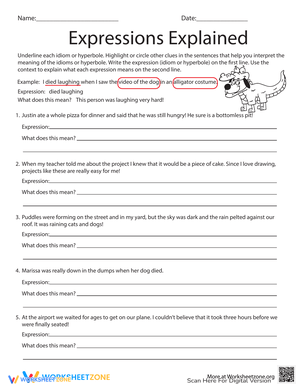
- Identifying idioms in context: Students mark which phrase in a sentence carries figurative, not literal, meaning.
- Inferring meaning from surrounding words: Students examine the sentence or passage and decide what the phrase communicates in that specific situation.
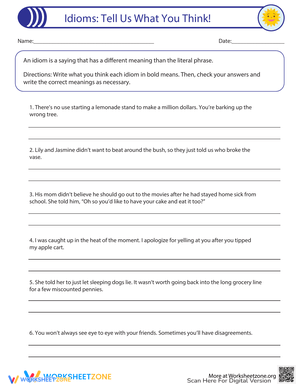
- Restating meaning in plain language: Students rewrite the phrase without figurative language — the task that most reliably separates genuine understanding from correct guessing.
- Comparing literal and figurative readings: Students explain why the word-for-word image does not make sense and why the intended meaning fits the context.
- Using idioms in original sentences: Students compose a new sentence with a familiar phrase used correctly, which requires understanding nuance and register, not just label-to-meaning recall.
Error Patterns Teachers Need to Anticipate in This Unit
The most visible error is full literal interpretation — a student reads "it was raining cats and dogs" and marks something about animals. That is easy to catch and address. The harder error shows up on rewrite tasks: a student circles the correct multiple-choice answer but then restates "raining cats and dogs" as "it was raining a lot of things." The student caught that some kind of exaggeration was involved but missed what the idiom specifically means. That partial understanding is invisible on matching tasks and surfaces only when students have to produce their own restatement rather than select one.
A second pattern appears during writing application tasks. Students who have stored an idiom as a label — knowing the phrase "under the weather" without really knowing what condition it names — will sometimes write it into a sentence that contradicts its meaning: "She was under the weather, so she felt great all day." That sentence tells you more about the gap in understanding than any recognition task would. It is one reason the application task on each worksheet earns its place — it catches something the earlier tasks cannot.
How to Work These Worksheets Into Your Weekly Lesson Plan
The most durable approach is distributing practice across the week rather than front-loading it into one block. Project two or three examples on Monday, model how to scan surrounding words for meaning clues, and follow with a short matching or context-inference worksheet as immediate practice. Midweek, move to a rewrite or comparison task — partner work is especially productive here, because students who have to justify their restatement aloud tend to catch their own errors before writing. A quick exit task on Friday using one or two new phrases from the week's reading closes the loop without requiring a separate planning block.
Teachers who use idioms printable worksheets for 5th grade as a recurring spiral-review tool rather than a one-unit activity consistently see stronger figurative language fluency by the time assessments arrive. The worksheets also hold up in substitute plans because the directions are concrete and the skill does not require prior setup. In intervention groups, cut each worksheet into strips, work through the first item orally as a group, then release students to the remaining items — that keeps the cognitive demand intact while reducing the visual load for readers who need extra support.
Standard Alignment
Common Core State Standards for ELA, Language Standard 5.5a asks fifth graders to interpret figurative language — including similes, metaphors, and idioms — in context and to explain nuances in word meaning. In practical classroom terms, that means students read a phrase, recognize that the literal reading does not fit, use context to construct the intended meaning, and explain that meaning clearly. Each worksheet in this set asks students to move through exactly that sequence, which makes the resource useful both as skill practice and as standards-based evidence during planning cycles or instructional walkthroughs. Because L.5.5a is an anchor standard, not a one-week topic, short recurring practice carries more instructional weight than a single dedicated lesson does.
Tailoring Each Worksheet to the Readers in Your Room
For students who process language very literally — including many English learners and some students with language processing differences — the most effective adjustment is slowing the entry point, not lowering the expectation. Start with idioms that appear in everyday classroom conversation before moving to ones that depend on cultural or regional background knowledge. "Give me a hand" lands more accessibly in a school context than "costs an arm and a leg." Starting with the familiar reduces the chance that background knowledge becomes the barrier instead of the interpretive skill itself.
- Pre-teach a small cluster of high-frequency phrases: Introduce four or five idioms students are likely to encounter in fifth-grade texts before any independent work begins.
- Add oral rehearsal before written tasks: Ask students to say the idiom, state its meaning, and use it in a new sentence aloud. That sequence lowers the written-production demand while keeping the thinking rigorous.
- Lead with the literal-versus-figurative comparison format: Students who need to externalize their reasoning find this format more accessible than multiple choice — writing both meanings side by side makes thinking visible before committing to an answer.
- For advanced students, require paragraph-level application: Ask students to use three idioms from the worksheet correctly inside a single paragraph they compose, which demands understanding of register and context rather than individual phrase recall.
One honest tradeoff: the context-inference format frustrates students who process print slowly when the surrounding sentence is short and gives little to work with. Longer, more descriptive context sentences actually help those students more. If a particular item has thin context, read it aloud with the group before releasing students to work independently — that one adjustment often changes the quality of the evidence the task produces.
Frequently Asked Questions
What does idiom instruction look like at fifth grade compared to earlier grades?
In third and fourth grade, most idiom work stops at recognition and simple matching. By fifth grade, students are expected to explain meaning using context as evidence and apply phrases correctly in their own writing. Each worksheet in this set includes at least one task that asks students to produce meaning, not just select it — which reflects that higher standard directly.
How does idiom practice connect to reading comprehension beyond the language block?
When students can interpret nonliteral phrases without losing momentum, they stay with the author's meaning instead of pausing to untangle a confusing image. Idioms printable worksheets for 5th grade build exactly that fluency — the kind that transfers directly into reading workshop and close reading, where idioms surface in mentor texts, informational articles, and narrative passages throughout the year.
Which worksheet formats work best for English learners or students with reading difficulties?
Sentence-level context tasks with full, descriptive supporting sentences are the most reliable entry point. Matching tasks efficiently introduce new phrases but can mask shallow understanding. The literal-versus-figurative comparison format reveals more about what a student actually grasps because it requires producing both meanings rather than selecting one. Oral rehearsal before any written task helps across both populations — students who talk through the meaning first tend to write more accurate restatements.
How can these worksheets fit into test prep without becoming repetitive?
Rotating the format is the key. Use idioms printable worksheets for 5th grade as a steady spiral-review tool — a matching task one week, a rewrite task the next, an application paragraph the week after that. By the time students encounter figurative language on a state assessment, they have practiced the interpretive habit repeatedly rather than newly learned it in a single sitting. That consistency, more than the number of items in any given worksheet, is what makes short printable practice durable as a test-prep strategy.












 Interactive Worksheet Maker
 Quiz Maker
 Word Search Maker
 Crossword Puzzle Maker
 Word Scramble Generator
 Sentence Scramble Generator
 Handwriting Worksheet Generator
 Name Tracing Generator
 Fill In The Blank Generator