


























Views
Downloads

Autumn Idioms Worksheet | Grade 4-6 Essential
Paste this activity's link or code into your existing LMS (Google Classroom, Canvas, Teams, Schoology, Moodle, etc.).
Students can open and work on the activity right away, with no student login required.
You'll still be able to track student progress and results from your teacher account.
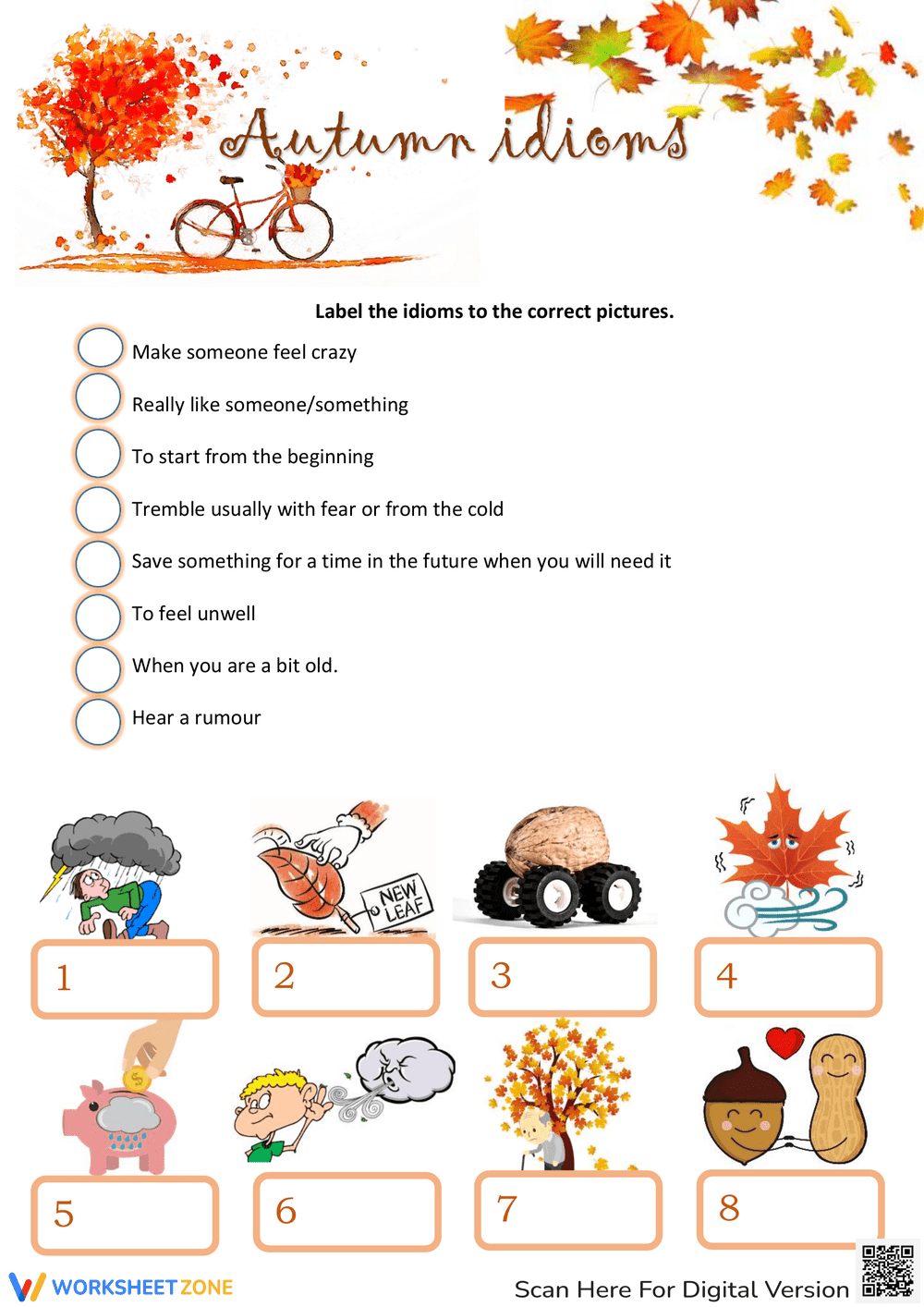
This Autumn Idioms Exercise provides upper elementary students with a structured way to identify and apply seasonal figurative language. By connecting literal definitions to visual cues and then applying those phrases in context, learners build a deeper understanding of how idioms function in everyday English. It is an effective tool for improving reading comprehension and vocabulary.
At a Glance
- Grade: 4-6 · Subject: ELA
- Standard:
L.4.5.B— Recognize and explain the meaning of common idioms, adages, and proverbs- Skill Focus: Figurative Language & Idioms
- Format: 2 pages · 16 problems · Answer key included · PDF
- Best For: Seasonal vocabulary practice or sub plans
- Time: 20–30 minutes
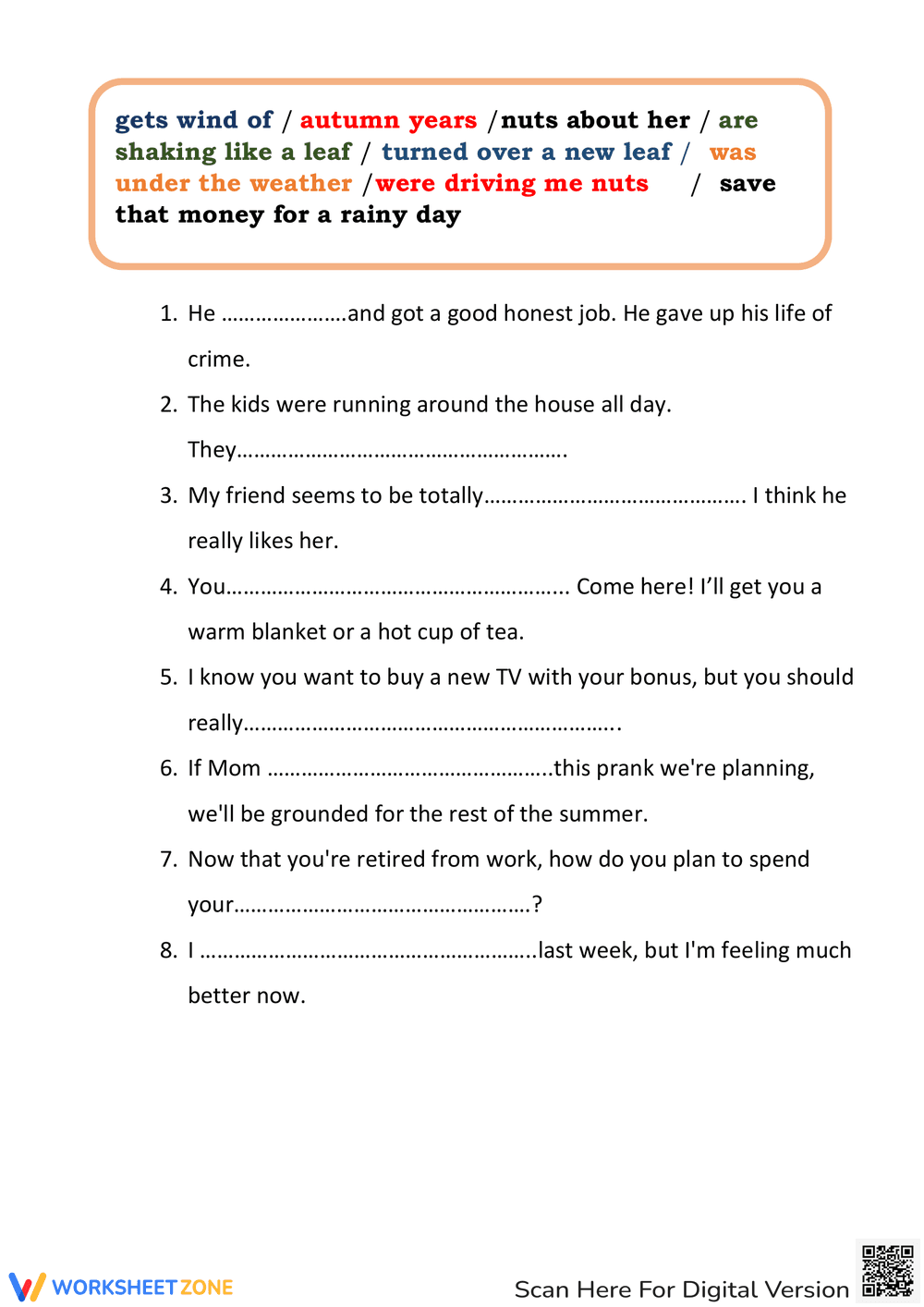
What's Inside: This 2-page PDF features a dual-layered approach to mastery. The first page contains 8 visual matching tasks where students link definitions like "to feel unwell" or "start from the beginning" to autumn-themed illustrations. The second page provides a word bank and 8 sentence-completion exercises, requiring students to use context clues to select the appropriate idiom for various narrative scenarios.
Zero-Prep Workflow: This resource is designed for immediate classroom implementation. Teachers can print the double-sided document in under 1 minute. Distribution takes seconds, as the instructions are self-explanatory for students in grades 4 through 6. Reviewing the 16 total answers can be done as a whole-class activity in approximately 5 minutes using the included answer key, making it a perfect solution for busy mornings or unexpected sub days.
Standards Alignment: The primary focus is `CCSS.ELA-LITERACY.L.4.5.B`, which requires students to recognize and explain the meaning of common idioms. By moving from visual recognition to contextual application, the worksheet also supports `CCSS.ELA-LITERACY.L.5.4.A` by encouraging the use of context clues to determine the meaning of phrases. Both standard codes can be copied directly into lesson plans, IEP goals, or district curriculum mapping tools.
How to Use It: Use this worksheet as a formative assessment after a mini-lesson on figurative language. It works exceptionally well as a "Do Now" activity during the fall months or as a center rotation task. Teachers should observe if students struggle more with the abstract definitions on page one or the contextual application on page two to identify specific gaps in linguistic reasoning. Completion typically takes 25 minutes.
Who It's For: This resource is tailored for students in grades 3-6, including English Language Learners (ELL) who often find idiomatic expressions challenging. It pairs naturally with a seasonal anchor chart or a short story containing autumn-themed metaphors. The visual aids provide necessary scaffolding for students who require more concrete representations of abstract language.
Research from Fisher & Frey (2014) emphasizes that figurative language mastery is a cornerstone of advanced literacy, as idioms often carry cultural nuances that literal translations miss. This worksheet targets CCSS.ELA-LITERACY.L.4.5.B by providing 16 specific opportunities for students to decode and apply common phrases like "under the weather" and "shaking like a leaf." By utilizing a gradual release of responsibility—moving from visual matching to independent sentence completion—the material ensures that students do not just memorize definitions but understand the functional use of idioms in narrative text. Such structured practice is essential for bridging the gap between basic decoding and the high-level inferencing required by the NAEP and other standardized assessments. This resource provides the repetition and context necessary for long-term retention of complex linguistic structures.


