




























Views
Downloads

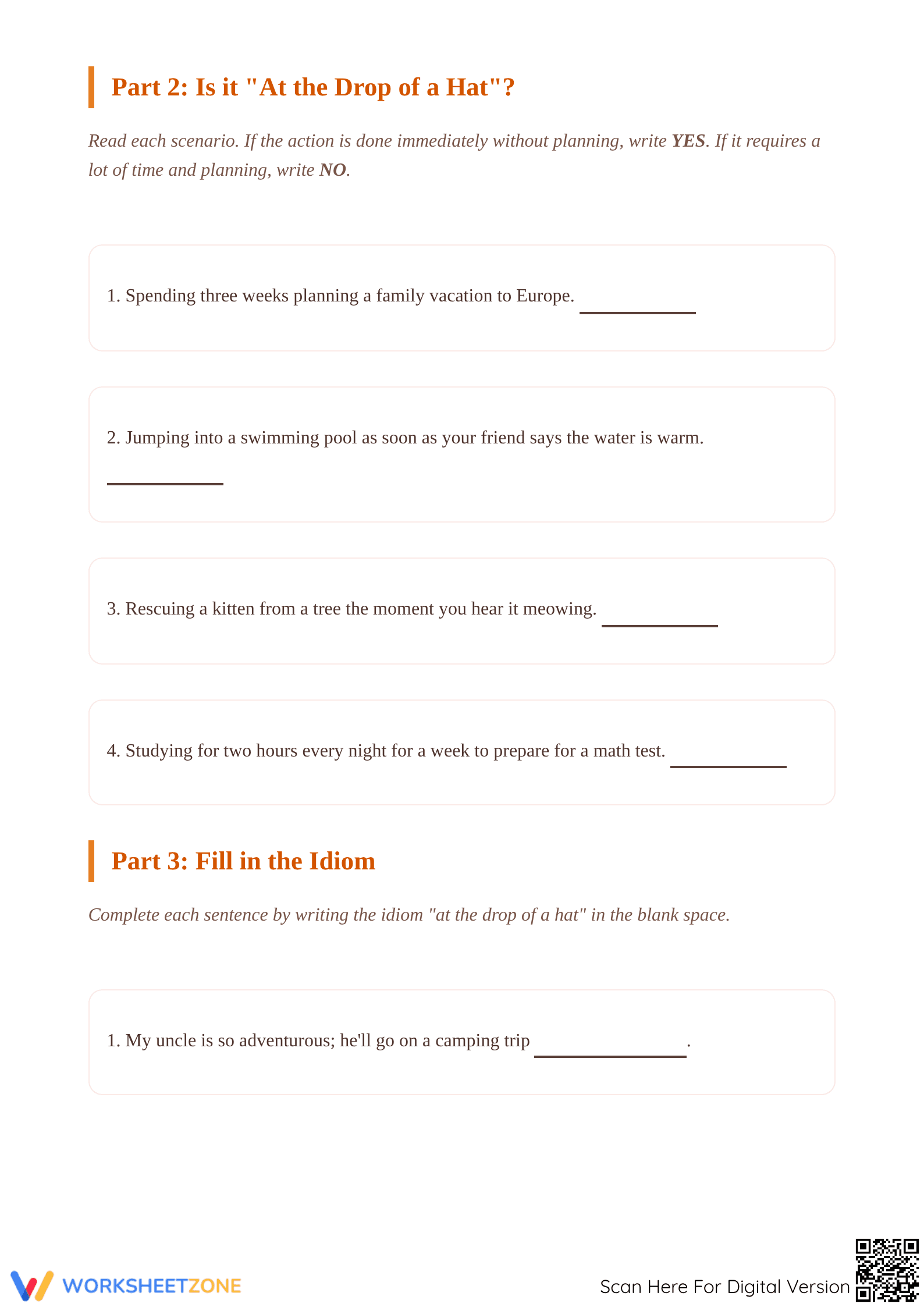


At the Drop of a Hat Idiom Worksheet | Printable ELA Grade 4

Paste this activity's link or code into your existing LMS (Google Classroom, Canvas, Teams, Schoology, Moodle, etc.).
Students can open and work on the activity right away, with no student login required.
You'll still be able to track student progress and results from your teacher account.
This Grade 4 figurative language worksheet provides students with 10 structured problems to master the meaning and application of the common English idiom "at the drop of a hat." Students will progress from identifying core definitions to applying the phrase in creative writing and visual contexts. A comprehensive answer key is included for efficient grading. Aligned to CCSS.ELA-LITERACY.L.4.5.B.
At a Glance
- Grade: 4 · Subject: English Language Arts
- Standard:
CCSS.ELA-LITERACY.L.4.5.B— Recognize and explain the meaning of common idioms, adages, and proverbs- Skill Focus: Idiom Interpretation and Usage
- Format: 4 pages · 10 problems · Answer key included · PDF
- Best For: Vocabulary building and figurative language practice
- Time: 20–30 minutes
What's Inside
This 4-page instructional packet features a dedicated introduction to the idiom's definition and 19th-century historical origin. The activity set includes scenario-based identification (Yes/No), sentence completion exercises, multiple-choice meaning selection, a creative writing prompt requiring 3-4 sentences of original application, and a visual representation task. The clear layout ensures students remain focused on the singular linguistic target.
Skill Progression
- Guided Practice: Students begin with a direct "Origin Note" and definition study to establish baseline conceptual understanding of the phrase's "instant" connotation.
- Supported Practice: Learners tackle 4 identification scenarios and 3 sentence-fill tasks where context clues provide scaffolds for correct idiomatic placement.
- Independent Practice: The final phases require higher-order synthesis through 1 creative writing application and 1 visual illustration of the phrase in action.
This structure follows the gradual-release model, moving from passive recognition to active production.
Standards Alignment
Primary Standard: `CCSS.ELA-LITERACY.L.4.5.B`. This worksheet directly supports the requirement for students to recognize and explain the meaning of common idioms. By analyzing the phrase in both historical and modern contexts, students move beyond literal interpretation to understand nuance in figurative speech. This standard code can be copied directly into lesson plans, IEP goals, or district curriculum mapping tools.
How to Use It
This resource is ideal for use during the "guided practice" phase of a figurative language unit. Assign it after a direct instruction lesson on idioms to check for student comprehension. For formative assessment, observe students during the "Scenario Identification" section; students who struggle to distinguish between planned and immediate actions may need a re-teaching of the core definition. Expected completion time is 25 minutes.
Who It's For
This worksheet is designed for Grade 4 general education students but is also highly effective for Grade 3-6 learners requiring targeted vocabulary intervention. It serves as an excellent resource for English Language Learners (ELLs) who often struggle with non-literal expressions. Pair this with a short narrative passage containing several idioms for a complete lesson cycle.
The mastery of idiomatic expressions is a critical component of reading comprehension and linguistic fluency. Research from Fisher & Frey (2014) emphasizes that academic vocabulary, including figurative language like the standard `CCSS.ELA-LITERACY.L.4.5.B`, is most effectively acquired when students are given multiple opportunities to encounter and apply phrases in varying contexts. By engaging with 10 distinct tasks, students transition from literal decoding to conceptual fluency. This worksheet addresses the common hurdle of "idiom amnesia" by providing a historical anchor (the 19th-century hat drop) to help cement the meaning in long-term memory. Such structured practice is vital for closing achievement gaps in ELA, as highlighted in recent ScienceDirect TpT Analysis reports. This resource provides the repetition necessary for students to confidently use figurative language in their own speaking and writing, ensuring they can interpret complex texts with greater precision and speed.


