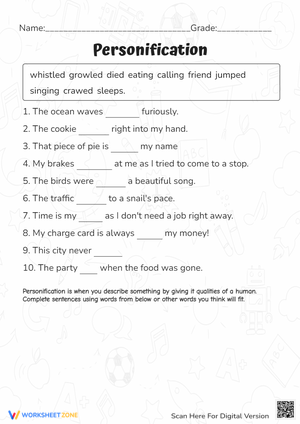
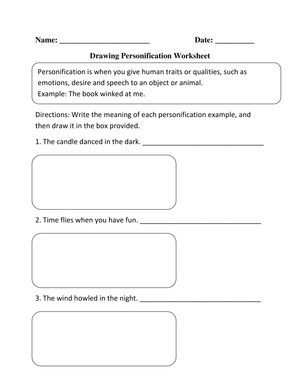
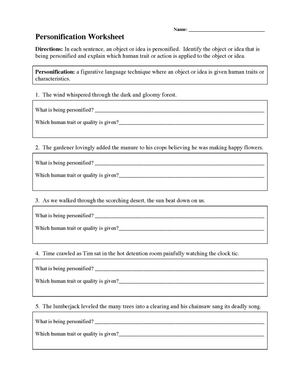
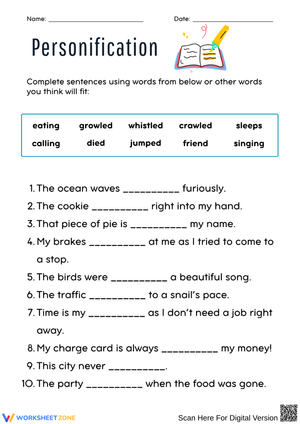
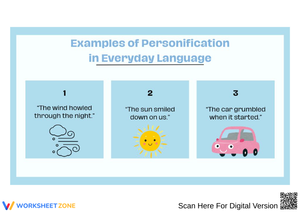
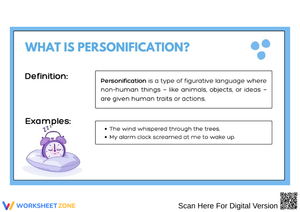
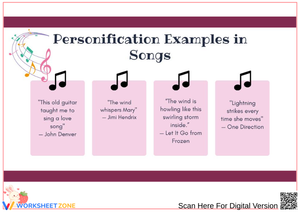
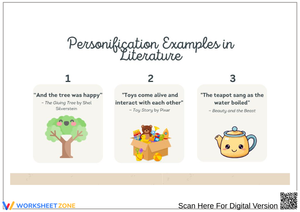
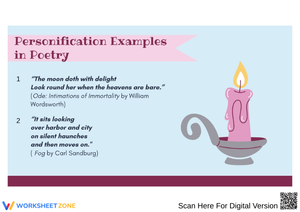
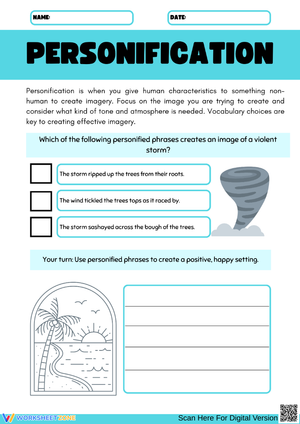
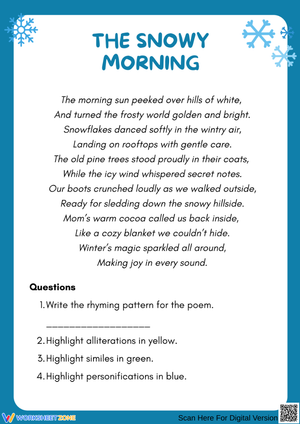
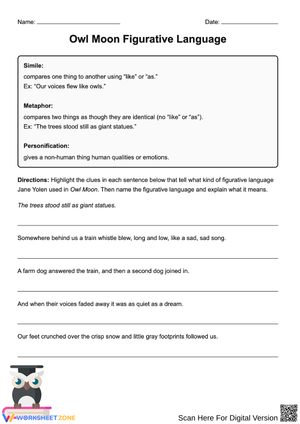
These personification worksheets for 5th grade give teachers a focused, reusable tool for one of the trickier figurative language skills in upper elementary — not because personification is conceptually hard, but because fifth graders routinely confuse identification with interpretation, and most printable sets stop at the first step. The set addresses both: students read, identify, explain, and write, building toward the kind of figurative language understanding that shows up in reading responses and writing workshop.
The Specific Skills Each Worksheet Targets
Each worksheet moves students through a deliberate task sequence rather than stopping at recognition. Students underline the nonhuman noun and bracket the human action assigned to it, then write a plain-language explanation of what that word choice does to the tone or image. That explanation step is where real comprehension lives, and it separates a strong fifth-grade figurative language worksheet from a vocabulary quiz.
- Identifying the nonhuman subject receiving a human trait or action.
- Writing a one-sentence explanation of what the personification means in context — not just what it says.
- Comparing personified phrasing against a literal rewrite to see what is lost without it.
- Generating original examples matched to a specific setting or mood, so the figurative language actually earns its place in the sentence.
- Sorting examples from mixed figurative language items to distinguish personification from similes and metaphors.
That last task matters more than it might seem. Students who can define all three devices in isolation will still mark the moon was a silver coin as personification on a test because it feels vivid. Sorting exercises interrupt that pattern by forcing students to name the move precisely rather than follow a vague impression.
Mistakes Students Make That These Worksheets Help You Catch
The most persistent error in fifth-grade personification work is treating any strong image as figurative language. The sun burned our shoulders sounds dramatic enough that students frequently circle it as personification — but the sun does literally produce heat, so no human quality is being transferred. A worksheet that asks "what human action or feeling is given to something nonhuman?" trains students to apply a precise test rather than rely on gut feeling about vividness.
The confusion between personification and metaphor runs deeper than teachers expect. When a worksheet item reads the old truck groaned up the hill, most fifth graders label it correctly. When it reads the city was a machine that never slept, a significant number will mark personification instead of metaphor because the city seems to have human habits. The distinction — giving a nonhuman thing a human quality versus saying one thing is another thing — needs explicit, repeated exposure to stick.
Writing tasks reveal a third pattern: students produce technically correct but semantically flat examples. The pencil danced across the paper has the right structure but does not create a clear picture. Worksheets that ask students to personify a specific subject in a specific context — a thunderstorm inside a story about fear, a clock during an anxious wait — push students past the minimal-effort example into language that does real work on the page.
Standard Alignment
These resources address CCSS ELA RL.5.4, which requires students to determine the meaning of words and phrases in a literary text, including figurative language. In classroom terms, that standard appears most directly during close reading: students cannot explain an author's craft choices without first understanding what a figurative phrase means and what it adds. The personification worksheets for 5th grade that include both identification and interpretation tasks map cleanly onto RL.5.4 because they require students to do both — read, then reason through what the language accomplishes.
The original writing tasks in the set also connect to CCSS ELA W.5.3d, which asks students to use concrete words, phrases, and sensory details to convey experiences and events precisely. Personification is one of the most teachable moves toward that standard because students can see, in a single revised sentence, how figurative language changes what a reader pictures.
Fitting These Worksheets Into the Week Without Losing Instructional Time
Bell ringers are where personification worksheets for 5th grade earn consistent use in real classrooms. Three sentences on a projected slide or a quick-print half-sheet, students annotate before the lesson begins — underline the nonhuman subject, bracket the human action, write one sentence of explanation. That routine runs about eight minutes and produces a visible artifact teachers can scan during morning meeting to catch who needs a reteach conversation before the week's reading lesson goes deeper.
Small-group instruction is where interpretation tasks do their clearest work. After a quick whole-class check shows students can identify examples but cannot explain them, pull a group of four or five and model your own thinking aloud on one item — read the sentence, name what is literally impossible, then ask what the author wanted the reader to feel. That talk move gives students a repeatable mental process they can apply independently afterward.
Sub plans are a genuine use case worth planning for. The directions on each worksheet are self-contained, the task is finite, and the format is direct enough that students work without redirection. In a week where routines are interrupted, having a worksheet that protects fifteen minutes of figurative language practice is not a small thing.
Adjusting the Set for a Range of Learners
For students still building confidence with figurative language, start with sentence-level identification before moving to passage-length tasks. A printed reference card with one clear personification example and three diagnostic questions — What is the subject? Is it nonhuman? What human quality is assigned to it? — lets students self-check without waiting for teacher confirmation on every item. That step-by-step support structure keeps students moving without dependence on repeated prompting.
Students who move through identification quickly benefit from writing tasks that raise the bar. Instead of asking for any personification example, give a constraint: personify the same object two ways to create two different emotional effects. A clock that ticked impatiently versus a clock that sighed through the afternoon — both are technically personification, but the revision exercise pushes students to treat the device as a deliberate craft choice, not a pattern to copy.
For English learners, the worksheets that pair a personified sentence with a literal rewrite are particularly useful. The side-by-side format shows exactly which word is doing figurative work, which reduces the processing demand of parsing meaning from an unfamiliar grammatical structure. When the task explicitly asks students to compare both versions in writing, responses tend to be more precise than open-ended explanation prompts produce on their own.
Frequently Asked Questions
Do these worksheets work as standalone homework, or do students need a classroom lesson first?
Identification and explanation tasks can go home without prior setup if students have had at least one in-class introduction to personification. Writing tasks — especially those asking students to create original examples for a specific scene or mood — work better after students have seen a few modeled examples and understand what "fits the context" actually means. A brief whole-class share before the homework goes out prevents the flat, interchangeable responses that show up when students interpret the task too broadly.
How many worksheets should I use before students are ready to apply the skill independently?
Three rounds of exposure tend to produce reliable transfer: one worksheet focused on identification, one on interpretation inside short passages, and one on student-generated writing. If students are still conflating personification with metaphor after those three rounds, a fourth worksheet using mixed figurative language sorting usually resolves the confusion before it becomes a persistent gap.
Can I use these for standardized test preparation?
State ELA assessments regularly embed figurative language items inside reading passages, and the interpretation format — read a short excerpt, explain what a phrase means in context — matches the constructed response task type students encounter on those tests. The personification worksheets for 5th grade that include passage-based items give students practice reading for figurative meaning rather than labeling an isolated term, which is much closer to what standardized assessments actually ask.
What if students confuse personification with metaphor on nearly every item?
That confusion almost always traces back to the same source: students are reading for feeling rather than structure. A sorting worksheet with ten mixed examples — some personification, some metaphor, a simile or two — and a written reason required for each answer (not just the label) reveals the gap quickly. The explanation requirement separates students who have internalized the distinction from students making educated guesses and landing on the correct answer by chance.












 Interactive Worksheet Maker
 Quiz Maker
 Word Search Maker
 Crossword Puzzle Maker
 Word Scramble Generator
 Sentence Scramble Generator
 Handwriting Worksheet Generator
 Name Tracing Generator
 Fill In The Blank Generator