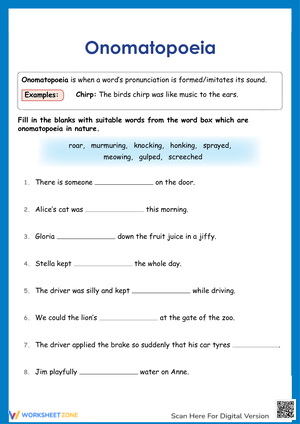
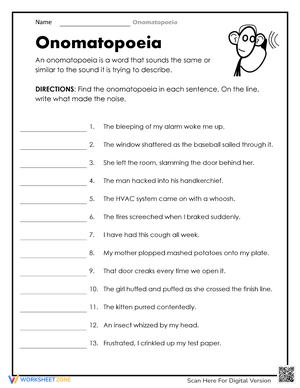
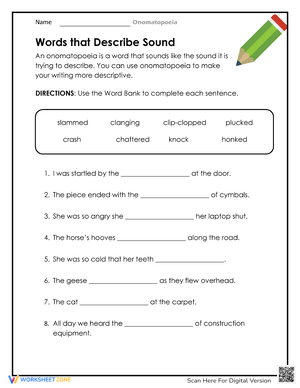
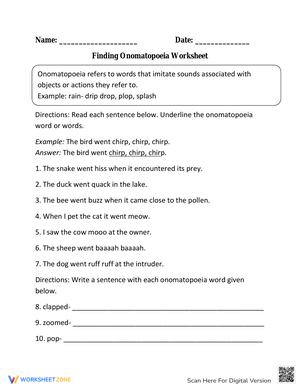
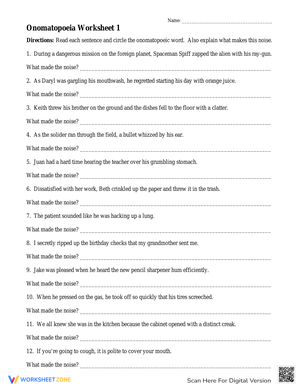
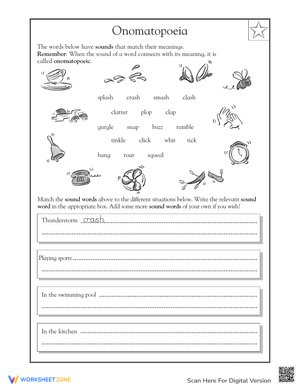
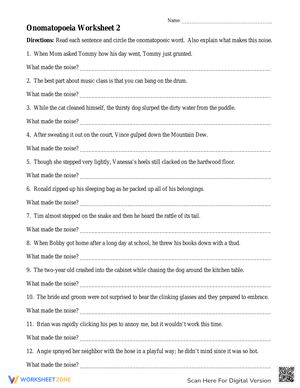
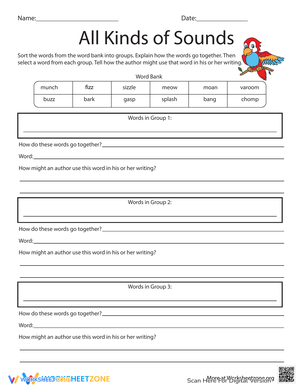
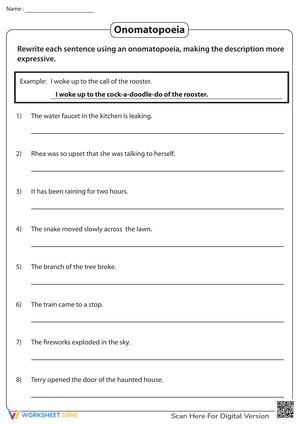
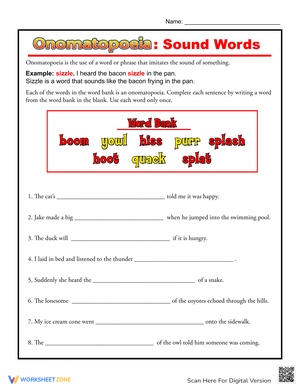
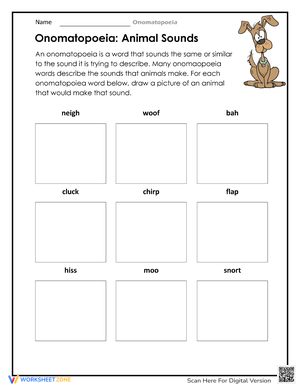
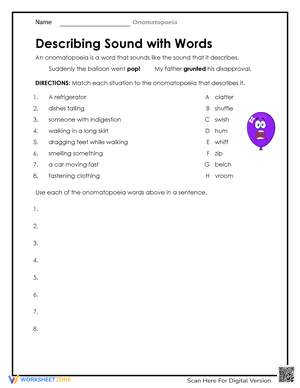
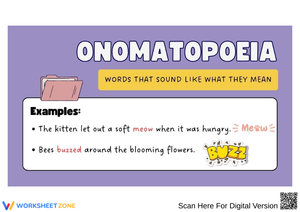
These 5th grade onomatopoeia worksheets give teachers a printable practice set that covers the full instructional arc — from identifying sound words in context to producing original examples in poetry, dialogue, and narrative description. Each worksheet is built around a specific task type, so teachers can assign them in sequence across a unit or pull individual worksheets for targeted review. Because the skill builds quickly when practice is well-sequenced, the resources work across whole-class instruction, small-group reteaching, and literacy center rotations.
The Specific Skills Each Worksheet Targets
Onomatopoeia lands at an interesting point in grade 5 because students can hear the connection before they can analyze it — "buzz" and "hiss" are obvious enough that even struggling readers grasp the basic concept quickly. The challenge is pushing past that initial recognition toward the kind of analysis the grade-level standard requires: explaining how a specific word choice affects tone, pacing, or the reader's sensory experience. These worksheets address that gap by moving students through a deliberate sequence rather than cycling through the same matching task repeatedly.
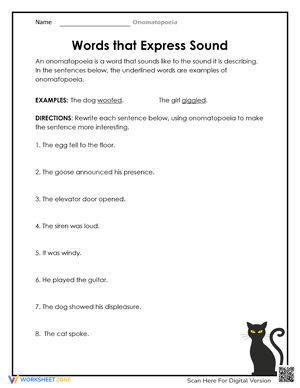
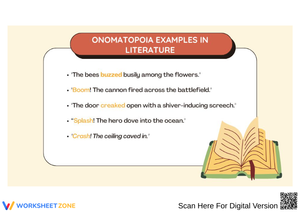
- Identify sound words embedded in sentences and short passages — not just in isolation, where any student can spot "boom" on a word list.
- Explain what sound the word imitates and what it contributes to the sentence's meaning or imagery.
- Complete sentences using the most appropriate sound word from a small set of options — two or three choices, not a full word bank, so students reason through the decision rather than guess alphabetically.
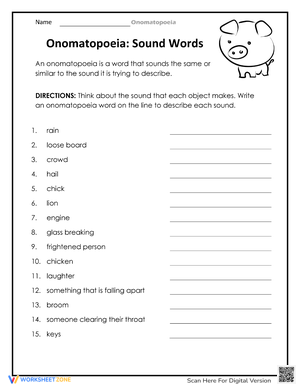
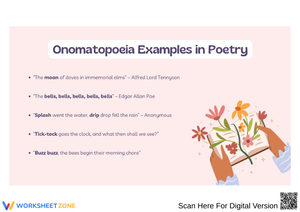
- Write original examples in poetry lines, comic captions, or narrative action scenes.
- Sort and distinguish onomatopoeia from other figurative language in mixed-review items, which matters because fifth graders are typically handling several figurative language terms in the same unit.
What Goes Wrong When Fifth Graders Work With Sound Words
The most persistent error is over-application. Once students learn the term, they start labeling every vivid word as onomatopoeia. A student who correctly identifies "sizzle" in a passage will sometimes circle "scorching" in the next line and argue it qualifies because it "sounds hot." That's a reasoning error, not a vocabulary gap — the student knows the definition but hasn't internalized the actual criterion. The fix is quick: ask the student to say the word aloud and describe what they hear, then ask whether that sound exists in the real world.
A second error appears consistently in writing tasks. Students produce what might be called a sound inventory — There was a crash. Then a boom. Then a hiss. — rather than weaving sound words into sentences with context and momentum. That list pattern shows up when students understand the term but haven't seen enough mentor-text examples of the technique in actual prose. A brief class share-out of well-crafted student sentences before the writing task usually prevents it.
There's also a reliable confusion between onomatopoeia and alliteration when both appear in the same line. When a student reads "the sizzling snake slithered," some mark alliteration and miss the onomatopoeia entirely — they apply whichever term they learned most recently. Mixed-review items on these worksheets surface that confusion explicitly so teachers can address it before a unit test, not after.
Pacing These Worksheets Across a Week of Instruction
Onomatopoeia works well as a five-day sequence rather than a one-lesson term. On Monday, introduce the concept through a mentor text read-aloud — something with strong sound imagery — and stop at the sound words to ask what the author could have written instead and what would have been lost. Tuesday works for independent identification practice; students underline sound words in a passage and briefly annotate why each one fits. Midweek, shift to sentence completion and passage-based questions where students reason through context rather than scan for obvious examples. By Thursday or Friday, students apply the skill: a few lines of poetry, a comic caption, or a revised sentence from a current narrative draft.
Teachers using 5th grade onomatopoeia worksheets this way collect formative data at each stage without the unit feeling padded. A student who moves through identification quickly but stalls on the writing task has a transfer gap — the kind that shows up on assessments when questions ask for original application. A student who writes convincing examples but misses sound words during close reading has an analytical gap. Those are different problems, and pacing the worksheets across the week surfaces both before the unit ends.
Standard Alignment
CCSS.ELA-LITERACY.L.5.5a requires fifth graders to interpret figurative language in context and explain how word choice contributes to meaning. Onomatopoeia instruction maps directly onto that standard because the target skill is not simply naming the device — students must explain why a writer chose "clang" instead of "hit," what that word does to the line's rhythm, and how it shapes what the reader hears. These worksheets build toward that analytical layer by pairing identification tasks with brief explanation prompts rather than stopping at recognition alone.
That standard placement also clarifies where these worksheets belong in the unit sequence. They are language-analysis practice, not vocabulary review, which means they fit most naturally in the figurative language strand of the ELA block rather than in a standalone word-study rotation.
Adjusting the Set for a Range of Skill Levels
For students still building their figurative language vocabulary, the identification worksheets carry the primary instructional load. Reduce the number of items, read the passage aloud before students work independently, or provide a brief reference card listing five or six common sound words. The goal at this stage is reliable recognition — students should be able to say with confidence whether "buzz" or "fast" qualifies — before moving toward analysis or writing tasks.
Students who have identification down need the writing tasks to stay challenged. A useful constraint: tell them they cannot use "buzz," "crash," "boom," or any sound word from the example sentences — they have to find their own. That restriction produces noticeably more precise language and pushes students to think about the actual sound of the scene they're describing rather than reaching for the most familiar option.
In a mixed-ability class, 5th grade onomatopoeia worksheets work well as a layered assignment: all students complete the identification and sentence-completion items, while students who finish early move to the writing extension independently. That structure lets the teacher pull a small group for guided work on the passage-based questions without the rest of the class waiting.
Frequently Asked Questions
What is onomatopoeia for 5th graders?
Onomatopoeia means using a word that imitates the sound of the action or thing it names — "buzz," "hiss," "clatter," "pop." For fifth graders, the definition isn't the hard part. The harder work is explaining how those words function in a piece of writing: what they add to imagery, pacing, or the reader's sensory experience. Grade 5 ELA instruction expects students to move past the simple definition and make that analytical connection.
How long does it take to teach onomatopoeia at the fifth-grade level?
With a five-day sequence, students can move from initial exposure to independent application. The first two days focus on recognition and identification. Days three and four shift to passage-based analysis and sentence completion. By day five, students write original examples. A single worksheet used in isolation covers the basics but doesn't give teachers the layered formative data that a sequenced approach provides.
What should an onomatopoeia worksheet include for grade 5 students?
Identification tasks alone aren't enough at this grade level. Each worksheet should pair recognition items with at least one analytical prompt — "Why did the author choose this word here?" or "How does this sound word change the feeling of the sentence?" — and at least one writing task. That combination gives teachers evidence of whether students can use the concept, not just name it.
How do these worksheets connect to the rest of a figurative language unit?
Onomatopoeia is one of the most concrete entry points in a figurative language unit because students can hear the connection immediately. Starting here — using 5th grade onomatopoeia worksheets before moving into simile, metaphor, or hyperbole — lets students practice the analytical moves (identifying a device in context, explaining word choice) with a concept they grasp quickly, then carry those same moves into more abstract devices later in the unit.












 Interactive Worksheet Maker
 Quiz Maker
 Word Search Maker
 Crossword Puzzle Maker
 Word Scramble Generator
 Sentence Scramble Generator
 Handwriting Worksheet Generator
 Name Tracing Generator
 Fill In The Blank Generator