These hyperbole worksheets for 5th grade give teachers a reliable path from simple recognition to genuine interpretation of figurative language. The gap between circling an exaggerated phrase and explaining what an author actually meant is where most instruction stalls at the upper-elementary level — and that's the gap this set addresses directly. Teachers get materials that fit naturally into reading comprehension work, writing workshop, and short review routines without requiring a separate unit or extended planning block.
What's Inside the Set
Each worksheet focuses on a specific dimension of hyperbole understanding rather than covering everything at once. That keeps the cognitive load manageable for students and makes it easier to assign individual worksheets to match exactly where a class or student needs practice.
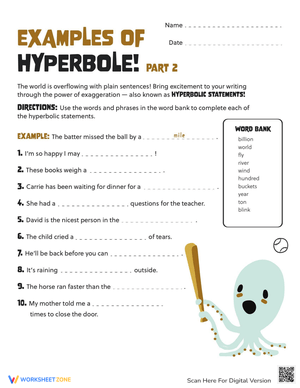
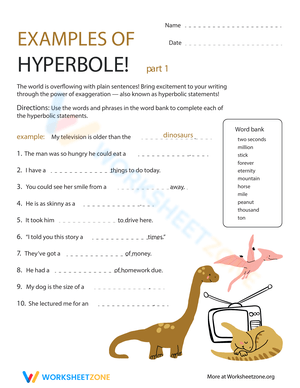
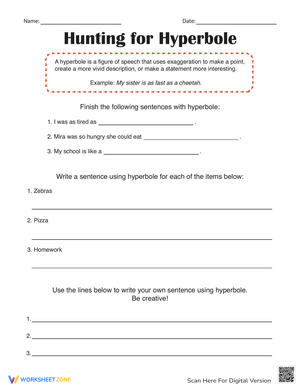
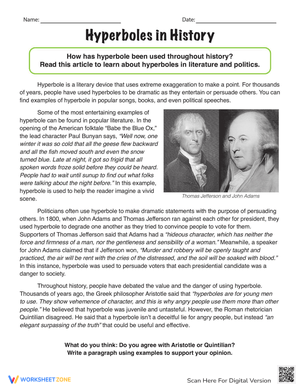
- Identification tasks — students read a group of sentences, mark which ones use hyperbole, and write a brief explanation of why the statement can't be taken literally.
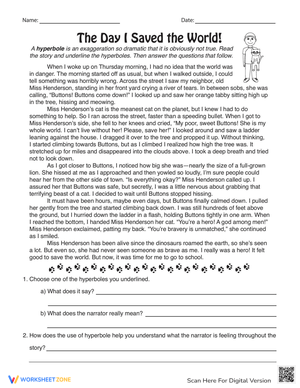
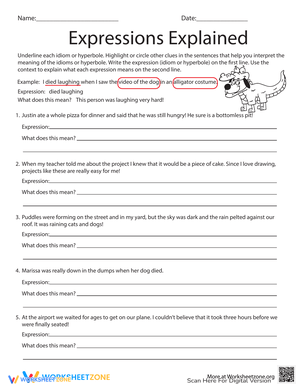
- Paraphrasing tasks — students rewrite a hyperbolic phrase in plain, realistic language, capturing what the speaker or narrator actually means rather than what the words literally say.
- Matching exercises — students connect a hyperbolic expression to the feeling or situation it conveys, which pushes them to think about purpose rather than just form.
- Tone and effect analysis — students decide whether the hyperbole creates humor, frustration, drama, or excitement and explain how that tone fits the context of the sentence.
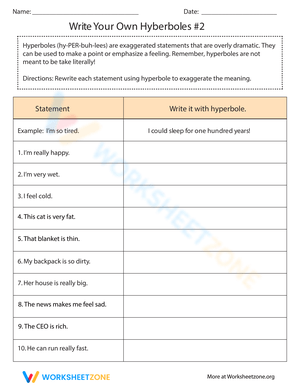
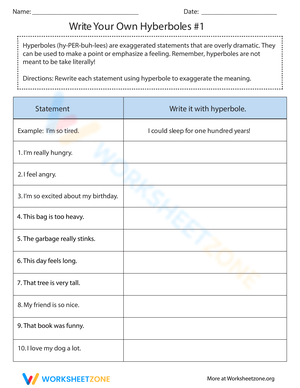
- Original writing tasks — students compose their own hyperbolic sentences within a specific context — a character's inner monologue, a sports announcer's call, an overheard argument — so the writing has a genuine purpose rather than being an abstract exercise.
That range matters because students who can spot hyperbole don't always understand it. A student who circles "I could eat a horse" may still write "very hungry" for the meaning — technically true but missing the tone and intent. Including both paraphrasing and an effect question on the same worksheet makes that gap visible immediately.
Error Patterns to Anticipate Before Students Write Anything Down
The most common problem in hyperbole practice isn't identification — it's the explanation that falls flat. Students correctly mark "I've told you a million times" as hyperbole and then write "a lot of times" for the meaning. That answer stops short of the actual point. Asking students to name the speaker's emotion — exasperation, frustration — or to describe the real-life situation behind the phrase pushes them toward a more complete response. The tone and effect items in these worksheets build that habit without requiring additional prompting from the teacher.
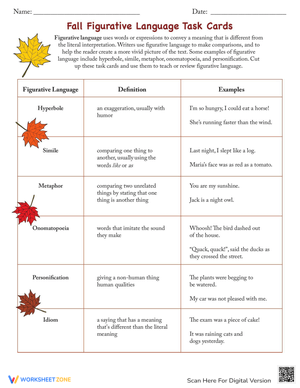
A separate error involves students mislabeling certain comparisons as similes. A sentence like "she crossed the finish line faster than a rocket" doesn't use "like" or "as," but students fresh from a simile lesson sometimes flag it anyway. A brief side-by-side review — one simile, one metaphor, one hyperbole — before distributing the worksheet clears that confusion. This matters most when the class is moving through a full figurative language unit rather than treating hyperbole as a one-day skill.
Where These Worksheets Fit Across Your ELA Block
The shorter identification and paraphrasing worksheets work well as Monday warm-ups, giving students a low-stakes return to figurative language before the week's reading text. The 8 minutes before transitioning to specials or the final stretch before afternoon pickup are also natural slots — the format is predictable enough that students can work independently once the class has worked through the first item together.
- Bell ringer: Project one sentence. Before anyone writes, ask two or three students to explain their thinking aloud. That oral step surfaces misunderstanding before it gets written in.
- Reading block extension: After a read-aloud, pull one hyperbolic line from the text and assign the paraphrasing task from the worksheet. The connection to an actual book makes the practice feel like reading work, not a grammar interruption.
- Writing workshop: Use the original-writing task to launch a revision pass — students find one sentence in their own draft, add an intentional exaggeration, and annotate why they chose it.
- Centers: Place one worksheet at a figurative language station alongside examples from earlier lessons. Students complete the identification section independently and tackle the writing portion with a partner.
- Sub plans: Each worksheet is self-contained. With the example at the top of the worksheet intact, students can begin without teacher walkthrough, and the consistent task sequence makes additional instructions unnecessary.
Standard Alignment
These worksheets connect to CCSS.ELA-LITERACY.L.5.5a, which asks students to interpret figurative language — including similes, metaphors, and hyperbole — within context. That word "interpret" carries real instructional weight: a student can locate a hyperbolic phrase without demonstrating any understanding of what it communicates. The paraphrasing and effect-analysis tasks in hyperbole worksheets for 5th grade address the higher bar the standard actually sets, making this set appropriate for formative assessment rather than just fill-in practice.
Grade 5 is also the point where CCSS language standards shift from recognizing figurative language as a textual feature to using it as a deliberate craft tool in writing. That developmental shift explains why the original-writing tasks are a core part of each worksheet rather than an add-on — they connect reading-side recognition to writing-side application, which is where both the standard and the instruction are ultimately headed.
Matching Tasks to Student Readiness Across the Set
Hyperbole worksheets for 5th grade support differentiation through task selection rather than through rewriting the lesson for separate groups. The identification and matching items serve as entry points for students who need more grounding in literal versus nonliteral language; the paraphrasing and effect questions raise the demand without changing the topic. Teachers control the level by deciding which tasks students complete independently versus with a partner or together as a class — no second version of the worksheet required.
- Students who need more support: Preteach literal versus nonliteral language using two or three familiar spoken examples before distributing the worksheet. Limit independent work to identification and matching. For the writing task, offer a sentence frame: "The character felt ___ so the author wrote ___."
- On-level practice: Students complete identification, paraphrasing, and the effect question, then write one original sentence and label the tone it creates.
- Extension: Students write hyperbole for a specified voice — a disappointed narrator, a cereal advertisement, a sports commentator calling a close game — and annotate their choices. Revising a partner's literal sentence by adding an intentional exaggeration adds a second layer of thinking.
Multilingual learners often understand exaggeration as a concept without difficulty — the challenge is usually rendering the paraphrase in academic English, not grasping the figurative thinking itself. Accepting a spoken explanation before a written one, or offering a sentence starter for the paraphrase, keeps the task accessible without reducing what the student is actually being asked to do.
Frequently Asked Questions
What grade level is hyperbole typically introduced?
Hyperbole appears across Grades 3–6, but Grade 5 is where students are expected to move past identification and into interpretation. At this level, the task is to explain what the exaggeration means and why a writer might have chosen it — not just to recognize that it's present.
How is hyperbole different from a simile?
Hyperbole relies on exaggeration and doesn't require a comparison. A simile makes a direct comparison using "like" or "as." Students sometimes confuse them when a hyperbolic sentence contains a comparison element, such as "she moved faster than a hurricane." Showing three side-by-side examples — one of each type — resolves the confusion quickly in most classrooms.
Can these worksheets be sent home for homework?
Yes. The identification and paraphrasing tasks are written for independent use, so students can complete them without a parent needing to explain the skill. Writing tasks benefit from a brief class discussion before being assigned as homework, so students have a model or two to reference when they sit down to work.
Do these work for students reading below grade level?
The identification and matching tasks use sentence-level examples rather than extended passages, which makes them workable for students who struggle with longer text. For hyperbole worksheets for 5th grade to be fully accessible to students with significant reading gaps, brief oral modeling at the start of the session — working through the first example together — removes most of the barrier without changing the task itself.












 Interactive Worksheet Maker
 Quiz Maker
 Word Search Maker
 Crossword Puzzle Maker
 Word Scramble Generator
 Sentence Scramble Generator
 Handwriting Worksheet Generator
 Name Tracing Generator
 Fill In The Blank Generator