




























Views
Downloads

Essential Christmas Idioms Worksheet | Grade 6 ELA

Paste this activity's link or code into your existing LMS (Google Classroom, Canvas, Teams, Schoology, Moodle, etc.).
Students can open and work on the activity right away, with no student login required.
You'll still be able to track student progress and results from your teacher account.
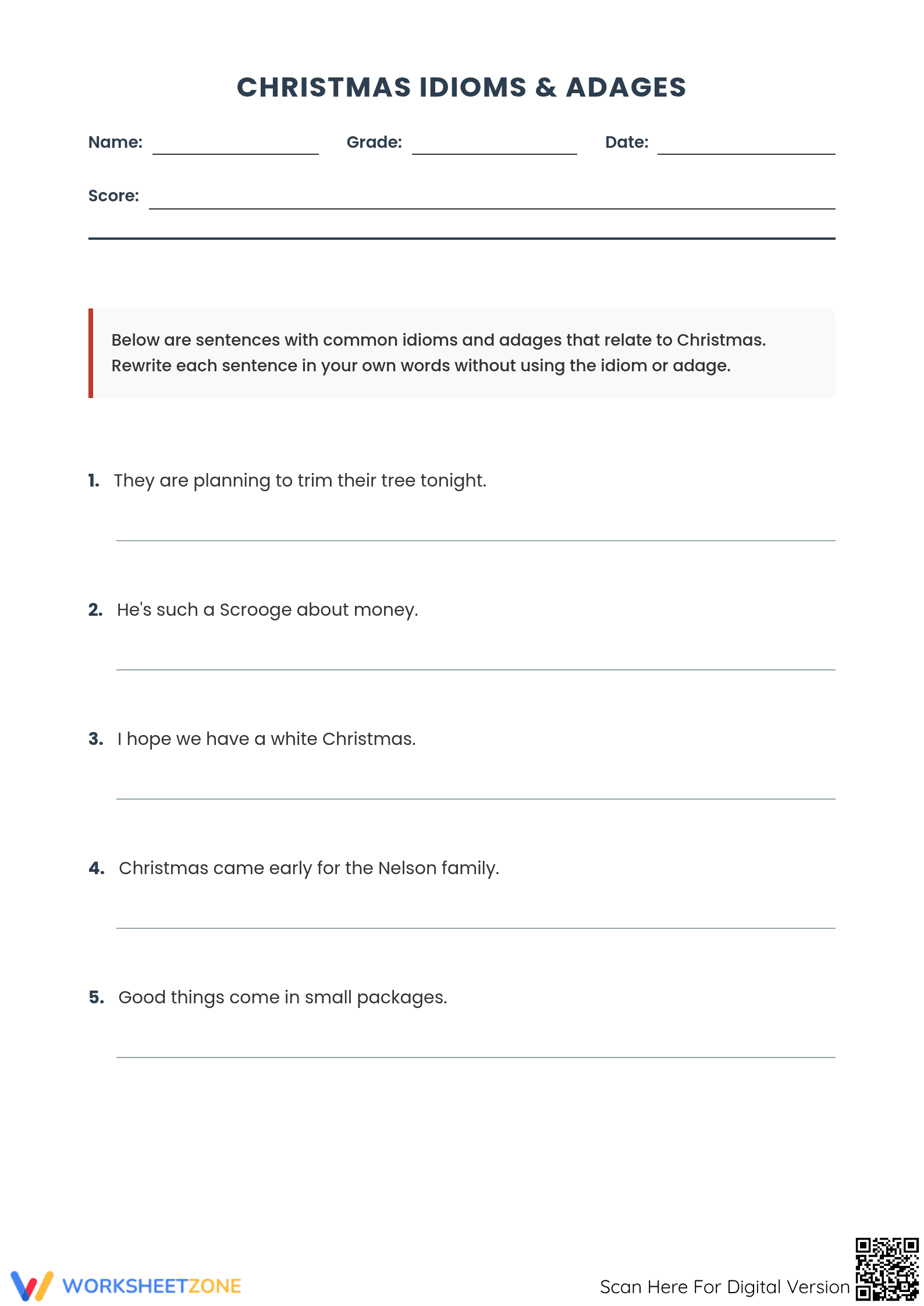
This Grade 6 ELA worksheet helps students master figurative language by interpreting holiday-themed idioms and adages. Students practice rewriting sentences to demonstrate a deep understanding of non-literal meanings. By translating phrases like "trim the tree" or "Scrooge" into plain English, learners bridge the gap between literal and figurative comprehension.
At a Glance
- Grade: 6 · Subject: English Language Arts
- Standard:
CCSS.ELA-LITERACY.L.6.5— Interpret figures of speech, including idioms and adages, in context- Skill Focus: Figurative Language Interpretation
- Format: 2 pages · 8 problems · Answer key included · PDF
- Best For: Seasonal figurative language practice and assessment
- Time: 15–20 minutes
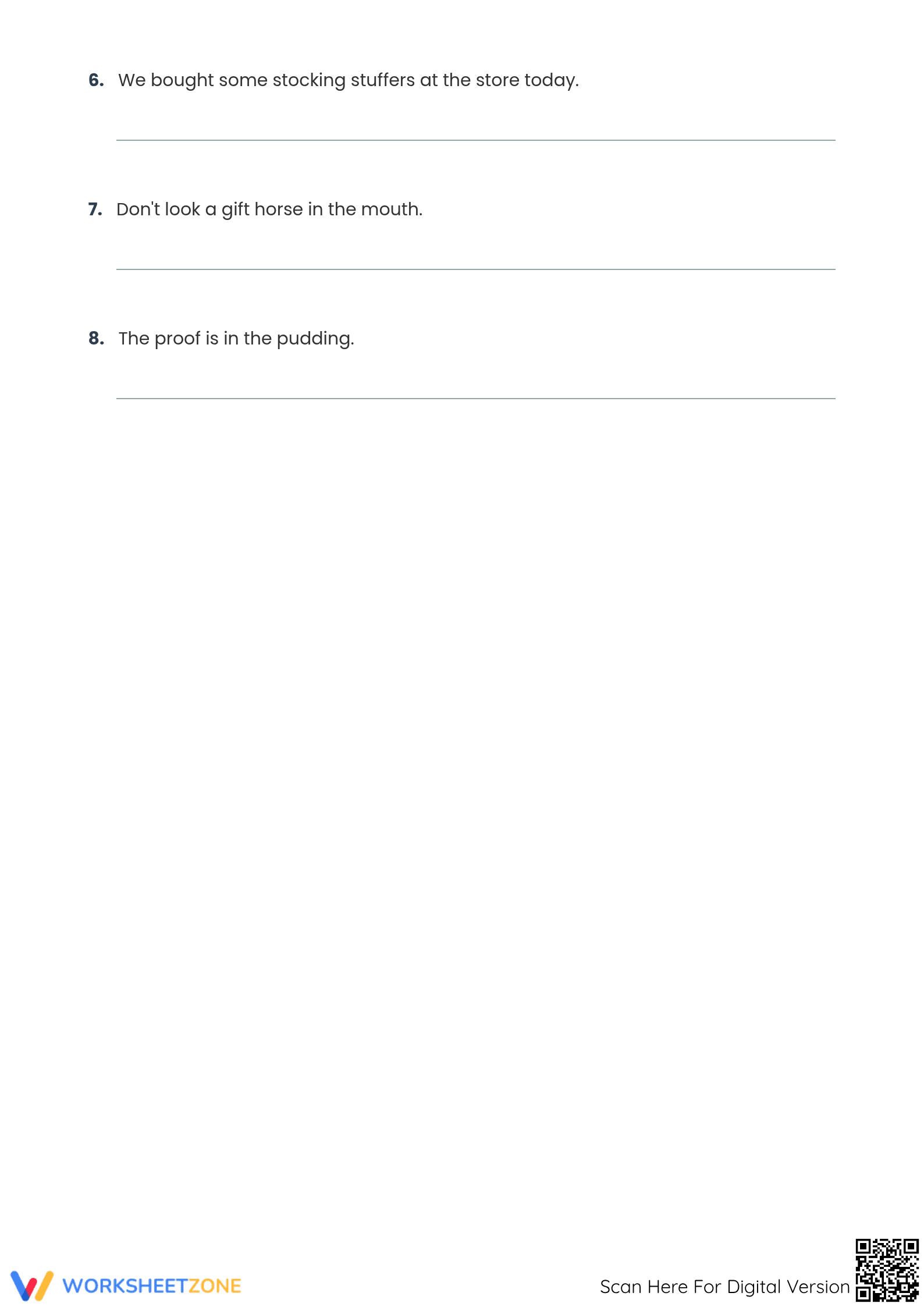
This two-page PDF features 8 distinct sentences, each containing a common Christmas-themed idiom or adage. The layout provides ample writing space for students to rewrite the sentences in their own words. It includes a comprehensive answer key for quick grading and a clear instructional prompt that sets expectations for the task.
Skill Progression
- Guided practice: The first two items use highly recognizable idioms like "trim the tree" to establish the rewriting pattern and build immediate student confidence.
- Supported practice: Items 3 through 5 introduce cultural references and adages, requiring students to infer meaning from context and prior knowledge.
- Independent practice: The final three items on page two challenge students with more abstract adages like "the proof is in the pudding," requiring higher-order interpretation.
This gradual-release model ensures students move from literal recognition to conceptual mastery of figurative expressions through a structured I Do, We Do, You Do approach.
Standards Alignment
This resource is directly aligned with `CCSS.ELA-LITERACY.L.6.5`, which requires students to demonstrate understanding of figurative language, word relationships, and nuances in word meanings. Specifically, it addresses sub-standard L.6.5.A by asking students to interpret figures of speech in context. Both standard codes can be copied directly into lesson plans, IEP goals, or district curriculum mapping tools.
How to Use It
Use this worksheet as a mid-unit formative assessment during a figurative language module. Assign it after a direct instruction lesson on idioms to check for individual student understanding. Alternatively, use it as a festive "bell-ringer" activity during the holiday season to keep students engaged while reinforcing core ELA skills. Teachers should observe if students struggle with the "Scrooge" reference, which may indicate a need for a brief literary background discussion. Expected completion time is 15 to 20 minutes.
Who It's For
This worksheet is designed for Grade 6 students but is also suitable for Grade 5 enrichment or Grade 7 review. It is particularly effective for English Language Learners (ELLs) who often find idiomatic expressions challenging. Pair this resource with a holiday-themed short story or an anchor chart of common adages for a complete instructional block.
Research from Fisher & Frey (2014) emphasizes that the explicit instruction of figurative language, such as idioms and adages, is critical for developing reading comprehension and linguistic nuance in middle school students. This worksheet targets CCSS.ELA-LITERACY.L.6.5 by requiring students to perform the cognitive task of translation from figurative to literal meaning. By engaging with 8 specific holiday-themed examples, students build a mental library of cultural expressions that are often found in complex informational and literary texts. According to the RAND AIRS 2024 report, structured practice with non-literal language significantly improves the ability of Grade 6 learners to navigate academic discourse. This resource provides the necessary repetition and context-based application required for students to move beyond surface-level reading and achieve the deeper interpretive skills demanded by national standards and standardized assessments.


