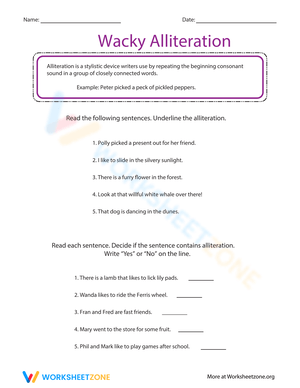
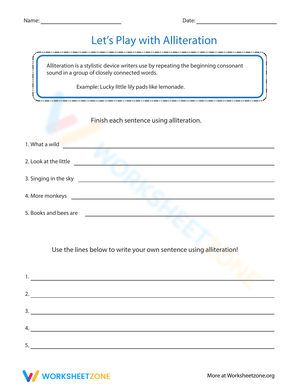
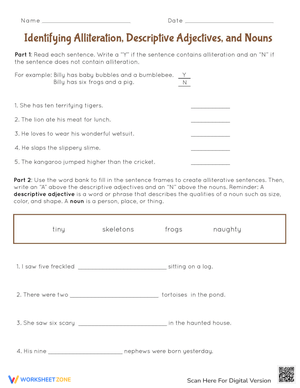
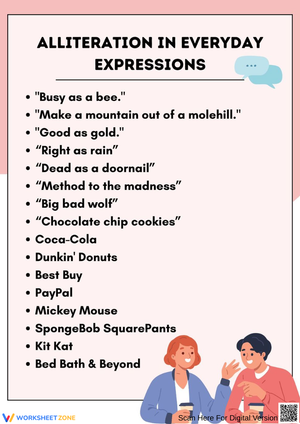
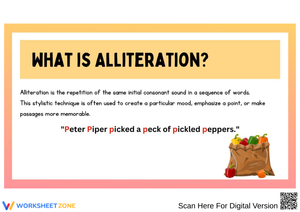
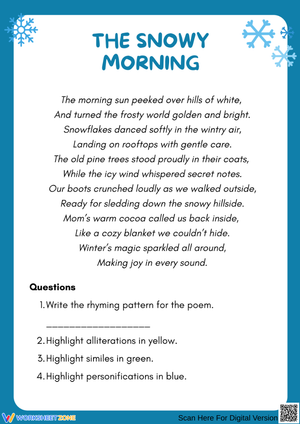
5th grade alliteration worksheets give teachers something useful at a precise instructional moment: when students are ready to move past "I hear repeated sounds" toward "here is what that repetition does to a line." These resources cover identification, effect analysis, device comparison, and original writing — the full progression that grade 5 ELA actually demands.
The Specific Skills These Worksheets Build
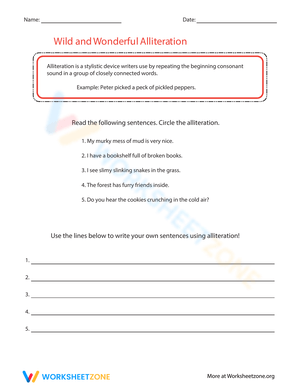
The work moves in a deliberate order. Students begin by identifying alliteration in phrases and short excerpts, then sort examples from non-examples to distinguish alliteration from rhyme, from general repetition, and from shared spelling that does not produce a shared sound. After sorting, they explain the effect of the sound pattern — choosing precise language like urgent, playful, smooth, or sharp rather than writing "it sounds good." The final task in most worksheets is original production: students write alliterative sentences or brief poem lines connected to a topic or vocabulary set.
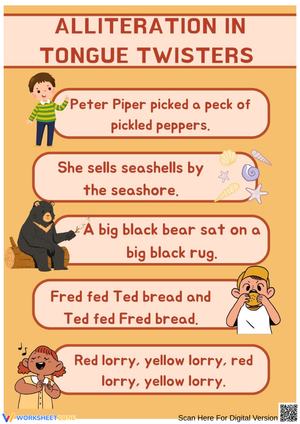
- Identify repeated initial consonant sounds in phrases, lines, and short paragraphs.
- Distinguish alliteration from rhyme, repetition, and shared spelling that does not produce a shared opening sound.
- Describe the effect of an alliterative phrase using specific tonal vocabulary.
- Compare alliteration with simile, metaphor, and idiom in the same figurative language review cycle.
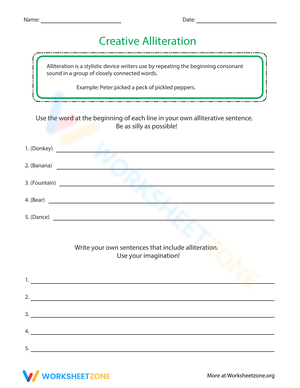
- Create original examples in a sentence, a brief description, or a poem opening.
A worksheet that stops at underlining repeated first letters is useful for an opener, but it does not carry the full weight of grade 5 instruction. These tasks push students to explain why a writer made that choice and what a reader hears and feels because of it.
Alliteration Inside Poetry and Figurative Language Study
Alliteration surfaces naturally during poetry lessons because students can hear it the moment they read a line aloud. That immediacy makes each worksheet useful as a warm-up before reading a mentor poem or as structured follow-up after one. Students practice the device in a controlled context, then return to the full poem and locate where the writer used the same technique. The worksheet bridges isolated skill practice and authentic text analysis without requiring a separate lesson transition.
A stronger grade 5 instructional move is to place alliteration beside two or three other figurative language devices in the same review cycle. When students have to decide whether a phrase shows sound repetition, figurative comparison, or a meaning-based device, they over-label less. That comparison work also raises the quality of short constructed responses — the format where grade 5 figurative language understanding actually gets assessed, not on a matching task but in a written explanation of craft choices.
One distinction worth establishing early: alliteration depends on the opening consonant sound, not the letter. A sentence like "Peter's phone fell quietly" is not alliterative even though three words begin with the letter p — "phone" opens with the /f/ sound, not /p/. When a worksheet includes that kind of non-example, it becomes a conference tool. A student who marks the sentence as alliterative reveals exactly where the instruction needs to go.
Mistakes Students Make That These Worksheets Help You Catch
The most consistent error is treating any repeated first letter as alliteration. Students who apply a visual rule will mark "phone" and "picture" as alliterative because both words begin with the letter p, but the opening sounds differ — /f/ and /p/. The correction requires one consistent habit: read the phrase aloud. If the opening sounds do not match when spoken, the device is not alliteration. Worksheets that include letter-versus-sound non-examples force students to apply that auditory test instead of defaulting to the visual one.
A second pattern shows up at the explanation stage. Students who correctly identify alliteration often stall when asked to describe its effect. "It sounds nice" and "it's interesting" are the default answers when students lack the vocabulary to say something more precise. Providing a small set of effect words — playful, tense, gentle, sharp, memorable — directly inside the explanation prompt gives students language to attach to what they are noticing. Those words appear in the prompts here, not as a separate vocabulary pre-lesson students have to recall on their own.
How to Build These Worksheets Into Your Lesson Plans
For whole-group mini-lessons, one worksheet with a mix of identification and explanation tasks keeps things focused. Model the first two questions — the visual-versus-sound distinction and one effect analysis item — then release students to finish independently or with a partner. That approach uses about eight minutes of direct instruction before students are working on their own, which means alliteration does not absorb the entire literacy block.
5th grade alliteration worksheets also fit naturally into centers, where students complete one in a single rotation and then read their answers aloud to a partner before the group transitions. That oral review step matters — reading alliterative lines aloud and comparing effect interpretations is precisely the expressive fluency work that extends the activity beyond simple task completion. For homework, assign the identification section and one explanation question; bring the writing extension back to class for discussion rather than grading it cold.
- Use one worksheet as a bell ringer before a poetry or figurative language unit opens.
- Assign the identification section for homework and discuss the effect questions the next morning.
- Score identification plus one written explanation as a quick formative check.
- Leave one worksheet with clear directions as a substitute-ready, self-contained activity.
Transfer is the real goal. After finishing a worksheet, give students one additional task: write a two-line poem, a character description opener, or a topic sentence that uses alliteration deliberately. That step shows whether students can deploy the device, not only recognize it.
Standard Alignment
These worksheets align with CCSS.ELA-LITERACY.L.5.5, which requires fifth graders to interpret figurative language in context and explain how specific word choices relate to meaning and tone. Alliteration sits at the intersection of sound and meaning, and the tasks here address both. Students do not just locate examples; they explain what effect the repeated sounds create and how that connects to a text's tone or the writer's intent. That dual focus reflects the standard's actual demand: language analysis grounded in interpretation, not pattern recognition for its own sake.
Differentiating the Set Across Ability Levels
For students who need more support, the most effective adjustments lower the entry barrier without lowering the intellectual demand. Highlight candidate phrases so students choose between options rather than scanning unfamiliar text cold, and offer a small word bank for effect vocabulary so they can select and explain rather than retrieve language from memory alone. The core task — deciding why a phrase sounds the way it does — stays intact. Only the amount of independent retrieval shifts.
5th grade alliteration worksheets can be pushed harder for students who are ready. Ask them to take a flat paragraph and revise two or three sentences using alliteration sparingly, then compare both versions aloud and defend which reads better. Students who overuse alliteration during this task often hear the problem themselves before the teacher points it out — which is a better outcome than being corrected after the fact. Another extension: have students write a brief argument for when alliteration strengthens writing and when it tips into gimmick. That kind of meta-reflection is genuinely grade 5 thinking about craft.
Frequently Asked Questions
What should fifth graders be able to do with alliteration?
By grade 5, students should identify alliteration in phrases and short texts, explain its effect within the context of a specific line or poem, and produce original examples in sentences or brief poems. They should also distinguish it clearly from rhyme and from meaning-based figurative language devices like simile and metaphor — a distinction that takes direct instruction and practice, not just exposure.
How is alliteration different from other figurative language devices taught in grade 5 ELA?
Alliteration is a sound device — it depends on repeated initial consonant sounds in nearby words. Devices like simile and metaphor create meaning through comparison. The distinction matters because students frequently conflate any vivid or interesting phrase with alliteration. Worksheets that ask students to sort and compare device types help them hold that distinction across varied texts, not just in the lesson where alliteration was first introduced.
Can these worksheets be used for centers or homework?
5th grade alliteration worksheets work in both settings. For centers, students complete one worksheet in a single rotation and compare answers with a partner before the group moves on. For homework, the most effective approach assigns identification and one explanation question, then returns to the writing extension during class the following day so the discussion of effect vocabulary has real student writing to anchor it.
What makes an alliteration worksheet appropriate for fifth grade rather than a younger grade?
Younger grades typically encounter alliteration as a phonological awareness activity — hearing and producing beginning sounds. By fifth grade, the expectation shifts to interpretation and craft. A grade-appropriate worksheet asks students to analyze effect, compare devices, and write with deliberate intention. It includes short text excerpts and written explanation prompts rather than isolated word lists, and it asks for reasoning that demonstrates understanding, not just identification.












 Interactive Worksheet Maker
 Quiz Maker
 Word Search Maker
 Crossword Puzzle Maker
 Word Scramble Generator
 Sentence Scramble Generator
 Handwriting Worksheet Generator
 Name Tracing Generator
 Fill In The Blank Generator