Imagery worksheets for 5th grade bridge the gap between labeling a descriptive word and explaining what that language actually does to a reader. At this grade level, the expectation shifts from recognition to interpretation: students need to quote specific sensory language, name the sense it activates, and explain its effect on mood or meaning. These worksheets give teachers reading passages, poetry excerpts, and sentence-revision tasks that make that shift teachable without building a week-long unit around it.
The Specific Skills Targeted
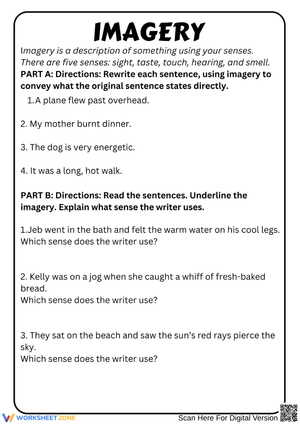
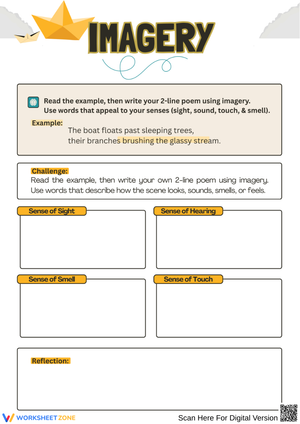
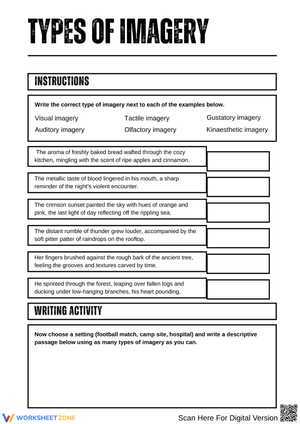
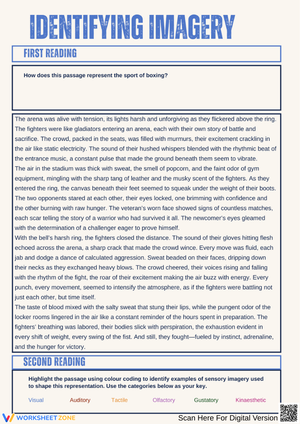
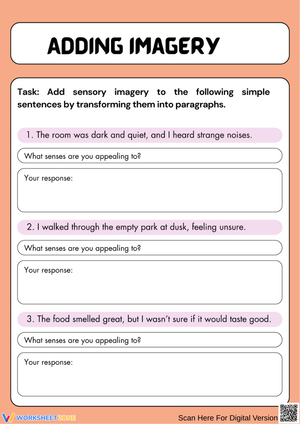
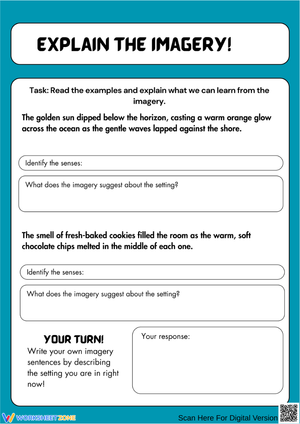
Each worksheet in the set covers a distinct part of the imagery skill rather than treating identification as the endpoint. One worksheet asks students to read a short passage and sort underlined words by sense — sight, sound, smell, taste, touch — into a five-column chart. Another uses a descriptive paragraph where students quote a phrase, name the sense it activates, and write a sentence explaining what picture or feeling it creates for the reader. Poetry worksheets push further: students connect imagery to the poem's mood, moving past "what sense is this?" to "what does this detail make the scene feel like?" The revision worksheet gives students flat, vague sentences and asks them to rewrite each one using sensory language they generate themselves.
That revision task reveals whether the skill has actually transferred. A student who can identify imagery in a given passage but writes "The storm was scary" when asked to create original sensory language has not internalized how the technique works. The writing prompts push past recognition toward application, and the gap between those two things becomes visible in student work.
Where Students Consistently Go Off Track
The most common error in Grade 5 imagery work is confusing "descriptive" with "sensory." Students underline adjectives like big or important and call them imagery because those words modify a noun. What they miss is that imagery has to activate a sense — the reader must be able to picture, hear, smell, taste, or feel something specific. A word like important tells the reader what to think, not what to sense. Worksheets that ask students to name the specific sense catch this error quickly: important does not fit in any column of a five-sense sort.
A second error shows up when students encounter imagery in literal description — no simile, no metaphor, just precise sensory language. Because figurative language instruction tends to lead with comparisons, students start to assume imagery requires a "like" or "as." They overlook a sentence like "The bread sat warm against her palm, its crust flaking onto the kitchen floor" because there is no comparison present. Several worksheets in the set address this directly by using examples where the imagery is purely literal.
Students can also name the sense but stop there. When asked to explain the effect, many write, "It is a smell because it says smoke." The deeper move — connecting that detail to how the reader feels or what meaning it adds — needs deliberate practice. The explanation prompts in each worksheet require students to write that second sentence, the one that begins with something like "This makes the reader feel..." or "This detail suggests that the character..."
How to Work These Worksheets Into Your Week
Imagery worksheets for 5th grade slot into several points in the literacy block without requiring a full unit reorganization. A sensory sort works well as a five-minute bell ringer — put a sentence on the board, hand students the chart, and have them defend their sorting choice before the lesson settles. A passage-based worksheet with explanation prompts fits a 20-minute reading response block. Poetry worksheets pair naturally with read-alouds: read the poem once for pleasure, then distribute the worksheet and have students annotate while you read it a second time. The revision worksheet works as a writing warm-up at the start of a descriptive writing lesson, before students move into their own drafts.
One practical move: order the worksheets by cognitive demand across the week rather than assigning them in sequence. Start with identification tasks — students underline and sort sensory words. Move midweek to explanation tasks where they describe the effect of a specific detail in writing. End the week with revision. That progression builds toward the hardest skill gradually rather than presenting it cold.
Standard Alignment
These worksheets address CCSS.ELA-LITERACY.RL.5.4, which asks Grade 5 students to determine the meaning of words and phrases in a text, including figurative language. Sensory language sits at the center of that standard because it is the most concrete form of figurative meaning-making students encounter at this level. The explanation and analysis tasks also connect to CCSS.ELA-LITERACY.W.5.3d, which calls for students to use sensory details and precise language in narrative writing. Pairing imagery worksheets for 5th grade with that writing standard — analyzing how a published author uses sensory language, then applying the same technique in a revision task — is one of the more efficient RL-W connections available in a Grade 5 ELA block.
Differentiating Across Learner Levels
For students who are still building reading fluency, the sensory sort worksheets are the right entry point. The passages are short, the five-sense chart gives students a concrete visual anchor, and the task is structured enough that students can work through it without getting stuck on directions. Pair those students with a brief reference list showing one example per sense — not to do the thinking for them, but to keep the lesson from stalling on vocabulary while the skill itself goes unpracticed.
Students who have the basics down benefit most from the poetry and paragraph worksheets that require written explanation. Push them past the first sentence: if a student writes "This is sight imagery," ask them to add a second sentence connecting that detail to the character's mood or the scene's feeling. Some students will also be ready to compose their own sensory paragraph rather than revise given sentences — that extension requires no additional materials.
For intervention groups, the most useful adjustment is narrowing the task. Rather than having students work through an entire passage, choose one sentence and move through three steps together: identify the sensory word, name the sense, explain the effect on the reader. That concentrated approach breaks through the confusion faster than re-reading worksheet directions from the top.
Frequently Asked Questions
What makes imagery different from other figurative language at the 5th grade level?
Imagery is about sensory language and visualization — it does not require a comparison. Similes and metaphors often create imagery, but so does precise literal description. A sentence like "cold water pressed through the cracks in her boots" carries strong imagery without any figurative comparison. Grade 5 students benefit from understanding that distinction because it stops them from hunting for "like" or "as" every time they look for imagery in a passage.
Can these worksheets be used outside the figurative language unit?
Yes. The passage-based worksheets fit naturally into any reading response lesson where students are discussing how an author builds mood or setting. The revision tasks work well at the start of a descriptive writing unit. Imagery instruction does not need to live only inside a figurative language block — sensory language appears in narrative, poetry, and descriptive writing throughout the year.
How many worksheets hold up well in a single lesson?
One per lesson is usually enough. Imagery analysis requires students to read carefully, consider what the language makes them sense, and write a thoughtful explanation — that cognitive work accumulates quickly. Using imagery worksheets for 5th grade at a pace of one per lesson, or one every other lesson, gives students time to discuss their responses rather than rush to finish the worksheet.
Do the worksheets include answer keys?
Yes. Each worksheet includes an answer key that identifies the targeted sensory language, names the relevant sense, and provides a model explanation for open-response questions. The model explanations are especially useful for the effect prompts, where there is a range of acceptable answers and teachers benefit from seeing what a strong student response looks like before reading through student work.












 Interactive Worksheet Maker
 Quiz Maker
 Word Search Maker
 Crossword Puzzle Maker
 Word Scramble Generator
 Sentence Scramble Generator
 Handwriting Worksheet Generator
 Name Tracing Generator
 Fill In The Blank Generator