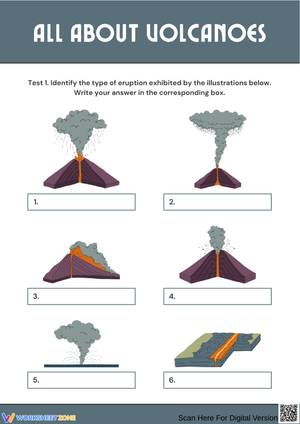
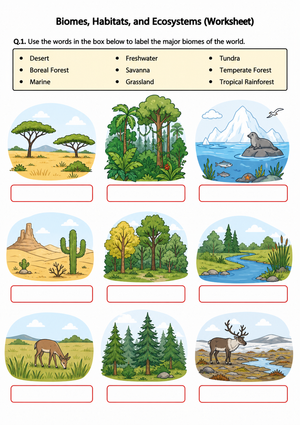
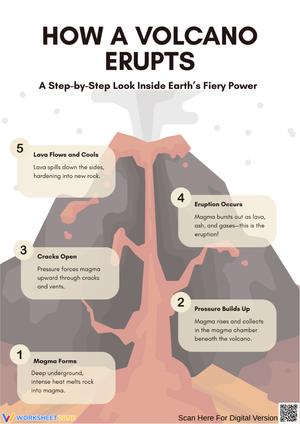
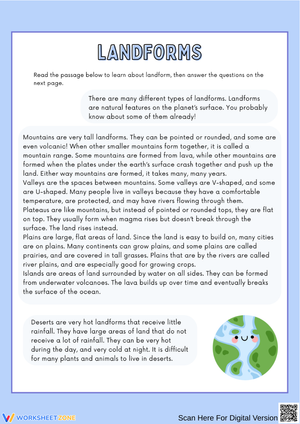
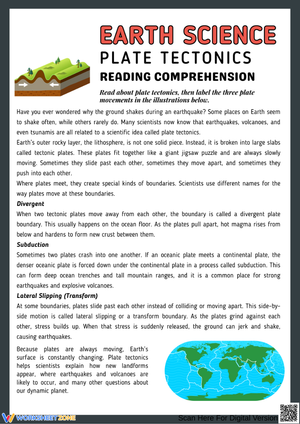
These 4th grade earth science printable worksheets cover the five content areas that fourth-grade science teachers spend the most time on: weathering and erosion, the fossil record, plate tectonics, natural hazards, and energy resources. Each worksheet targets a specific NGSS performance expectation from the 4-ESS and 3-5-ETS1 clusters, so teachers can pull individual worksheets to reinforce a single concept or run the full set as unit support. These are documentation and reasoning practice resources — best deployed after students have had initial exposure through direct instruction or hands-on investigation, not as a first introduction to a concept.
What Students Practice Across the Set
The skills in this set sit at the analysis and evidence-interpretation end of the science practice spectrum — not labeling for recall, not coloring diagrams. Across the five content areas, students are doing this kind of work:
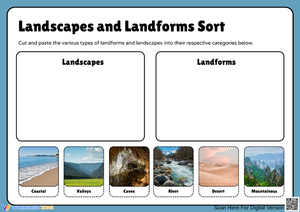
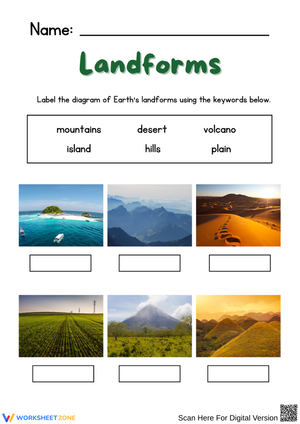
- Weathering and erosion: Students sort landform images by the dominant process that shaped them, then write a two-step explanation — breakdown first, transport second — using labeled cross-section diagrams.
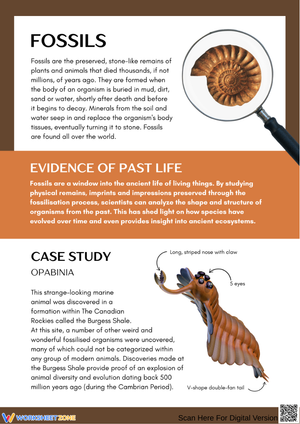
- Rock strata and the fossil record: Students rank sedimentary layers by relative age and use fossil evidence to reconstruct ancient environments, identifying marine, swamp, or forested conditions from organism type rather than from a prompt.
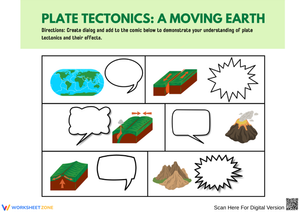
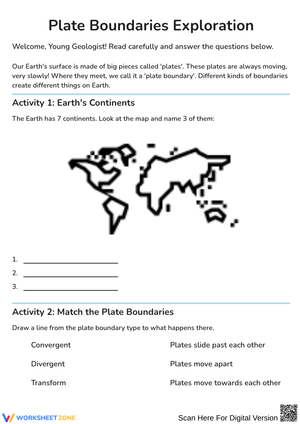
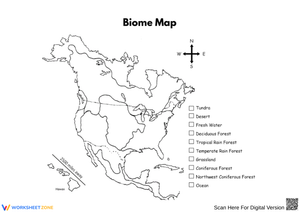
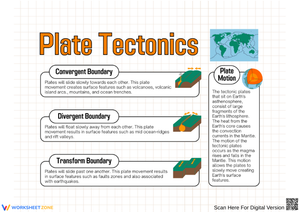
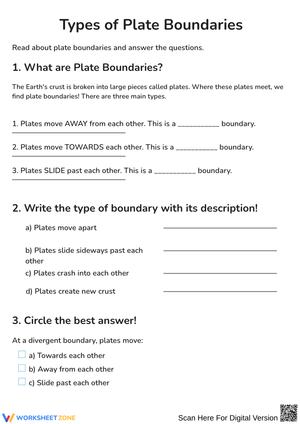
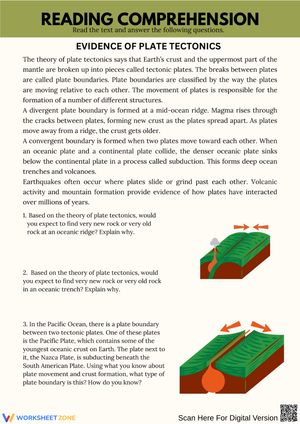
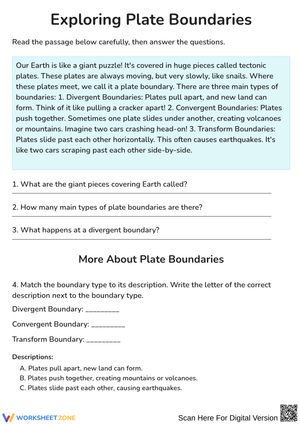
- Plate tectonics: Students plot earthquake epicenters, volcanic chains, and deep ocean trenches on blank world maps to discover boundary locations from data before any label is supplied.
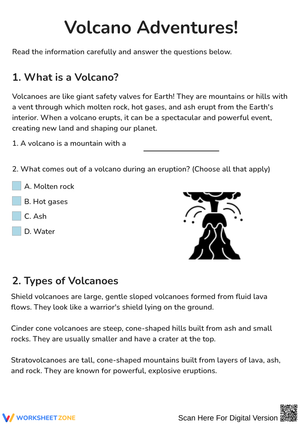
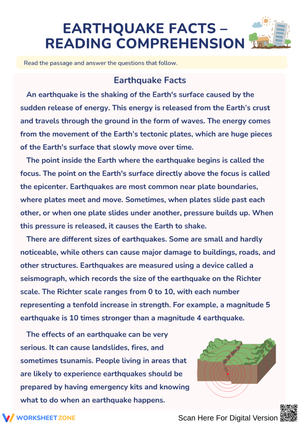
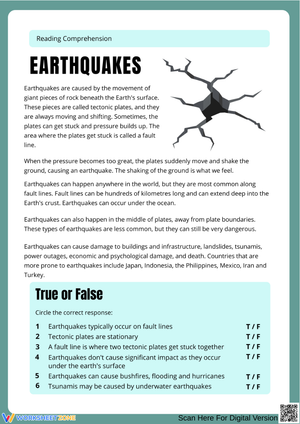
- Natural hazards: Students read scenario descriptions of earthquakes, volcanic eruptions, and coastal flooding, identify the geological cause, and propose a mitigation or safety response.
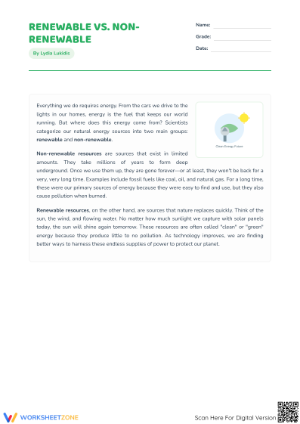
- Energy resources: Students complete comparison tables and annotate bar graphs showing extraction cost, availability, and environmental impact across renewable and non-renewable sources.
Student Misconceptions Worth Watching For and Correcting
The weathering/erosion distinction breaks down in a predictable place. Most students arrive believing erosion means the rock breaks — they've absorbed that use of the word from casual language. A student who correctly explains that a canyon was carved by a river will still write "the canyon formed through erosion" and skip weathering entirely. The fix is requiring students to name both processes in sequence on every diagram task: not just circle one answer, but write a two-step causal explanation. That friction is deliberate and worth keeping.
The strata sequencing work exposes a different problem. Students absorb "deeper equals older" as a rule but don't understand why, so the rule fails them the moment a fault line appears in the diagram. A student who correctly ranks four horizontal layers by depth will often rank the fault older than the layers it visibly cuts — applying the depth heuristic instead of the cross-cutting principle. A one-minute explanation of cross-cutting relationships before students open that worksheet prevents most of those errors.
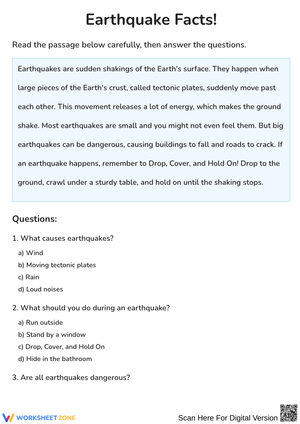
In the plate tectonics exercises, watch for students who correctly describe plates "moving toward each other" in their written explanation but then label the sketch "divergent boundary." The directional concept lands before the vocabulary does, and that reversal shows up consistently in the short-answer section. Reinforcing the Latin roots — converge meaning to come together, diverge meaning to move apart — closes that gap faster than re-explaining the geology.
Recommended Ways to Work These Worksheets Into Your Planning
The erosion and weathering worksheets move best as post-lab documentation. Run the stream table first — let students adjust slope and flow rate, watch sediment accumulate downstream — then hand out the worksheet and ask them to record what they observed using the vocabulary the diagram provides. That handoff from physical manipulation to written scientific explanation is exactly the skill NGSS performance expectations assess, and it's more productive than using the worksheet as a pre-lab preview when students are guessing at answers they haven't earned yet.
The fossil and strata worksheets land better mid-unit, after students have handled sedimentary rock samples. If your class has rock kits, the physical memory of holding layered sandstone makes the diagram feel grounded rather than abstract. If not, a close-up photograph of exposed canyon walls propped on the board during the activity accomplishes most of the same priming. Students reason more carefully about the diagram when they believe the layers are real.
The 4th grade earth science printable worksheets also fit the Monday morning warm-up slot cleanly. The natural hazard case studies are short enough that most fourth graders read, annotate, and respond in seven or eight minutes — long enough to get everyone settled and thinking before the main lesson block, not so long that it bleeds into instruction time. Those scenario worksheets also generate strong whole-class discussion if you project the scenario and debrief responses together afterward.
Standard Alignment
These 4th grade earth science printable worksheets address the following NGSS performance expectations from the Grade 4 Earth and Space Systems disciplinary core ideas, plus one engineering standard from the 3-5 band:
- 4-ESS1-1 — Identify patterns in rock formations and fossils to reconstruct Earth's ancient environmental conditions. The strata and fossil worksheets are direct preparation; the diagram-based tasks produce the evidence-based reasoning this standard requires.
- 4-ESS2-1 — Make observations or collect data showing that rocks, soils, and sediments are transported by water, ice, and wind. The weathering and erosion worksheets address this through process sequencing and data annotation tasks.
- 4-ESS2-2 — Analyze and interpret map data to describe patterns in Earth's features. The plate tectonics mapping worksheet is built around this standard: students plot data first, then name the pattern themselves.
- 4-ESS3-1 — Obtain information to describe how humans can reduce the impact of Earth processes on their communities. The natural hazard worksheets set up the scenario and ask students to construct a mitigation response, producing the evidence this standard calls for.
- 3-5-ETS1-1 — Define a design problem that accounts for trade-offs between competing solutions. The open-ended response sections in the natural hazard and energy resource worksheets ask students to evaluate those trade-offs explicitly, not just describe the problem.
Adjusting for a Spread of Learners in the Same Class
For students who struggle with diagram-heavy tasks — the strata sequencing and map plotting especially — one quick move is writing a directional key in the margin before they begin: "oldest = deepest" on one line, "youngest = shallowest" on the next. It costs thirty seconds and removes the working-memory load of holding directionality while also reading the diagram. That's not a separate worksheet or a simplified version; it's a handwritten note on the corner of the existing one.
Advanced students who finish the standard tasks quickly benefit from an extension prompt built from the same diagram. For the erosion worksheet: ask them to predict what the landform will look like after another 10,000 years and support the prediction with specific evidence from the diagram. For the fossil worksheet: ask them to identify one organism depicted, name a living relative, and explain what that biological continuity suggests about environmental conditions in that region over geological time. These extensions require higher-order reasoning without additional printing.
For students with vocabulary gaps — which in earth science often means English language learners but also students who simply haven't encountered geological terms before — the 4th grade earth science printable worksheets work best alongside a two-column reference kept at the corner of the desk: term on the left, labeled sketch on the right. The geological vocabulary in this unit carries enough conceptual weight that one missing word can stall a student's reasoning on a diagram task entirely. Keeping that reference visible is not a crutch; it's effective instruction.
Frequently Asked Questions
Do these worksheets require lab materials or special equipment to use?
No. Every worksheet works as standalone practice using diagrams, maps, and short scenario texts. Several pair naturally with classroom investigations — the erosion worksheet alongside a stream table, the strata worksheet with sedimentary rock samples — but those are optional pairings. Each worksheet functions independently without them.
Which worksheet works best for students encountering plate tectonics for the first time?
Start with the feature-mapping worksheet before using any task that names boundary types. Having students plot earthquake and volcano locations themselves — before they've been told about plate boundaries — makes the pattern feel like something they discovered rather than something they were handed. The boundary-label worksheets land better after students have already seen that the distribution is non-random.
How do these worksheets fit into a typical Grade 4 earth science unit sequence?
Most teachers run the weathering and erosion worksheets early in the earth systems unit, move to the fossil and strata set mid-unit, and save the plate tectonics and natural hazard worksheets for the back half when students have enough vocabulary to reason about larger patterns. The energy resource comparison worksheet works well near the end as a capstone task — when students can draw on content from earlier in the unit to weigh trade-offs across energy sources rather than just sort them into categories.
Do the worksheets include answer keys?
Yes. The set includes a teacher answer key for every diagram task and short-answer section. For open-ended response prompts — the hazard mitigation questions and the energy trade-off evaluations — the key provides a sample response and a list of reasoning elements that should appear in a complete answer, rather than a single correct response. That distinction matters when you're using those prompts as formative assessment evidence rather than scored items.












 Interactive Worksheet Maker
 Quiz Maker
 Word Search Maker
 Crossword Puzzle Maker
 Word Scramble Generator
 Sentence Scramble Generator
 Handwriting Worksheet Generator
 Name Tracing Generator
 Fill In The Blank Generator