


























Views
Downloads
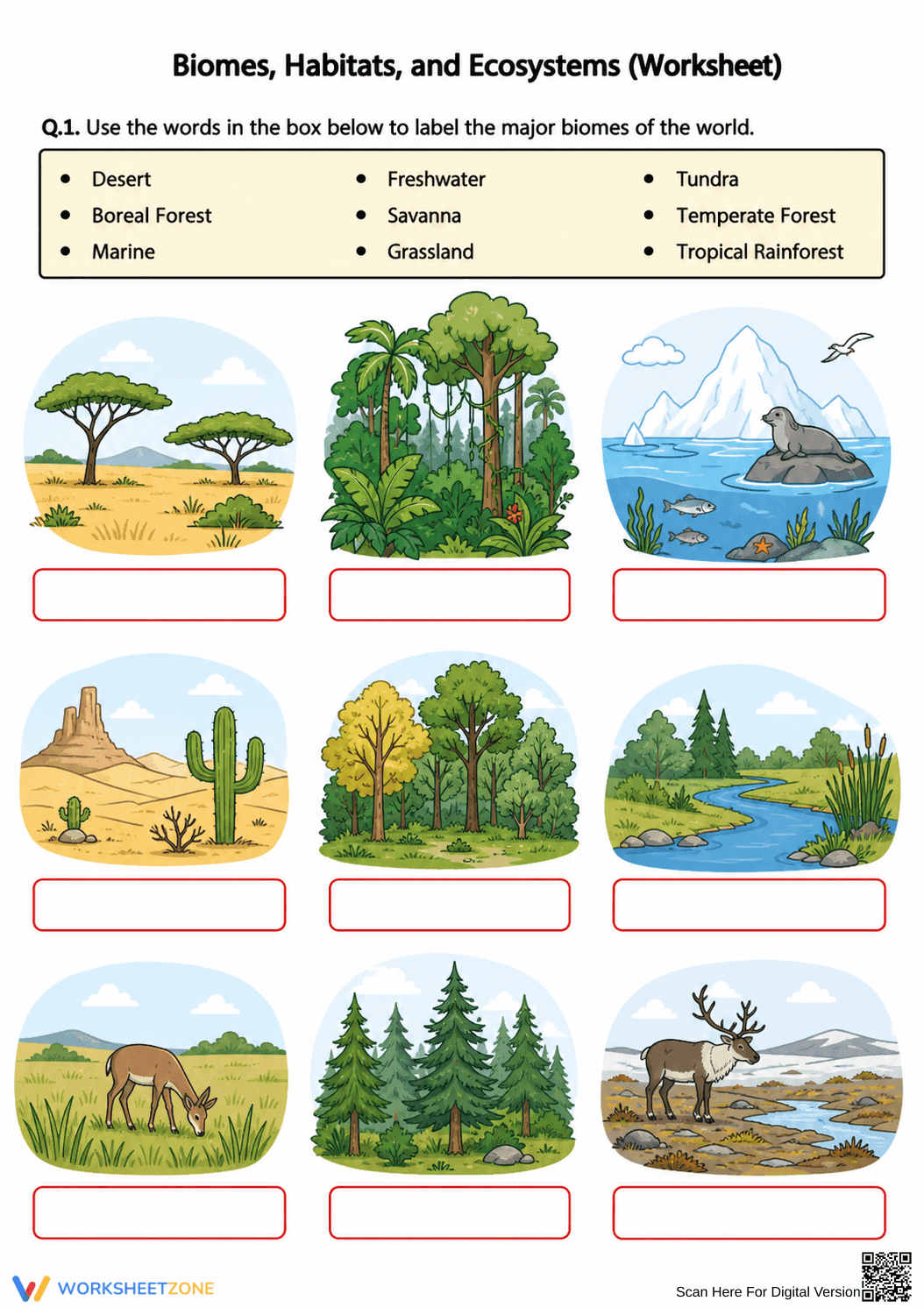

Essential Biomes and Ecosystems Labeling | Grade 5 Science
Paste this activity's link or code into your existing LMS (Google Classroom, Canvas, Teams, Schoology, Moodle, etc.).
Students can open and work on the activity right away, with no student login required.
You'll still be able to track student progress and results from your teacher account.
This Grade 5 science worksheet empowers students to identify and classify the world's major biomes through visual analysis. By matching environmental characteristics to scientific terminology, learners develop a foundational understanding of how climate and geography shape distinct ecosystems. This activity ensures students can distinguish between terrestrial and aquatic environments with precision.
At a Glance
- Grade: 5 · Subject: Science
- Standard:
5-LS2-1— Develop a model to describe the movement of matter among plants and animals- Skill Focus: Biome identification and classification
- Format: 1 page · 9 problems · Answer key included · PDF
- Best For: Ecosystem unit introduction or formative assessment
- Time: 15–20 minutes
The worksheet features nine illustrations representing diverse global environments, including the tundra, savanna, and marine biomes. A clear word bank is provided to support vocabulary acquisition. The single-page layout is designed for clarity, with dedicated labeling boxes beneath each scene to keep student work organized and legible.
The instructional design follows a structured progression to ensure student success.
- Guided Practice: The teacher can model the first two labels, such as the Desert and Tropical Rainforest, by pointing out specific visual markers like cacti or dense canopy layers.
- Supported Practice: Students use the remaining terms to identify biomes with distinct features, such as the Boreal Forest's conifers or the Marine biome's aquatic life.
- Independent Practice: Learners finalize the labeling for nuanced ecosystems like the Grassland versus the Savanna, demonstrating their ability to observe subtle differences in vegetation.
This resource is primarily aligned with 5-LS2-1, focusing on the environmental context where matter cycles through food webs. By identifying the specific biome, students set the stage for understanding the unique producers and consumers found in those regions. It also supports MS-LS2-1 by providing the necessary vocabulary for analyzing resource availability in different ecosystems.
Use this worksheet as a hook at the start of an ecosystems unit to gauge prior knowledge. Alternatively, assign it as a formative assessment after a lesson on climate zones to verify that students can connect abstract concepts to visual representations. During the activity, observe if students struggle to differentiate between forest types, which serves as a prompt for a mini-lesson on temperate versus boreal characteristics.
This activity is designed for Grade 5 but is adaptable for Grade 4 or Grade 6 review. It is an excellent resource for English Language Learners (ELLs) due to the heavy reliance on visual cues. Pair this worksheet with a biome map or digital slideshow to deepen the connection between the illustrations and reality.
According to Fisher & Frey (2014), visual non-linguistic representations are critical for the gradual release of responsibility model. This worksheet applies that research by providing clear illustrations that serve as scaffolds for standard 5-LS2-1. By mapping terms like tundra or savanna to visual environments, the activity reinforces the link between climate and biological reality. Research indicates that students engaging with illustrated classification tasks retain terminology more effectively than those using text-only definitions. This resource provides the necessary visual support to move students toward mastery of ecosystem dynamics and biodiversity concepts.


