




























1 / 2
0
Views
0
Downloads


0.0
0
Save
0 Likes
Share
Plate Tectonics: Labeling and Comprehension Worksheet
0 Views
0 Downloads

Paste this activity's link or code into your existing LMS (Google Classroom, Canvas, Teams, Schoology, Moodle, etc.).
Students can open and work on the activity right away, with no student login required.
You'll still be able to track student progress and results from your teacher account.
Information
Description
What It Is:
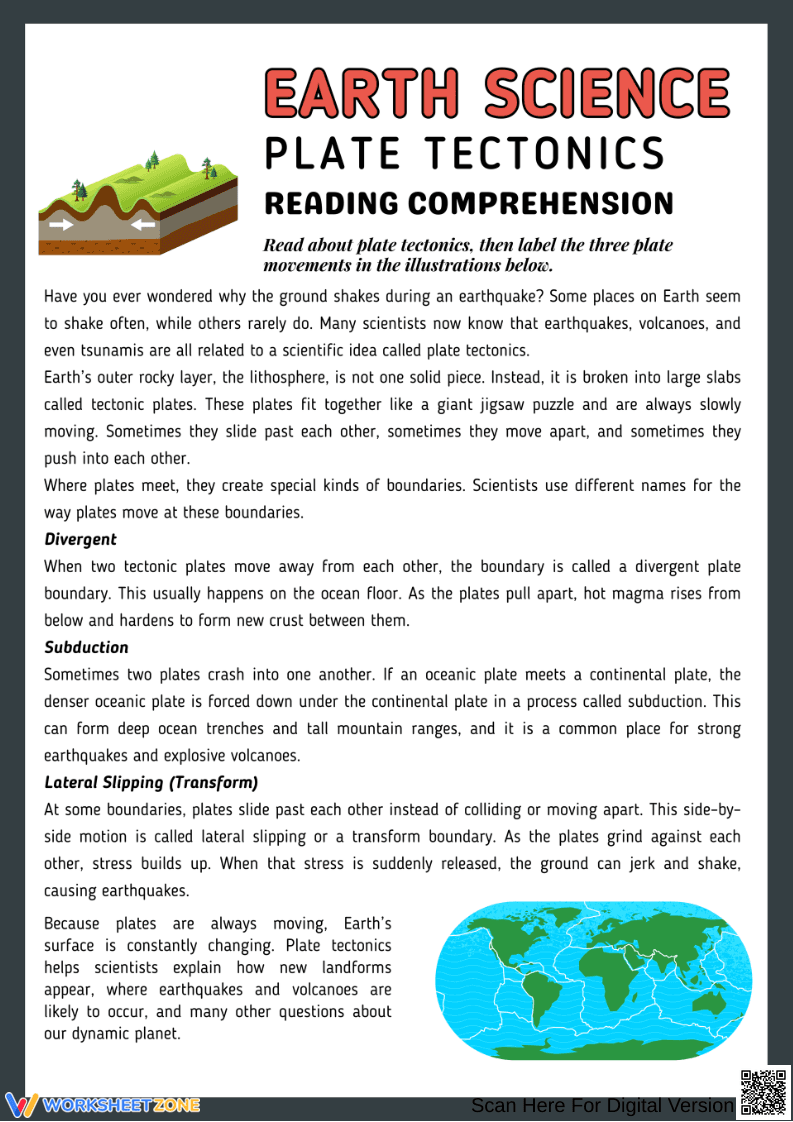
A printable Earth science worksheet that teaches the three main types of plate movements—divergent, subduction (convergent), and transform boundaries. Students label diagrams that show each type of movement and answer comprehension questions to reinforce key concepts about earthquakes, stress, and Earth’s outer layers.
Why Use It:
This worksheet helps students deepen their understanding of plate tectonics by combining visual learning with critical-thinking questions. It supports NGSS standards related to Earth’s structure, tectonic plate movement, and natural hazards. The mix of diagrams and short-response questions builds both vocabulary and conceptual knowledge.
How to Use It:
• Introduce plate movements using the diagrams as visual references.
• Assign comprehension questions as classwork, homework, or assessment.
• Pair with hands-on models or map activities showing real plate boundaries.
• Use as a review before quizzes on plate tectonics, earthquakes, and volcanoes.
Grade Suitability:
Best suited for Grades 4–7.
• Ideal for learners beginning to study Earth’s layers and tectonic motion.
• Great for visual learners and students preparing for geological science units.
Target Users:
Teachers, homeschooling families, tutors, and students studying Earth science and natural hazards.
A printable Earth science worksheet that teaches the three main types of plate movements—divergent, subduction (convergent), and transform boundaries. Students label diagrams that show each type of movement and answer comprehension questions to reinforce key concepts about earthquakes, stress, and Earth’s outer layers.
Why Use It:
This worksheet helps students deepen their understanding of plate tectonics by combining visual learning with critical-thinking questions. It supports NGSS standards related to Earth’s structure, tectonic plate movement, and natural hazards. The mix of diagrams and short-response questions builds both vocabulary and conceptual knowledge.
How to Use It:
• Introduce plate movements using the diagrams as visual references.
• Assign comprehension questions as classwork, homework, or assessment.
• Pair with hands-on models or map activities showing real plate boundaries.
• Use as a review before quizzes on plate tectonics, earthquakes, and volcanoes.
Grade Suitability:
Best suited for Grades 4–7.
• Ideal for learners beginning to study Earth’s layers and tectonic motion.
• Great for visual learners and students preparing for geological science units.
Target Users:
Teachers, homeschooling families, tutors, and students studying Earth science and natural hazards.


