Earth S Rotation and Revolution printable worksheets for 4th Grade
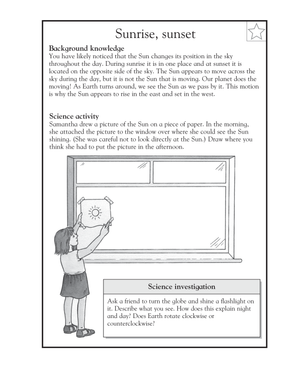
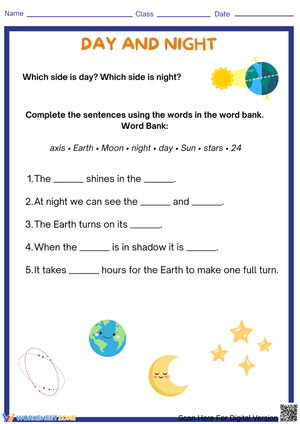
Earth s rotation and revolution printable worksheets for 4th grade give teachers a targeted way to address one of the most persistently confused concept pairs in elementary science — not because the ideas are especially complex, but because the vocabulary sounds similar and the timescales are abstract. A 24-hour spin and a 365-day orbit both involve Earth moving, and students often treat them as interchangeable until they get repeated, structured practice sorting them apart. This set uses diagram labeling, vocabulary sorting, and short written explanations to make those distinctions visible and stick.
The Specific Skills Each Worksheet Builds
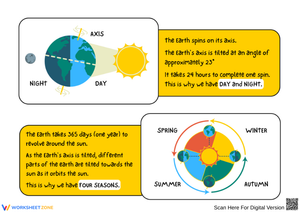
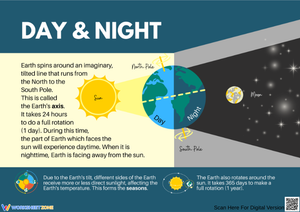
The resources focus on three skill areas that fourth graders need to solidify before this topic can go deeper. First, students identify and define the two motions: rotation as Earth spinning on its axis, revolution as Earth traveling its orbital path around the Sun. Second, they connect each motion to its observable effect — rotation to day and night, revolution to the length of a year, and the combination of revolution plus axial tilt to seasonal change. Third, they practice using the vocabulary accurately in their own written sentences, which is where the real consolidation happens.
- Labeling diagrams that show Earth's axis, spin direction, and orbital path around the Sun
- Matching terms — axis, orbit, rotation, revolution, tilt — to accurate, grade-level definitions
- Sorting factual statements into rotation or revolution categories
- Completing comparison charts that place both motions side by side with their causes and effects
- Answering short constructed-response prompts about day, night, and seasons
The comparison chart format deserves specific mention. When students fill in a two-column chart with rotation on one side and revolution on the other, they cannot answer one column without referencing the other. That side-by-side structure does more for retention than isolated definition drills because it forces the contrast students actually need to hold in memory.
Frequent Student Errors Worth Watching For and Correcting
The rotation/revolution swap is the obvious one, but it takes a specific form in student writing that teachers should anticipate. Students don't mix up the words randomly — they typically apply the correct word for whichever concept was mentioned most recently in class. Ask about seasons a minute after discussing day and night, and a student who just answered a rotation question correctly will write "Earth rotates around the Sun to make seasons." The vocabulary is present; the concept mapping is wrong. Cut-and-sort worksheets surface this almost immediately, because placing "causes day and night" and "takes about 365 days" in the wrong columns shows up in a visual you can check at a glance during a quick walk-through.
A second error pattern involves the time durations. Students know a year is 365 days and a day is 24 hours, but when asked to connect those numbers to the correct motion, many reverse them — writing that rotation takes a year or that revolution takes about 24 hours. This is a conceptual problem, not a vocabulary problem, and it surfaces almost exclusively in short-answer responses rather than matching tasks. Including at least one constructed-response worksheet in the sequence gives you a reliable way to catch it before any graded assessment.
Recommended Lesson-Planning Strategies for These Worksheets
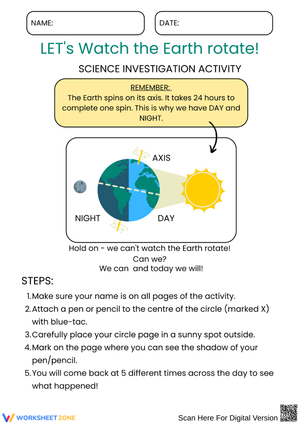
The most effective approach treats the worksheets as checkpoints in a five-day arc rather than a single-day activity. Open with a whole-class demonstration — physically spin a globe on its axis for rotation, then slowly carry it in a wide circle around the room for revolution. The day-one labeling worksheet follows immediately while that physical model is still in students' heads. They label Earth, the axis, the spin arrows, and the orbital path. That's enough for day one.
Day two works well as a vocabulary sort. Have students work the cut-and-sort worksheet with a partner before comparing answers as a class. The conversations that come out of disagreements — particularly when one student puts "causes seasons" under rotation and their partner disputes it — are often more instructive than the worksheet itself. Days three and four can include the comparison chart and a short constructed-response worksheet. Earth s rotation and revolution printable worksheets for 4th grade used this way give you four informal assessment checkpoints before any graded test, which is enough data to identify who needs reteaching before the unit wraps up.
One practical classroom move worth building into the routine: assign a specific marker color to each motion and keep it consistent across every worksheet in the sequence. Students always trace rotation arrows in one color and revolution in another. By the third worksheet, the color assignment is habit, and your walkthrough checks become much faster — a single glance tells you whether a student has the two concepts sorted or still tangled.
Standard Alignment
The content in these worksheets connects to ESS1.B: Earth and the Solar System — the NGSS disciplinary core idea that addresses Earth's rotational and orbital motion. In the full NGSS framework, observable effects of rotation and revolution are assessed explicitly in grade 5 through 5-ESS1-2, which asks students to represent data revealing patterns of daily and seasonal change. Most state-adopted science standards, however, place the conceptual groundwork for rotation and revolution at fourth grade, treating it as the mechanistic understanding that the grade 5 performance expectations assume students already have. Teachers using earth s rotation and revolution printable worksheets for 4th grade in those districts are building exactly that foundation — students who can name, define, and connect both motions to real observable patterns before they reach the data-representation work in grade 5.
Differentiating These Worksheets Across Ability Levels
For students who need additional support, start with the labeling worksheet before anything else. It provides a visual structure that reduces the language students have to process independently, and reading the diagram prompts aloud before students write removes decoding as a barrier. Trimming a matching task from eight vocabulary terms to four also keeps the working memory load manageable while preserving the comparison practice. These are small, practical adjustments that don't require rewriting an entirely different worksheet from scratch.
Students ready for extension benefit most from the constructed-response format, but with a harder prompt than the standard worksheet provides. Rather than asking what rotation causes, ask them to write two sentences connecting rotation, Earth's spherical shape, and the fact that different parts of Earth are in darkness simultaneously. That pulls spatial reasoning into the vocabulary work. A few students every year will explain seasons using revolution alone, leaving axial tilt out entirely — asking them to add a specific sentence about why the tilt matters pushes that understanding another level further and exposes an incomplete model they would otherwise carry forward.
Frequently Asked Questions
Do these worksheets address axial tilt, or only the two motions?
Axial tilt appears in connection with seasons, since revolution alone doesn't fully explain why seasons occur. The labeling worksheets show Earth's tilted axis, and the short-response questions ask students to explain seasonal change in terms of both orbital position and tilt angle. Tilt isn't treated as a third standalone concept — it's introduced as the piece of the seasons explanation that students most consistently leave out.
At what point in a unit do these worksheets fit best?
They work at every stage, but not all the same way. Vocabulary matching and diagram labeling belong early — within the first two days of instruction. The cut-and-sort format works best in the middle of the unit when students have been exposed to both terms but haven't consolidated the difference yet. Short constructed-response worksheets belong near the end, when you want evidence of whether students can explain the concepts rather than simply recognize them.
Can students complete these independently, or do they require teacher support?
The labeling and matching formats are structured enough for independent work after a brief whole-class introduction. The sort activity is better as a partner task on the first exposure — the conversation students have while sorting is part of the value. Constructed-response worksheets can go either way, but having a sentence frame available ("Earth rotates, which means ____. This causes ____.") helps students who freeze at a blank line without reducing the conceptual demand of the task.
How does the set handle the connection between revolution and seasons without overcomplicating it for fourth graders?
Earth s rotation and revolution printable worksheets for 4th grade treat the rotation-to-day-and-night connection as the more concrete of the two, since students can observe sunrise and sunset as direct evidence. The revolution-to-seasons connection is handled more carefully, with diagram worksheets that show Earth at multiple orbital positions and short-response prompts that specifically prompt students to mention axial tilt. That distinction matters — "revolution causes seasons" is technically incomplete without tilt, and fourth graders who leave the unit with that incomplete model will run into problems when they encounter the grade 5 content.
Are answer keys included?
Yes. Each worksheet comes with an answer key. For the short constructed-response worksheets, the key includes a model response rather than a single fixed phrase, which makes it easier to evaluate student explanations that use different wording but show accurate understanding of both motions.
Clear All