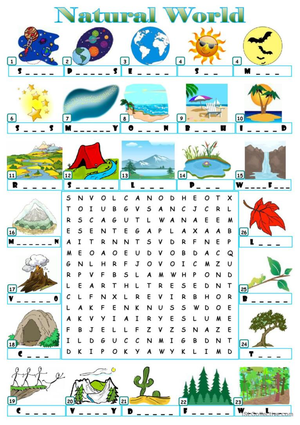
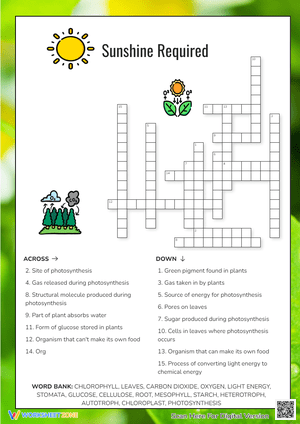
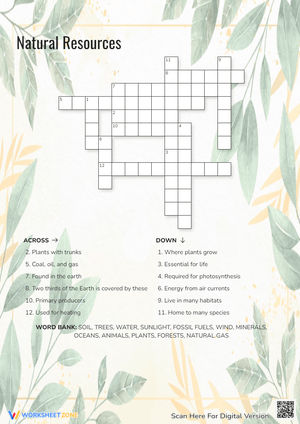
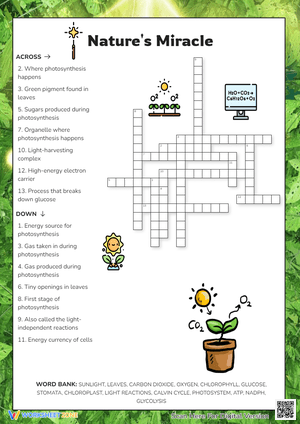
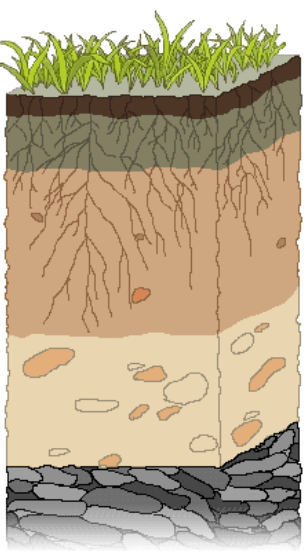
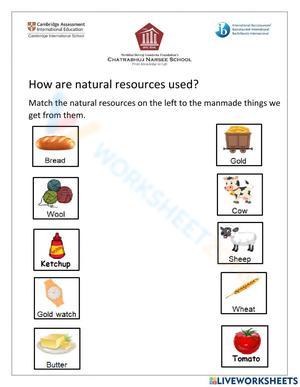
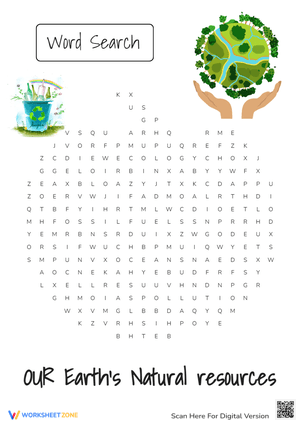
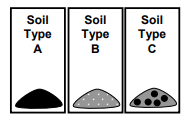
These 4th grade natural resources pdf worksheets give teachers a set of ready-to-print science activities spanning classification, vocabulary, diagram work, and conservation writing — the full range of tasks that NGSS 4-ESS3 actually requires at this grade level. The set runs from identifying Earth's basic materials through comparing solutions to resource challenges, covering both the conceptual groundwork and the applied thinking the standards demand.
What Students Practice in This Set
The foundational work is sorting and classification. Students read a list of materials — coal, wind, freshwater, gold, timber, natural gas, sunlight — and sort them into renewable and nonrenewable categories. That basic task is the starting point, not the endpoint. The more substantive demand is the explanatory step: students write one or two sentences justifying why each resource belongs in the column they chose. That habit of explanation is where the real understanding lives, and the worksheets build toward it through progressively more complex tasks.
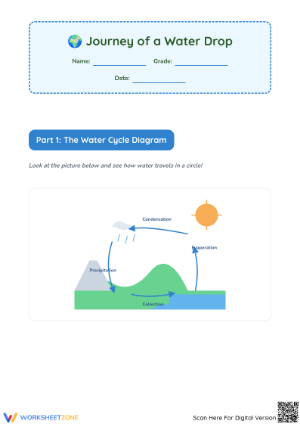
Diagram worksheets ask students to trace a resource from its natural source to a finished product. Tracing coal from underground extraction to power plant to classroom electricity is a natural fit, but the format also extends to timber becoming paper or lumber, and underground water becoming drinking water. Students also label the water cycle as a renewable system — a task that grounds the abstract idea of "can be replenished" in earth science content they already know from earlier grades.
Vocabulary work runs through several worksheets using fill-in-the-blank sentences, word-matching, and short contextual passages rather than bare definition lists. The eight terms students need to control by the end of the unit are: natural resource, renewable, nonrenewable, conservation, fossil fuel, mineral, erosion, and sustainability. Encountering those words inside a sentence about a specific resource — rather than as isolated definitions — is what makes them transferable.
Misconceptions That Surface Early in This Unit
The most persistent error: students sort coal into the renewable column because it comes from the ground, and the ground is nature. In their reasoning, natural equals renewable. The fix is not more sorting practice — it is making the timescale argument explicit. When students understand that coal formed over roughly 300 million years and that humans consume it across decades, the renewable/nonrenewable distinction stops feeling arbitrary. Several worksheets include a "why?" prompt directly below the sort for exactly this reason; asking students to justify each placement is what moves them past guessing.
A second error shows up in conservation writing. Ask a 4th grader how to protect a natural resource and many write "don't use it." That response avoids the NGSS expectation, which requires generating realistic solutions that reduce impact — not eliminate use entirely. Worksheets that ask students to propose two or three distinct conservation strategies and compare their likely effectiveness push past that avoidance answer into the comparative reasoning 4-ESS3-2 actually requires.
Working These Worksheets Into Your Weekly Science Plan
Start the unit with a sorting worksheet as a knowledge probe rather than a graded task. Before any direct instruction, students sort a list of resources and write a brief justification for each placement. This takes about twelve minutes and immediately shows you who already holds the renewable/nonrenewable concept and who is starting from zero. That information shapes every lesson that follows.
Vocabulary work fits best mid-unit. Using the 4th grade natural resources pdf worksheets for vocabulary at this stage — after students have heard the terms in discussion and reading — turns fill-in-the-blank activities into retrieval practice rather than cold memorization. Students who have encountered fossil fuel in a class discussion before seeing it in a worksheet are doing something cognitively different than students meeting the word for the first time on a printed task. The sequence matters.
Conservation writing worksheets belong at the end. One approach that reliably deepens understanding: pair the written worksheet with a brief class discussion about a local resource — a regional river, a stretch of farmland, a nearby forest — before students write independently. The specificity of a real local example gives students something concrete to argue about rather than writing in the abstract about "the environment."
Standard Alignment
NGSS 4-ESS3-1 requires students to obtain and combine information to describe that energy and fuels come from natural resources and that using those resources affects the environment. The classification and diagram worksheets address that expectation directly — students are not just naming resources, they are tracing extraction and use through a chain of steps. NGSS 4-ESS3-2 requires students to generate and compare solutions that reduce human impact on Earth's systems. The conservation writing tasks target that standard specifically. The 4th grade natural resources pdf worksheets align to both performance expectations without requiring teacher modification; the task structures already ask for the thinking each standard names.
Making the Set Work Across Different Readiness Levels
Students who need more support do well starting with picture-based classification worksheets, which pair images of each resource with its name rather than requiring students to work from text alone. This keeps the conceptual task — sorting by renewable vs. nonrenewable — accessible to readers who might struggle with a text-heavy list. Partner work on these worksheets is also productive; two students can sort together and negotiate disagreements in a way that surfaces reasoning without requiring independent writing from the start.
Students who move through classification tasks quickly benefit most from the open-ended conservation writing prompts. A useful extension without adding a separate worksheet: ask them to propose two different solutions to the same resource problem and explain which would have a greater long-term impact. Most 4th graders find that comparison genuinely hard. You can also ask these students to identify a resource not listed in a given worksheet and explain how they would classify it — that task tests whether a student understands the underlying principle or just remembers the memorized examples.
Frequently Asked Questions
What NGSS standards do these worksheets address?
The two primary standards are 4-ESS3-1 and 4-ESS3-2. 4-ESS3-1 addresses understanding where energy and fuels come from and how their use affects the environment. 4-ESS3-2 focuses on generating and comparing solutions to reduce human impact on Earth's systems. Classification, diagram, and conservation writing tasks in the set connect to one or both of those performance expectations.
Do these work for science stations or small-group rotation?
The 4th grade natural resources pdf worksheets are formatted as self-contained tasks, which makes them straightforward to place in station rotations. Classification and matching worksheets work especially well in stations because students can check their own sort against a posted key. The conservation writing worksheets are better suited to whole-class or teacher-led settings, where you can redirect students who default to "don't use it" as their only solution.
How do I help students who are still confused about renewable versus nonrenewable after sorting practice?
Move from category labels to timescale reasoning. Instead of asking students to sort again, ask: "How long did this take to form? How quickly are humans using it?" That reframe usually dislodges the "natural equals renewable" assumption. A diagram worksheet that places the formation timescale of coal alongside the growth timescale of a tree is one of the more effective tools in the set for exactly that confusion — students can see the mismatch rather than just hear it described.












 Interactive Worksheet Maker
 Quiz Maker
 Word Search Maker
 Crossword Puzzle Maker
 Word Scramble Generator
 Sentence Scramble Generator
 Handwriting Worksheet Generator
 Name Tracing Generator
 Fill In The Blank Generator