




























0
Views
0
Downloads

0.0
0
Save
0 Likes
Share
Plate Tectonics: Types of Plate Boundaries
0 Views
0 Downloads

Paste this activity's link or code into your existing LMS (Google Classroom, Canvas, Teams, Schoology, Moodle, etc.).
Students can open and work on the activity right away, with no student login required.
You'll still be able to track student progress and results from your teacher account.
Information
Description
What It Is:
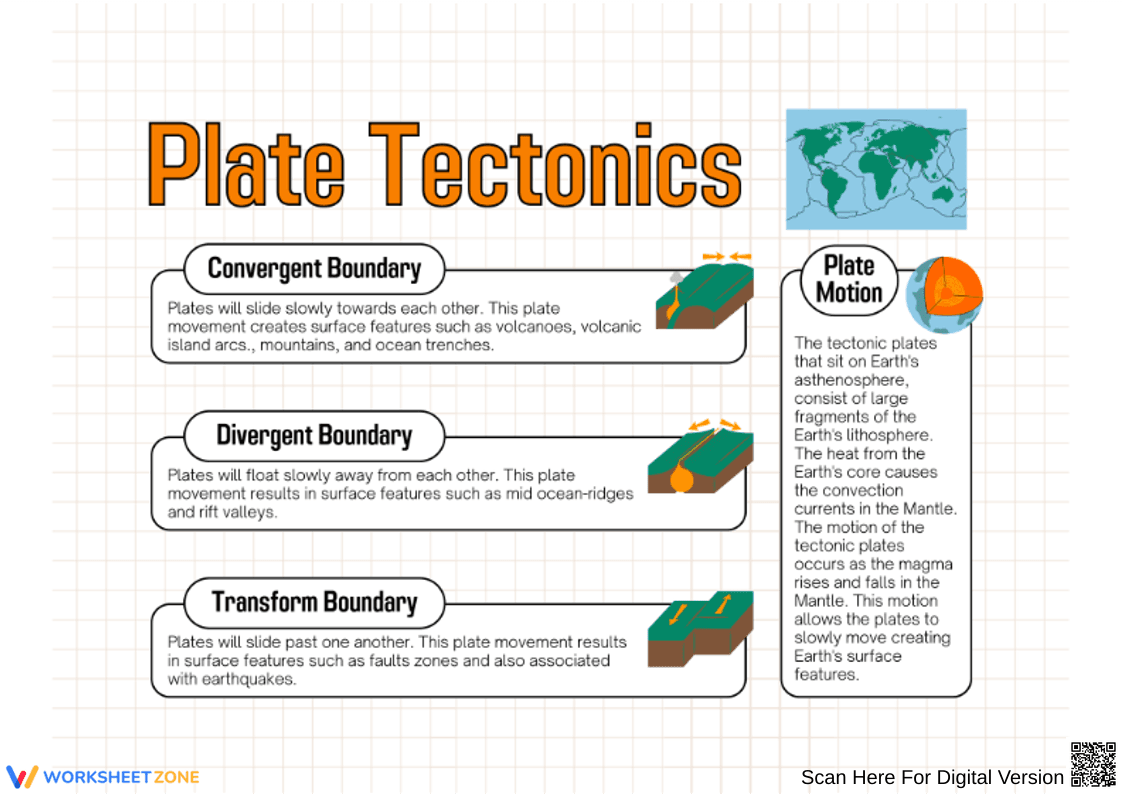
A visual science worksheet explaining the three major types of plate boundaries—convergent, divergent, and transform—and how tectonic plates move due to convection currents in the mantle. The worksheet includes diagrams and short descriptions that help students understand how mountains, volcanoes, trenches, and earthquakes form.
Why Use It:
This worksheet builds foundational Earth science knowledge by clearly illustrating how plate movement shapes Earth’s surface. It reinforces key vocabulary, supports NGSS-aligned instruction, and helps students visualize geological processes that cannot be directly observed.
How to Use It:
• Use as an introduction to plate tectonics in a geography or Earth science unit.
• Pair with a hands-on activity (e.g., clay models of plate boundaries).
• Assign as reference material for interactive notebooks or homework.
• Use diagrams to spark class discussions about real-world examples of boundary types.
Grade Suitability:
Best suited for Grades 4–7.
• Great for students learning about Earth’s structure and geological change.
• Useful for developing vocabulary related to tectonics and Earth processes.
Target Users:
Teachers, homeschool educators, tutors, and students studying plate tectonics, Earth’s layers, and geological formations.
A visual science worksheet explaining the three major types of plate boundaries—convergent, divergent, and transform—and how tectonic plates move due to convection currents in the mantle. The worksheet includes diagrams and short descriptions that help students understand how mountains, volcanoes, trenches, and earthquakes form.
Why Use It:
This worksheet builds foundational Earth science knowledge by clearly illustrating how plate movement shapes Earth’s surface. It reinforces key vocabulary, supports NGSS-aligned instruction, and helps students visualize geological processes that cannot be directly observed.
How to Use It:
• Use as an introduction to plate tectonics in a geography or Earth science unit.
• Pair with a hands-on activity (e.g., clay models of plate boundaries).
• Assign as reference material for interactive notebooks or homework.
• Use diagrams to spark class discussions about real-world examples of boundary types.
Grade Suitability:
Best suited for Grades 4–7.
• Great for students learning about Earth’s structure and geological change.
• Useful for developing vocabulary related to tectonics and Earth processes.
Target Users:
Teachers, homeschool educators, tutors, and students studying plate tectonics, Earth’s layers, and geological formations.


