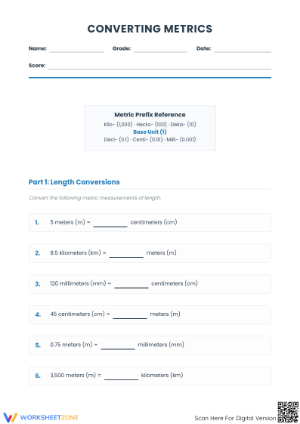
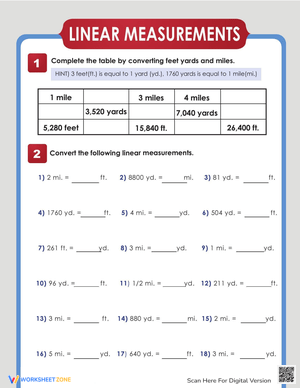
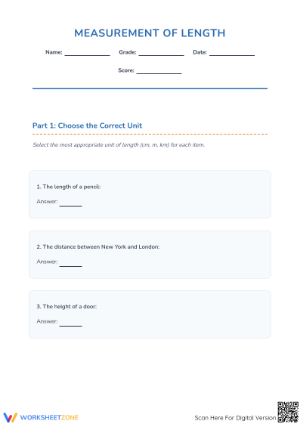
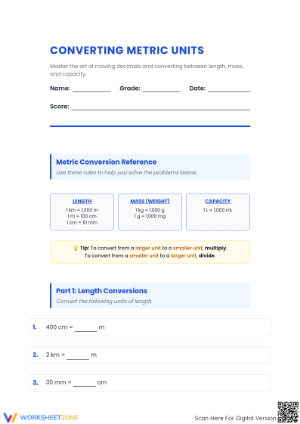
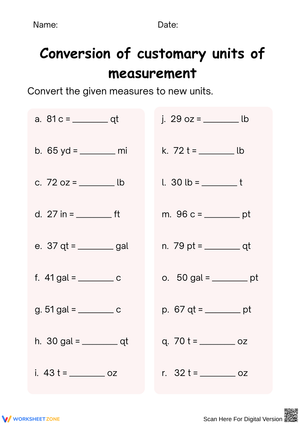
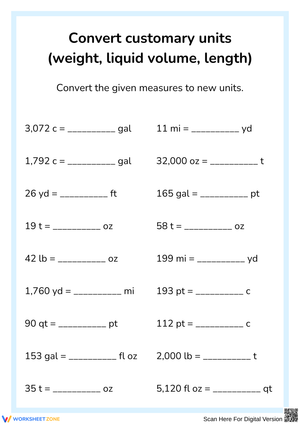
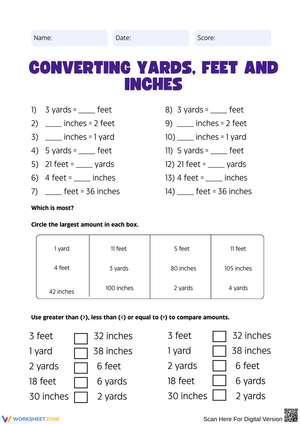
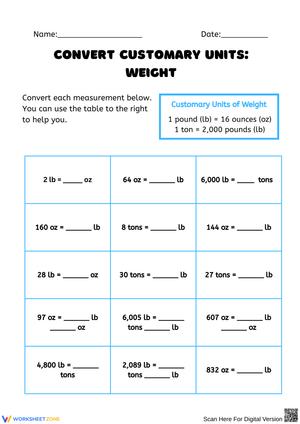
These scale and conversions worksheets for 4th grade give teachers a set of independent, print-ready exercises covering both the metric and customary systems, two-column equivalency tables, and scale-reading tasks on rulers, thermometers, and graduated cylinders. Each worksheet targets one conversion context rather than surveying everything at once, so teachers can assign them selectively as the unit progresses instead of handing out a general review and hoping the right things stick.
What the Set Covers
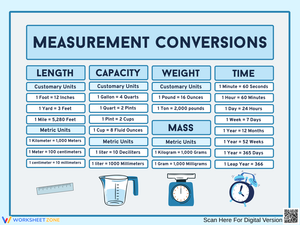
The worksheets address every conversion relationship Grade 4 students are expected to know:
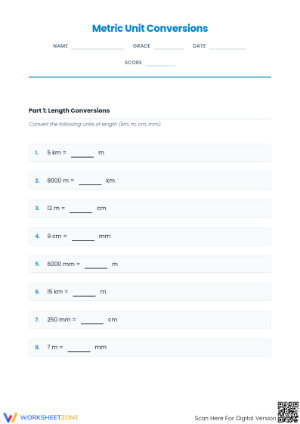
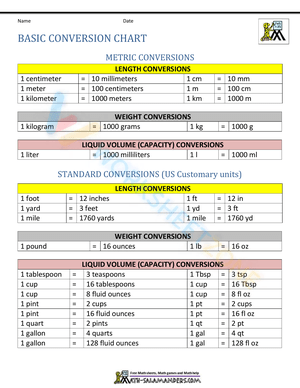
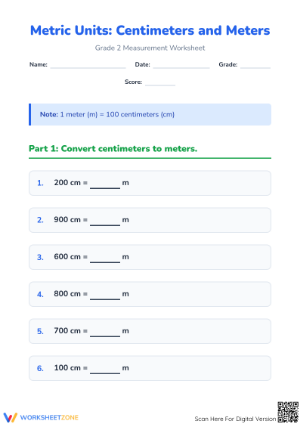
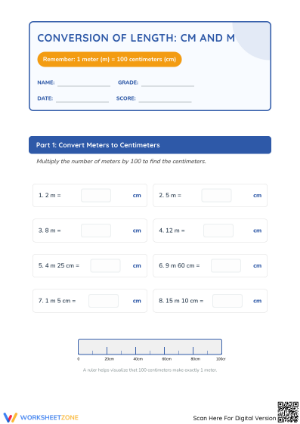
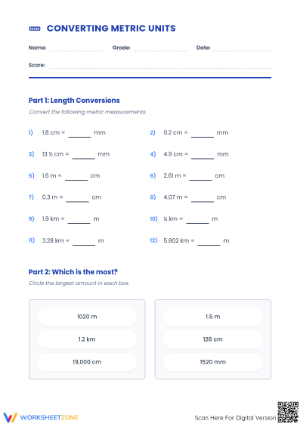
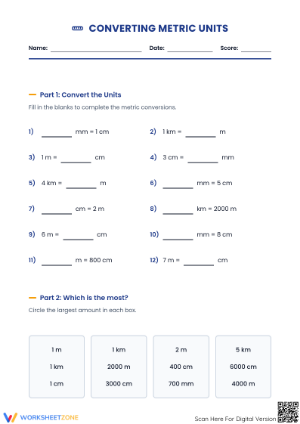
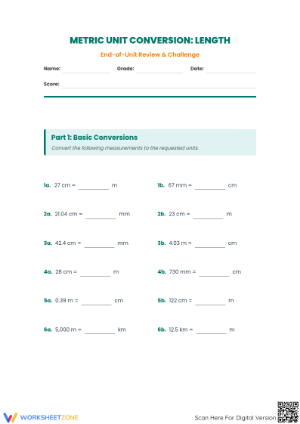
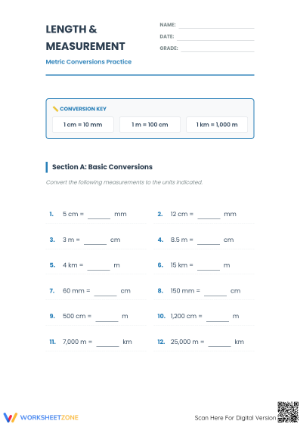
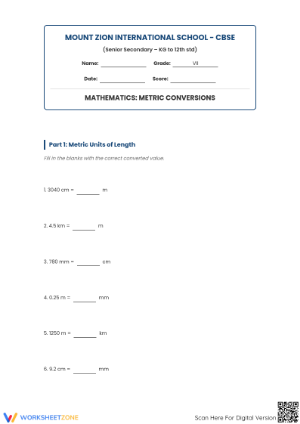
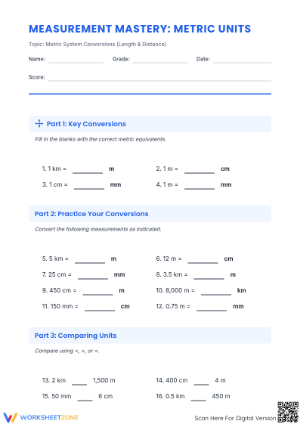
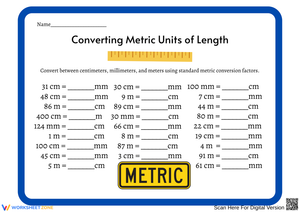
- Metric length: kilometers to meters, meters to centimeters, centimeters to millimeters
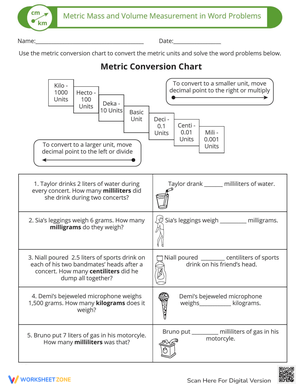
- Metric mass: kilograms to grams
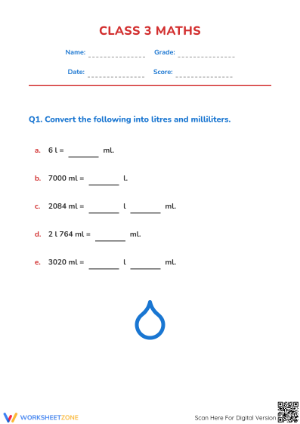
- Metric capacity: liters to milliliters
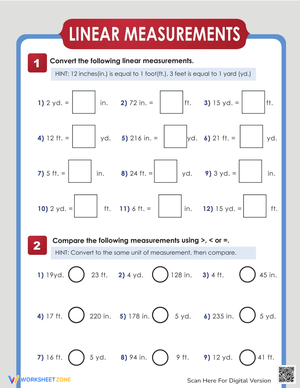
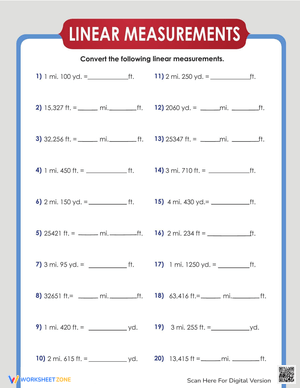
- Customary length: miles to yards, yards to feet, feet to inches
- Customary weight: tons to pounds, pounds to ounces
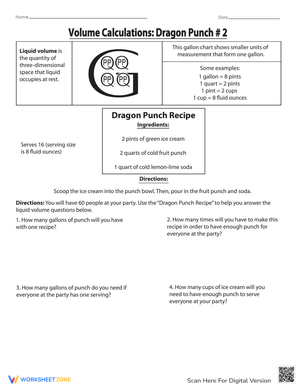
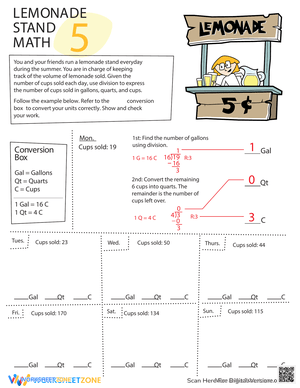
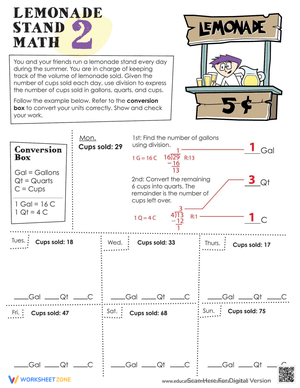
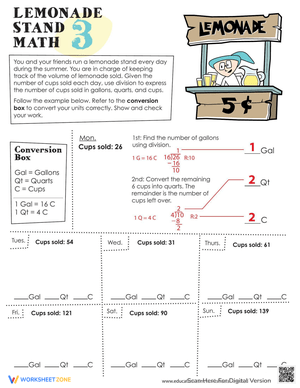
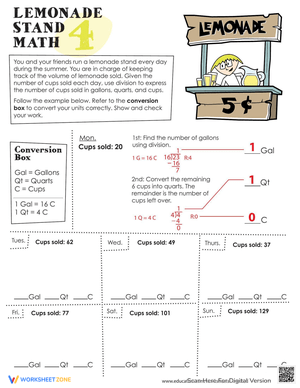
- Customary liquid volume: gallons to quarts, quarts to pints, pints to cups
- Time: hours to minutes, minutes to seconds
- Scale reading: rulers with fractional-inch markings, thermometers with varied increments, graduated cylinders
Several worksheets use two-column equivalency tables as their primary format — a structure 4.MD.A.1 names explicitly. Students fill in multiple rows for the same unit pair, which forces repeated application of the same conversion factor until the multiplicative pattern registers rather than remaining an isolated fact.
Standard Alignment
These worksheets align with CCSS 4.MD.A.1, which requires students to know the relative sizes of measurement units within one system and to express measurements given in a larger unit as an equivalent in a smaller unit. The standard also calls for using two-column tables to record equivalents and for representing measurement quantities using diagrams and number lines — both of which appear across the set.
In classroom terms, this standard sits at a real turning point. Through Grade 3, students measure and report: read the ruler, write the number, done. Grade 4 asks them to treat unit relationships as scale factors — 1 foot is 12 times as long as 1 inch, so 5 feet is 60 inches, not 5 plus 12. That shift from additive to multiplicative reasoning is where most of the difficulty in this unit lives. The scale and conversions worksheets for 4th grade in this set address one conversion relationship per worksheet rather than grouping everything together, which keeps cognitive load manageable for students who are simultaneously still building fluency with multi-digit multiplication.
Four Error Patterns Worth Anticipating Before You Teach This Unit
The most consistent mistake: students divide when they should multiply. Ask a class to convert 4 yards to feet and a reliable cluster will write 1.33 — or just 1 — because they reason that feet are smaller, so the answer must be a smaller number. The logic is completely backward, and it persists even after direct instruction. Catching it early on the first conversion worksheet tells you which students need a concrete model before additional practice locks in the wrong procedure.
Metric conversions surface a different problem. Students who have absorbed "metric means move the decimal" apply that rule without tracking direction: on "5 kilograms = ___ grams," a student running the half-remembered rule might write 0.5 or 500. The answer is 5,000, and the two-column table format makes the error impossible to miss because the pattern across rows falls apart before the student finishes the exercise. Scale-reading worksheets expose a third reliable confusion: students count lines rather than read intervals. On a thermometer graduated in two-degree increments, counting each mark as one degree turns 68°F into 64°F. And in customary liquid volume, most fourth graders can name gallons and cups as the endpoints but consistently swap quarts and pints — assigning those two relationships on separate worksheets gives you a much cleaner read on exactly where the breakdown is.
Building These Worksheets Into Your Week
Bell ringers are the most natural slot. Three conversion problems at the start of the math block review the previous lesson in the time it takes students to settle in — typically 8 to 10 minutes — without signaling that it's a graded task. Two-column table worksheets are especially well-suited here because students can move through them independently while you handle morning logistics.
Small-group rotations work well too. One station uses metric unit exercises, another focuses on customary length and weight, a third handles scale-reading tasks. That arrangement lets you pull whichever group is struggling most while the others work without interruption — each worksheet carries enough built-in context that students rarely need to stop and ask what they're supposed to do.
One move worth making before any worksheet lands on a desk: have students mark off 10-centimeter intervals on a blank paper strip, fold it to mark individual centimeters within one section, and use it as a reference they built themselves. That construction step internalizes the metric scale in a way that reading a pre-printed ruler does not. Students who go through it first make noticeably fewer errors on the metric conversion exercises that follow. The scale and conversions worksheets for 4th grade work best as consolidation after that kind of concrete experience, not as a replacement for it.
Adjusting the Set for Different Student Levels
Students who need more support work well with a conversion reference card alongside the worksheet — not to eliminate the memorization goal, but to shift their attention to the operation itself. Once the multiplicative pattern is solid, pull the card. Printing two-column table worksheets with the first row already filled in also helps: seeing that 1 foot equals 12 inches before being asked how many inches are in 7 feet gives students an anchor that keeps frustration from shutting the attempt down entirely.
Students ready to push further can tackle multi-step problems — a word problem requiring a conversion from yards to feet and then feet to inches in sequence is substantially harder than either conversion alone. The scale-reading worksheets offer a strong extension too: instead of reading a given scale, students design one for a specified range and interval, then write two problems for a partner to solve. That reversal asks them to work backward through the same skill and surfaces gaps that forward application can hide.
Frequently Asked Questions
Should Grade 4 students also convert from smaller units to larger?
CCSS 4.MD.A.1 focuses specifically on converting from a larger unit to a smaller unit — feet to inches, not inches to feet. Going the other direction typically involves fractions or decimals, which are addressed more directly in Grades 5 and 6. Students should understand that the relationship works both ways, but the worksheets here keep practice within the Grade 4 scope: multiply to go from the larger unit to the smaller one.
How do two-column table worksheets differ from standard conversion drill problems?
A drill problem — "convert each measurement" followed by a numbered list — checks whether students can recall a factor and apply it once. A two-column table asks students to fill in five or six rows for the same unit pair. That repetition makes the multiplicative pattern visible in a way isolated problems rarely do: students often notice on their own that each row's output increases by a fixed multiple of the input, which is exactly the reasoning 4.MD.A.1 is targeting.
Are these worksheets meant for formative or summative use?
Most teachers use these scale and conversions worksheets for 4th grade as formative checks — quick reads after instruction that show which students have the concept and which need a different approach before the unit moves on. They're not formatted as summative assessments. The scale-reading worksheets, however, transfer directly into test-prep contexts: standardized assessments at this level regularly include instrument diagrams that students must read and interpret under timed conditions, and worksheet practice with varied thermometer and ruler scales prepares students for exactly that.
What's the best sequence for assigning these worksheets across a measurement unit?
Start with metric conversions. The base-10 structure gives students an accessible first success with larger-to-smaller conversion before the irregular customary factors arrive. Move to customary length next — feet and inches are the most familiar units for most students — then weight, then liquid volume. Save the scale-reading worksheets for the second half of the unit, when students have enough conversion fluency to focus on reading the instrument rather than simultaneously working out what a milliliter represents.













 Interactive Worksheet Maker
 Quiz Maker
 Word Search Maker
 Crossword Puzzle Maker
 Word Scramble Generator
 Sentence Scramble Generator
 Handwriting Worksheet Generator
 Name Tracing Generator
 Fill In The Blank Generator