


























Views
Downloads
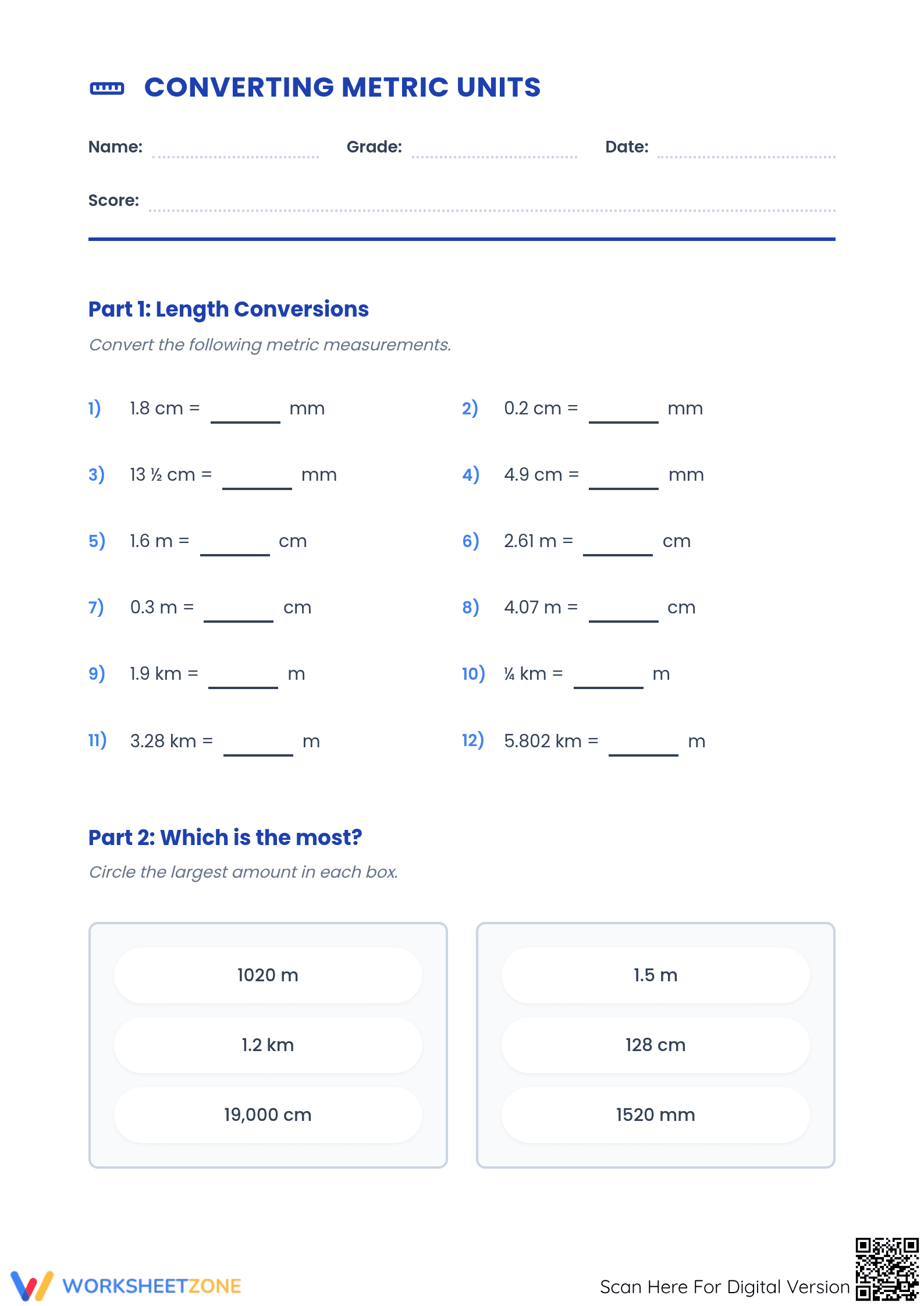


Grade 5 Metric Conversion — Printable No-Prep Worksheet
Paste this activity's link or code into your existing LMS (Google Classroom, Canvas, Teams, Schoology, Moodle, etc.).
Students can open and work on the activity right away, with no student login required.
You'll still be able to track student progress and results from your teacher account.
This Grade 5 metric conversion worksheet provides students with comprehensive practice in translating measurements between kilometers, meters, centimeters, and millimeters. By engaging with various task formats, learners develop a concrete understanding of powers of ten and measurement relationships. The outcome is increased fluency in measurement conversions essential for upper elementary math success.
At a Glance
- Grade: Grade 5 · Subject: Math
- Standard:
5.MD.A.1— Convert metric length units using multiplication and division by powers of ten- Skill Focus: Metric length conversion (km, m, cm, mm)
- Format: 2 pages · 26 problems · Answer key included · PDF
- Best For: Independent practice and measurement unit review
- Time: 20–30 minutes
This two-page PDF resource features three distinct sections designed to build measurement mastery. The first section contains 12 direct conversion problems involving decimals and fractions. The second section presents four comparison challenges where students identify the largest quantity among three choices. Finally, the third section provides 10 comparison tasks using mathematical symbols. A complete answer key is included for rapid grading.
The print-and-go design ensures you spend less than 2 minutes on preparation. Step 1: Print the 2-page PDF document (1 minute). Step 2: Distribute the copies to your students for immediate work (1 minute). Step 3: Review student answers using the provided answer key during or after the session. This workflow is ideal for emergency sub plans or busy morning transitions.
This resource aligns directly with `5.MD.A.1`: "Convert among different-sized standard measurement units within a given measurement system (e.g., convert 5 cm to 0.05 m), and use these conversions in solving multi-step, real world problems." Both standard codes can be copied directly into lesson plans, IEP goals, or district curriculum mapping tools.
Use this worksheet as a summative assessment following a unit on the metric system or as a guided practice activity during direct instruction. During the activity, observe if students correctly move the decimal point when multiplying or dividing by powers of ten. This resource typically takes 25 minutes for students to complete accurately.
This worksheet is perfect for Grade 5 students mastering measurement systems or Grade 6 students requiring remediation. It pairs naturally with an anchor chart displaying metric prefixes or a hands-on activity using meter sticks and trundle wheels. Differentiation is built-in via the progressive difficulty of the three task sections.
Effective measurement instruction requires a transition from conceptual understanding to procedural fluency. According to Fisher & Frey (2014), the gradual release of responsibility is crucial when teaching abstract mathematical conversions like those found in the metric system. This worksheet facilitates that transition by providing 26 structured tasks that align with the 5.MD.A.1 standard. By requiring students to convert between kilometers, meters, centimeters, and millimeters, the resource reinforces the base-ten nature of the metric system. The inclusion of decimals and fractions ensures students are prepared for higher-order mathematical demands found in middle school. Educators can utilize this standalone resource to verify that students can accurately translate units, a foundational skill for both science and engineering. This analysis of instructional materials confirms that consistent practice with varying task formats leads to long-term retention of measurement competencies.


