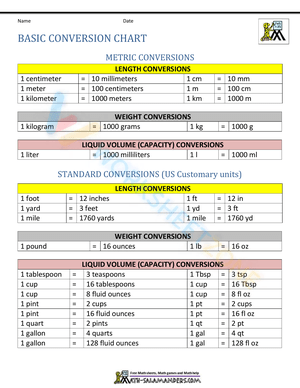
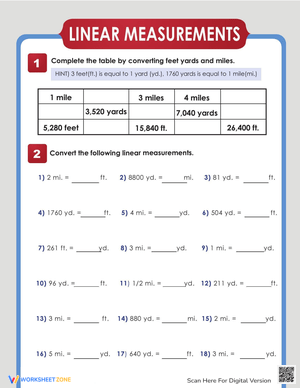
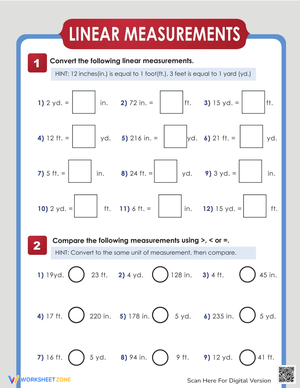
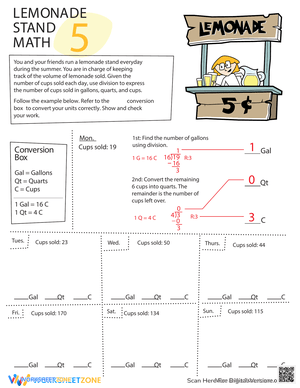
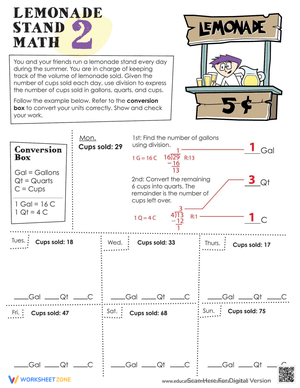
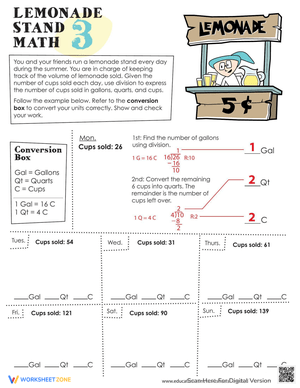
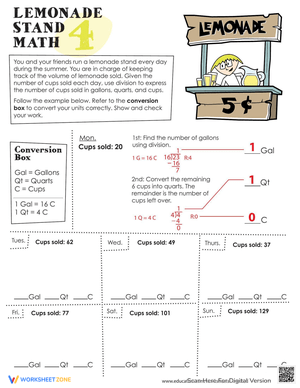
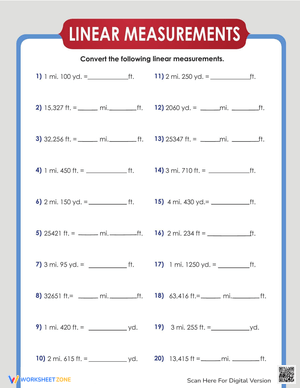
These converting us imperial units pdf worksheets for 4th grade give teachers a ready-made practice set built around the whole-number conversion relationships students are expected to know — feet to inches, yards to feet, pounds to ounces, and gallons down through cups — without requiring extra prep beyond printing. The focus stays narrow on purpose: customary unit relationships inside a single measurement system, where the real demand is on understanding relative size, not multi-step computation.
Common Misconceptions to Watch For and Correct
The error that surfaces most reliably is the direction mistake: students choose the right conversion fact but apply the wrong operation. A student converting 3 feet to inches knows that 12 is relevant, then divides — writing 0.25 — because nothing in their mental model signals that dividing produces a smaller result when moving to a larger unit. The written work looks like arithmetic carelessness, but the actual problem is that the student has not internalized that smaller units always produce a larger number in the final answer.
Category confusion runs a close second. Because "ounces" appears in both weight and capacity contexts, students working from memory sometimes carry a fluid-ounce fact into a weight problem. This tends to surface when practice mixes measurement families without a prior sorting task. Spending two minutes at the start asking students to group unit names by length, weight, and capacity — before touching a single conversion problem — measurably reduces these errors. The issue is not arithmetic; it is conceptual category knowledge.
A third pattern emerges after extended work on length: some students apply 12 as a universal multiplier across all unit types. Given 4 pounds to convert, they write 48 ounces because 12 is the number that feels right from days of length work. The actual relationship is 16 ounces per pound, but repeated exposure to 12 inches per foot builds an overgeneralized rule. Naming this explicitly before students shift from length to weight prevents a whole category of errors that otherwise look like simple inattention.
What's Inside the Set
The worksheets address each measurement category separately before mixing skills. Within each category, practice moves from direct conversion problems to conversion tables to comparison tasks, then to short word problems. That sequence reflects a deliberate decision about cognitive load: students who can convert 2 yards to feet on a direct-recall item frequently stumble when the same relationship appears inside a table with missing values. Both formats build different parts of the skill, and word problems require students to select the correct conversion relationship without any structural prompt.
- Length: converting between inches, feet, and yards using the 12-inch and 3-foot relationships
- Weight: converting between ounces and pounds, using the 16-ounces-per-pound fact in both directions
- Capacity: moving among cups, pints, quarts, and gallons, with visual reference support on earlier worksheets in the category
- Conversion tables: filling in two-column tables that ask students to express larger units as smaller units across multiple rows
- Comparison tasks: marking whether one measurement is greater than, less than, or equal to another — which requires a correct conversion before any comparison is possible
- Word problems: short, context-grounded questions using recipe measurements, ribbon lengths, and weights of classroom objects
Each worksheet targets one measurement family or one task type. That keeps practice focused and makes it straightforward for teachers to assign a targeted exercise rather than a broad review that covers too much ground at once.
Standard Alignment
These resources align to CCSS 4.MD.A.1, which requires students to know relative sizes of measurement units within one system and to express larger units in terms of smaller units within a table. In most Grade 4 instructional progressions, this standard comes before any work with metric units, which means customary conversion is not a supplemental topic — it is the primary measurement content for a meaningful stretch of the school year. The standard specifically names the two-column conversion table as a target structure, and that format maps directly onto what these worksheets provide. Converting us imperial units pdf worksheets for 4th grade that stay within whole-number customary relationships address the exact skill set 4.MD.A.1 describes, without pulling students into operations or unit systems they are not yet expected to handle.
Lesson-Planning Ideas to Get the Most From These Worksheets
The sequence that produces the clearest results: one measurement family per day for three days, then a mixed review on the fourth. Spending day one on length, day two on weight, and day three on capacity gives students enough repetition within each category before a mixed worksheet demands they distinguish among all three. Teachers who move to combined practice too early tend to see the category confusion errors described above — not because students lack the facts, but because the categories are not yet reliably sorted in memory.
Within a lesson, these worksheets work best as a follow-up to brief direct instruction rather than an opening activity. A 10-minute guided session modeling a conversion relationship — including an explicit discussion of the direction question, "Am I moving to a larger or smaller unit?" — sets students up to work independently with less confusion. The comparison tasks and word problems at the end of each worksheet make a natural closing discussion: pull two or three student responses and ask the class to verify the reasoning, not just confirm the final number.
For homework, send the worksheet that matches that day's lesson objective and make sure a reference box appears at the top. Parents frequently try to assist using mental math shortcuts that skip the conversion reasoning; a printed fact reference on the worksheet reduces the chance a student returns the next day having practiced a method that conflicts with classroom instruction.
Adapting These Worksheets for Different Student Levels
Students who need more support work well with a physical anchor alongside the converting us imperial units pdf worksheets for 4th grade — a ruler marked in both inches and feet, or a set of unit cards they can sort and order by size before starting the conversion problems. The two-column table format does much of the organizing work, but some students need a concrete referent before they trust the numerical relationship enough to write it down. Keeping the reference box available throughout the unit, rather than removing it after the first session, is the right call for these students. Accuracy with support comes before accuracy without it.
For students who have the basic facts secured and are ready to stretch, the comparison tasks and word problems offer the most productive challenge. Ask those students to write a sentence explaining why the conversion produced a larger or smaller number — not just what number they arrived at. A response like "36 inches is greater than 2 feet because inches are smaller units so you need more of them" demonstrates the conceptual understanding that conversion tables alone cannot reveal. Some teachers use the word problem section as a verbal exit task: the student explains the setup aloud before writing a single digit.
Frequently Asked Questions
Which conversion relationships should fourth graders know well before moving to word problems?
Five relationships carry most of the work: 12 inches in 1 foot, 3 feet in 1 yard, 16 ounces in 1 pound, 4 quarts in 1 gallon, and 2 cups in 1 pint. The gallon-to-quart-to-pint-to-cup chain causes the most trouble because it involves four units with three separate conversion steps, and students lose track of where they are in the chain. That sequence benefits from a vertical visual anchor — a simple listed diagram — before students encounter it in written problems.
Can these worksheets function as formative assessment?
Yes. Because each worksheet targets a narrow skill, the results tell teachers exactly where a student's understanding breaks down — at the fact-recall level, at the operation-direction level, or at the application level. A student who answers direct conversion items correctly but misses the comparison tasks almost certainly needs work on unit-size reasoning rather than more fact drill. That kind of diagnostic clarity is harder to extract from a broad mixed-review assignment.
Should students be allowed to use a conversion reference while working?
In early instruction, yes. A visible reference frees working memory for the reasoning task — understanding how unit sizes relate — rather than burdening it with recall under pressure. Once a student is consistently accurate with the reference available, gradual removal makes sense. Fluency follows accuracy; pulling the reference before accuracy is established usually just produces repeated practice with the same errors.
Do these worksheets include metric units?
No. Converting us imperial units pdf worksheets for 4th grade cover only the customary system, which is where 4.MD.A.1 places the Grade 4 emphasis. Metric measurement appears in separate standards and later grades. Mixing both systems in the same practice set at this level typically produces more confusion than it resolves.













 Interactive Worksheet Maker
 Quiz Maker
 Word Search Maker
 Crossword Puzzle Maker
 Word Scramble Generator
 Sentence Scramble Generator
 Handwriting Worksheet Generator
 Name Tracing Generator
 Fill In The Blank Generator