




























Views
Downloads
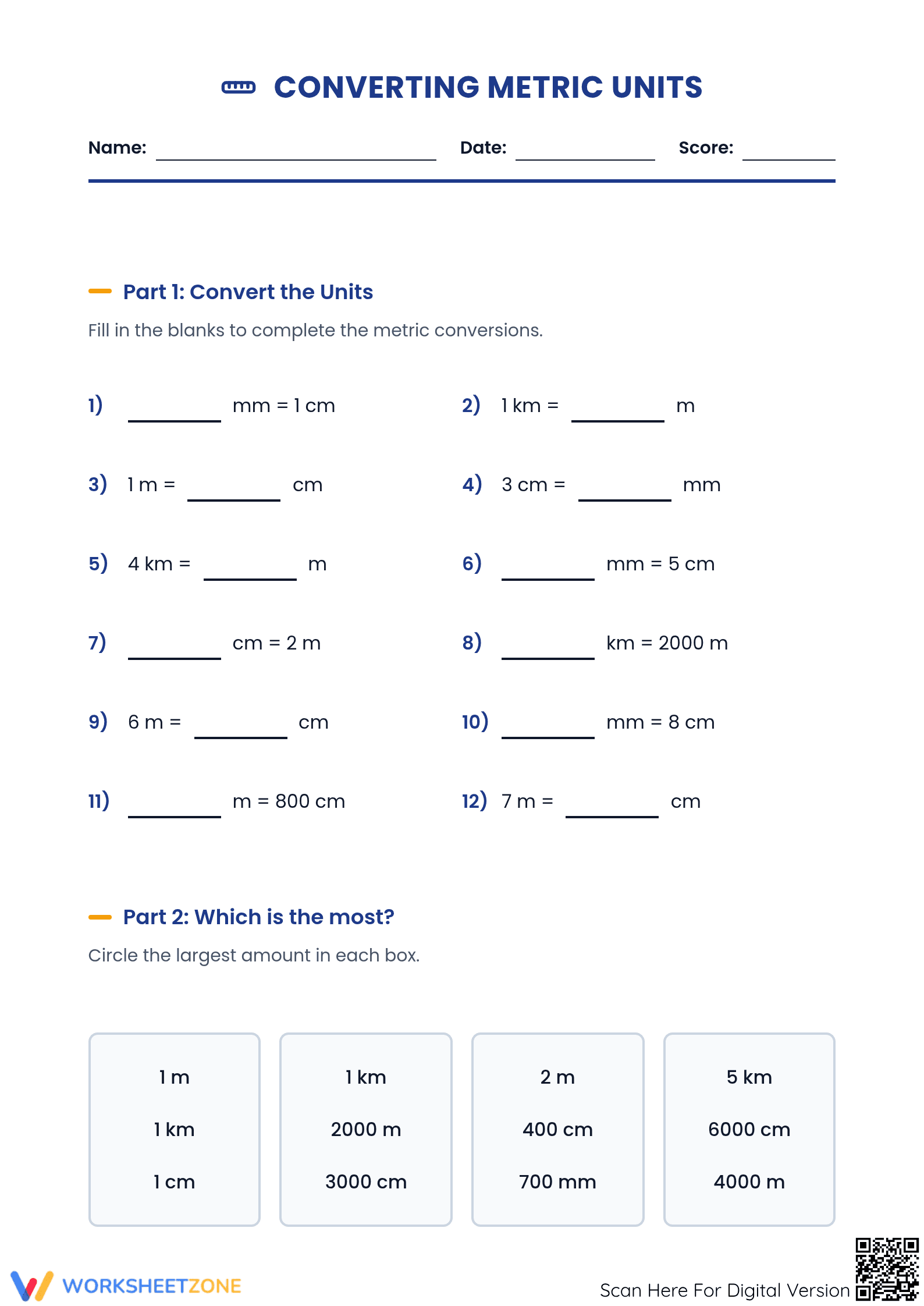


Essential Converting Metrics Worksheet | Grade 4-7 Math

Paste this activity's link or code into your existing LMS (Google Classroom, Canvas, Teams, Schoology, Moodle, etc.).
Students can open and work on the activity right away, with no student login required.
You'll still be able to track student progress and results from your teacher account.
Mastery of metric conversions is a foundational skill in upper elementary mathematics. This comprehensive worksheet provides students with targeted practice in converting between kilometers, meters, centimeters, and millimeters. By engaging with direct conversion, comparison, and size identification tasks, learners build the procedural fluency required for complex measurement and data problems.
At a Glance
- Grade: 4–7 · Subject: Math / Measurement
- Standard:
CCSS.MATH.CONTENT.4.MD.A.1— Express measurements in a larger unit in terms of a smaller unit- Skill Focus: Metric unit scale and conversions
- Format: 2 pages · 26 problems · Answer key included · PDF
- Best For: Independent practice or formative assessment
- Time: 20–30 minutes
This two-page resource is divided into three logical sections to ensure comprehensive coverage. Part 1 features 12 direct conversion problems where students fill in missing values across various unit scales. Part 2 challenges students to identify the largest amount from sets of measurements, reinforcing their understanding of unit relationships. Part 3 concludes with 10 comparison tasks using equality and inequality symbols, providing a robust check for conceptual understanding.
Zero-Prep Workflow
This worksheet is designed for immediate classroom integration with zero teacher setup. Step 1: Print the two-page PDF (30 seconds). Step 2: Distribute to students for independent work or as a guided math center activity (1 minute). Step 3: Review student answers using the included full-page answer key to provide instant feedback or collect for a quick formative grade. Total teacher prep time is under 2 minutes.
Standards Alignment
The primary focus of this activity is CCSS.MATH.CONTENT.4.MD.A.1, which requires students to know relative sizes of measurement units within one system and express measurements in a larger unit in terms of a smaller unit. The comparison tasks also support CCSS.MATH.CONTENT.5.MD.A.1 by requiring multi-step conversion logic. Both standard codes can be copied directly into lesson plans, IEP goals, or district curriculum mapping tools.
How to Use It
Use this worksheet as a post-instruction check after introducing the metric system's base-ten structure. It serves as an excellent "Exit Ticket" or independent practice set during a math rotation. For a formative assessment tip, observe students during Part 2; if they struggle to compare different units without writing out conversions, they may need additional scaffolding with a metric staircase anchor chart. This provides a clear completion time range of 20 to 30 minutes.
Who It's For
This resource is tailored for students in grades 4 through 7 who are developing or refining their measurement skills. It is particularly effective for learners who benefit from structured, clean layouts that minimize visual distractions. It pairs naturally with a metric length measurement lab or a measurement conversion passage to provide a bridge between conceptual understanding and procedural calculation.
Systematic practice in unit conversion, as demonstrated in this 26-task resource, is critical for developing the mathematical proficiency highlighted in NAEP assessments. Research by Fisher & Frey (2014) emphasizes the importance of guided-to-independent practice sequences to ensure that students internalize mathematical relationships rather than relying on rote memorization. By requiring students to navigate between millimeters, centimeters, meters, and kilometers, this worksheet addresses the cognitive demand of unit scaling. The inclusion of comparative logic in Part 3 raises the task from simple arithmetic to logical reasoning, a key component of effective measurement instruction according to recent ScienceDirect TpT Analysis. This evidence-based approach ensures that students can accurately apply conversion rules across various contexts. As an essential tool for standard CCSS.MATH.CONTENT.4.MD.A.1, this worksheet provides the structured repetition necessary for long-term retention and application in higher-level physics and geometry.


