




























Views
Downloads


Printable Metric Length Conversion Worksheet | Grade 4 Math

Paste this activity's link or code into your existing LMS (Google Classroom, Canvas, Teams, Schoology, Moodle, etc.).
Students can open and work on the activity right away, with no student login required.
You'll still be able to track student progress and results from your teacher account.
This Grade 4 metric conversion worksheet provides students with a comprehensive practice set to master the relationship between centimeters and meters. By moving between abstract calculation and real-world application, students develop a concrete understanding of metric units. This printable resource ensures learners can confidently convert larger units into smaller ones and compare various measurements accurately.
At a Glance
- Grade: 4 · Subject: Math
- Standard:
CCSS.MATH.CONTENT.4.MD.A.1— Express measurements in a larger unit in terms of a smaller unit- Skill Focus: Converting and comparing meters and centimeters
- Format: 3 pages · 26 problems · Answer key included · PDF
- Best For: Metric unit mastery and skill reinforcement
- Time: 25–35 minutes
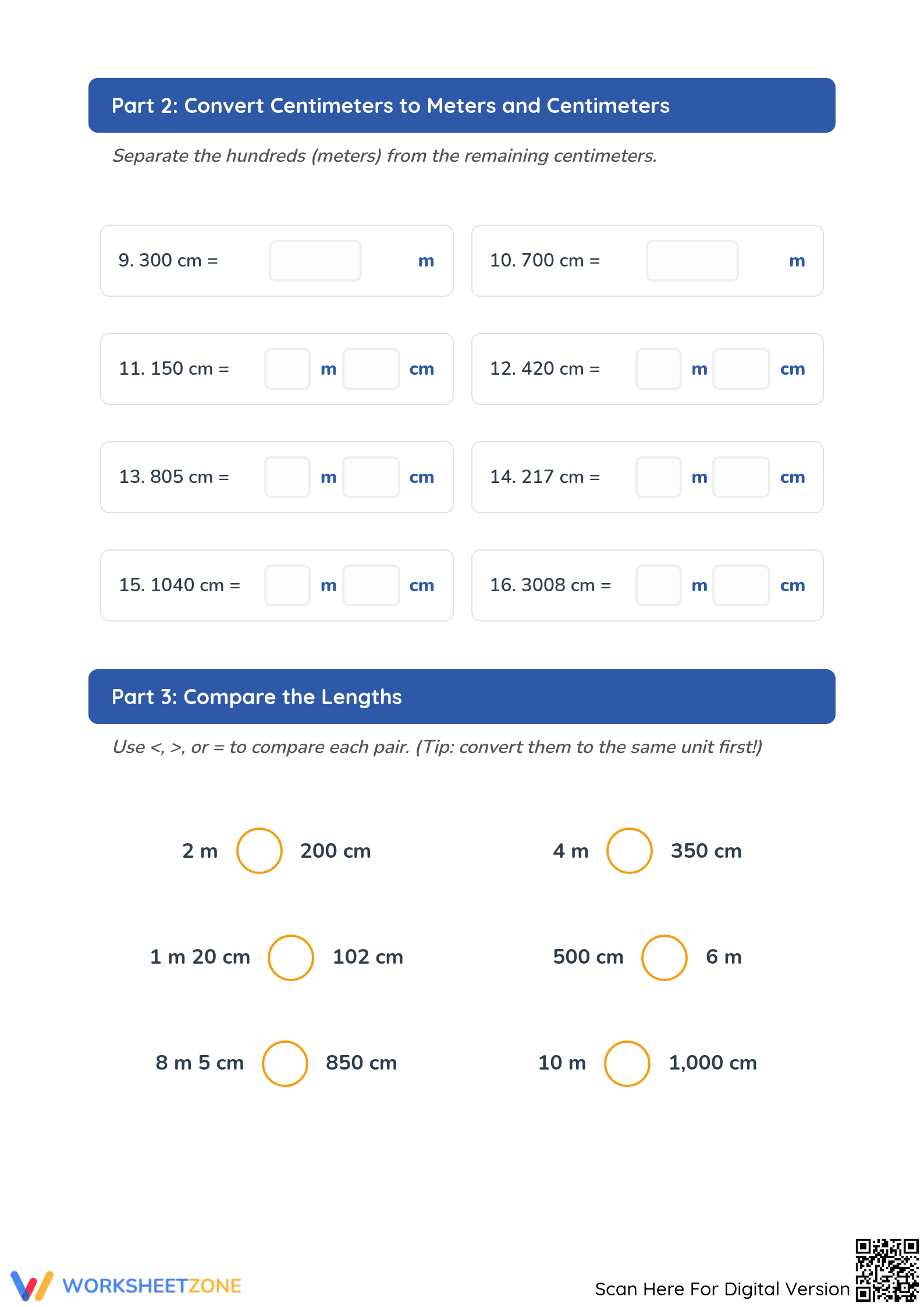
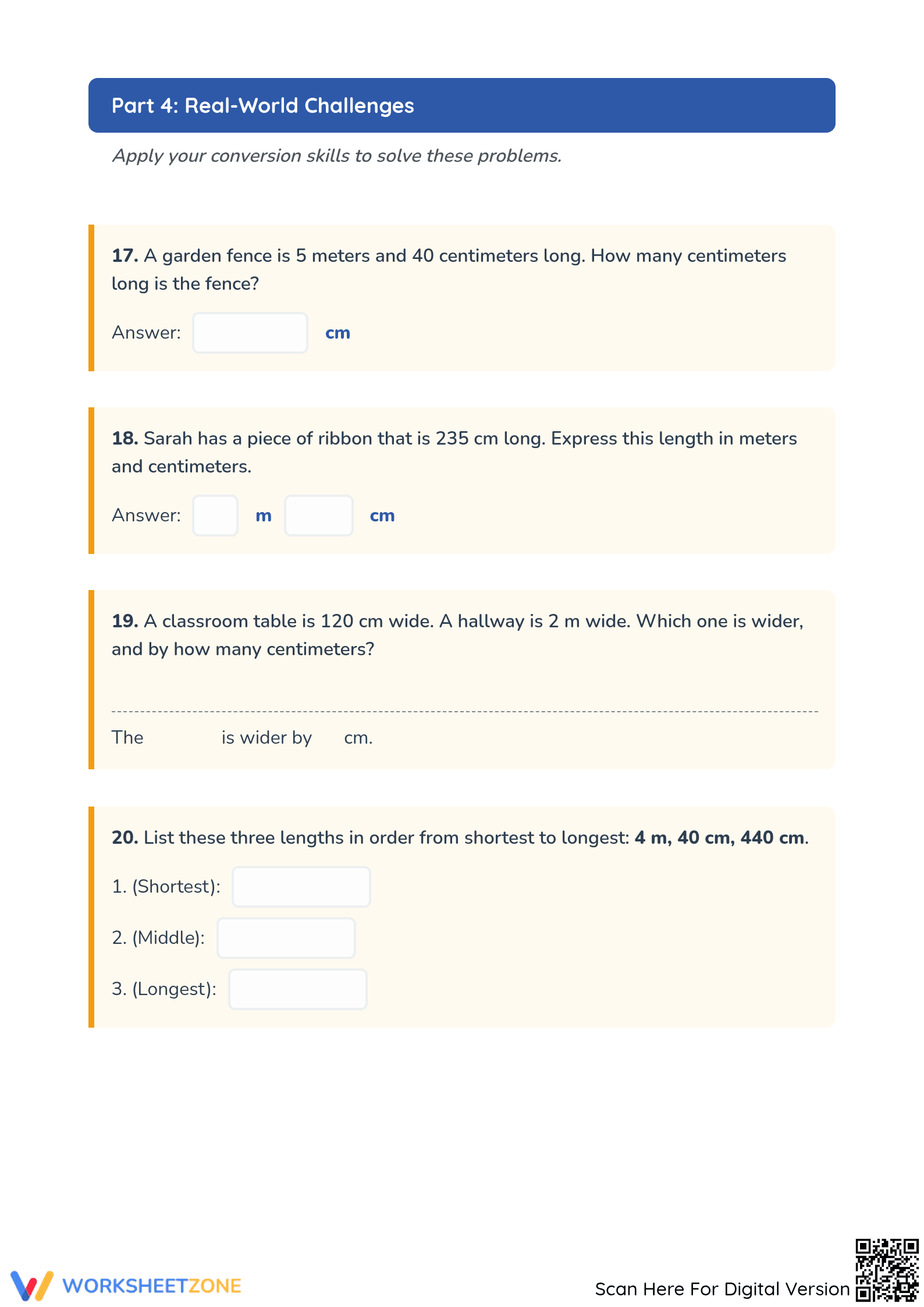
This three-page instructional packet includes a visual "Remember" anchor box, 8 direct meter-to-centimeter conversions, and 8 complex conversions separating hundreds into meters and centimeters. Additionally, the set features 6 comparison problems using mathematical symbols and 4 multi-step real-world word problems. A complete answer key is provided for immediate grading or student self-checking.
The zero-prep design allows teachers to implement this resource in under two minutes. Simply print the three-page PDF and distribute it to students; the built-in reference box handles the initial direct instruction phase. Because the worksheet includes worked examples and a clear instructional tip for comparisons, it functions perfectly as an emergency sub plan or independent practice session.
The primary focus is CCSS.MATH.CONTENT.4.MD.A.1: "Know relative sizes of measurement units within one system of units including km, m, cm... express measurements in a larger unit in terms of a smaller unit." It also supports 4.MD.A.2 by applying conversions to solve word problems involving distances. Both standard codes can be copied directly into lesson plans, IEP goals, or district curriculum mapping tools.
Use this as a summative assessment following a unit on metric measurements to gauge student proficiency in multi-step conversions. Alternatively, assign the first two pages as a guided practice activity during class and save the word problem section for a high-stakes homework assignment. Teachers should observe if students are consistently multiplying by 100 or using mental place-value shifts.
This resource is designed for Grade 4 general education students, but serves as excellent remediation for Grade 5 learners or an enrichment task for advanced Grade 3 students. It pairs naturally with a physical meter stick or centimeter ruler to provide a tactile reference for the abstract conversions required in the word problem section.
According to the RAND AIRS 2024 report on mathematics instructional materials, providing students with structured, multi-part practice that transitions from direct computation to word problem application is essential for long-term retention of measurement concepts. This worksheet aligns with these findings by utilizing a gradual-release model within its 26-problem set. By addressing CCSS.MATH.CONTENT.4.MD.A.1 through four distinct task types—direct conversion, unit separation, symbol-based comparison, and situational application—the material ensures that students move beyond rote memorization of the 1:100 ratio. The inclusion of an explicit visual reference box supports cognitive load management, allowing learners to focus on the procedural accuracy of their calculations. Research from EdReports (2024) indicates that such alignment to the rigor of college and career-ready standards is a primary predictor of student success in middle school geometry and statistics. This resource provides a robust foundation for future proportional reasoning.


