


























Views
Downloads



Printable Metric Conversions | Grade 4 Math
Paste this activity's link or code into your existing LMS (Google Classroom, Canvas, Teams, Schoology, Moodle, etc.).
Students can open and work on the activity right away, with no student login required.
You'll still be able to track student progress and results from your teacher account.
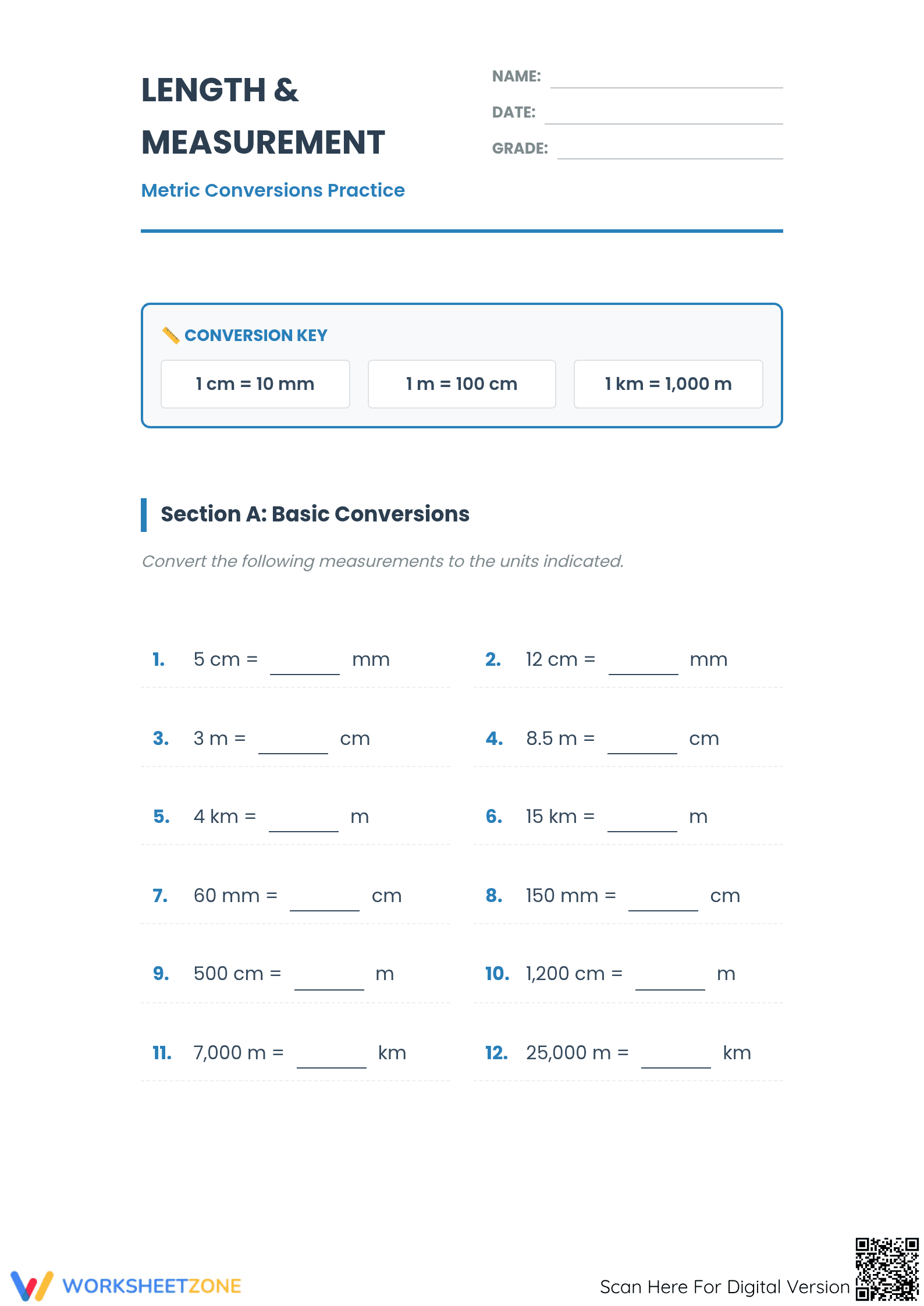
This worksheet provides focused practice on converting metric units of length for fourth and fifth-grade students. Through a series of scaffolded exercises, learners will build confidence and precision in converting between millimeters, centimeters, meters, and kilometers. The goal is for students to solve multi-step measurement problems accurately.
At a Glance
- Grade: 4 · Subject: Math
- Standard:
CCSS.MATH.CONTENT.4.MD.A.1— Express measurements in a larger unit in terms of a smaller unit.- Skill Focus: Metric System Conversions (Length)
- Format: 4 pages · 31 problems · Answer key included · PDF
- Best For: Independent practice, homework, or formative assessment
- Time: 25–40 minutes
What's Inside
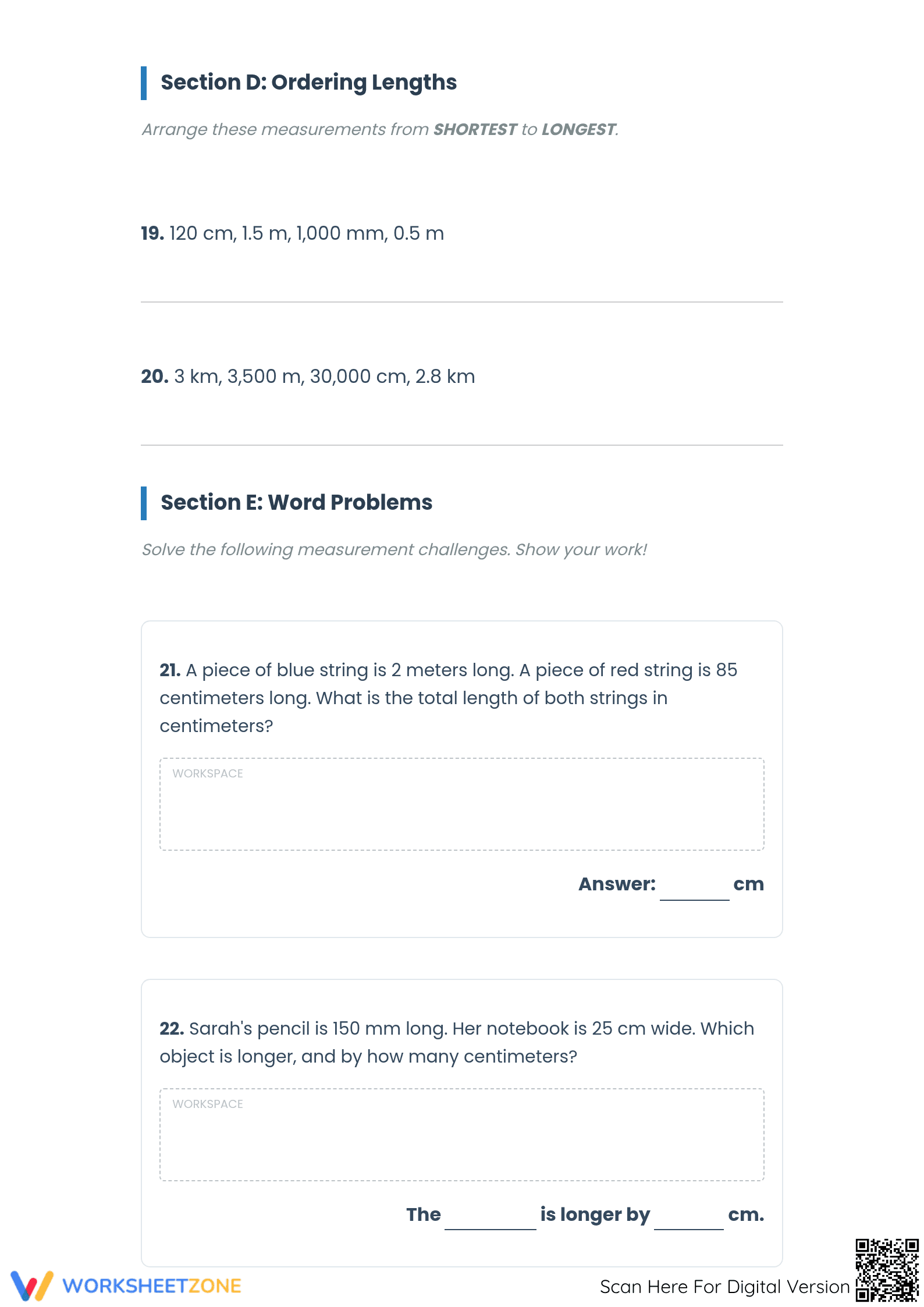
This four-page PDF includes a complete answer key. The worksheet is structured into five sections plus a challenge problem. It starts with a conversion key reference, then moves to direct conversions, a mixed-unit table, length comparisons, ordering tasks, and finally, multi-step word problems requiring students to apply their skills in context.
Skill Progression
The worksheet follows a gradual-release model to support learning:
- Guided practice: Students use a "Conversion Key" for reference while tackling 12 basic, single-step conversion problems to build initial confidence.
- Supported practice: The next sections ask students to complete a conversion table, compare lengths using inequalities, and order mixed-unit measurements.
- Independent practice: The final sections feature word problems and a perimeter challenge, requiring students to synthesize skills without direct scaffolds.
This progression ensures students build a solid foundation.
Standards Alignment
This resource aligns with CCSS.MATH.CONTENT.4.MD.A.1, which requires students to convert measurements within a single system. It also supports fifth-grade standard CCSS.MATH.CONTENT.5.MD.A.1 for multi-unit conversion. Both standard codes can be copied directly into lesson plans, IEP goals, or district curriculum mapping tools, ensuring clear documentation of standards coverage.
How to Use It
Use this worksheet for independent practice after a lesson on metric length or as a homework assignment. For formative assessment, observe students as they work on the word problems (Section E) to check their understanding. Note whether they select the correct operation after converting. The activity is designed to be completed in a 25 to 40-minute class period, depending on student proficiency.
Who It's For
This is designed for Grade 4 students learning metric conversions and Grade 5 students needing review. Its clear, scaffolded structure also benefits learners in special education settings. Pair it with a visual anchor chart of metric unit relationships for students who require additional support.
Effective measurement instruction requires students to solve problems involving conversions, a core mathematical practice. This worksheet directly addresses CCSS.MATH.CONTENT.4.MD.A.1, which focuses on converting from larger to smaller units. Providing structured practice with clear progression from basic conversions to contextual word problems aligns with research on building procedural fluency from conceptual understanding. According to Fisher & Frey (2014), such gradual-release models help students move from dependence to independence. The 31 problems included here offer repeated, deliberate practice, which is critical for mastery. By tackling these real-world scenarios, students not only learn to convert units but also understand the application of measurement in practical contexts, a key indicator of proficiency as noted in analyses by RAND AIRS 2024.


