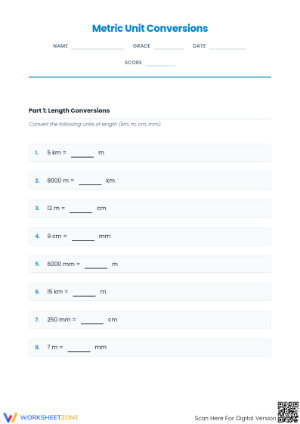
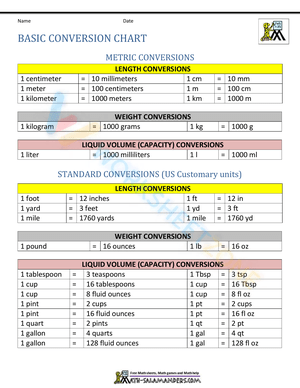
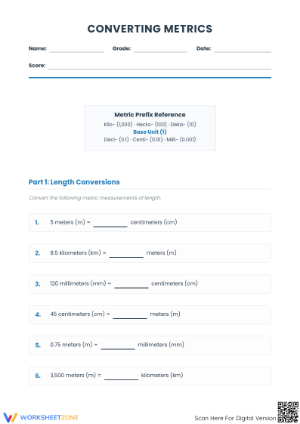
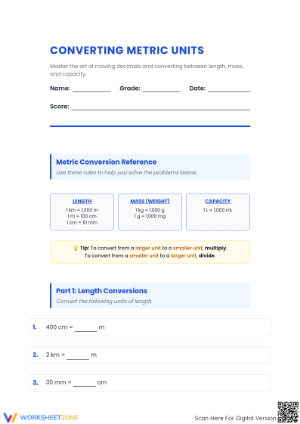
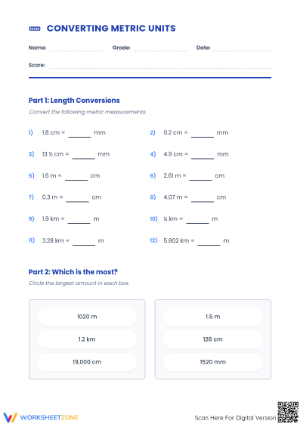
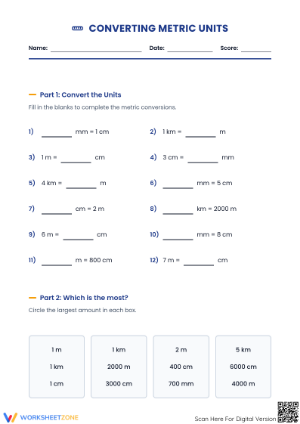
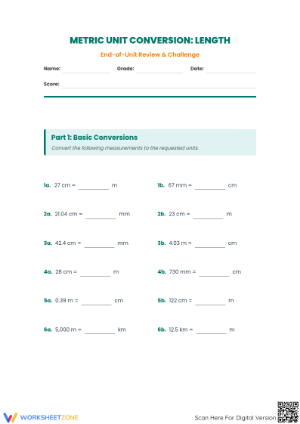
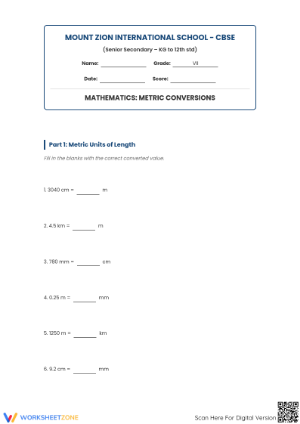
These 4th grade metric conversion worksheets resources give teachers printable, focused practice across all three metric measurement categories — length, mass, and capacity — organized to move students from basic unit relationships into comparison and word-problem tasks. The set targets the place-value reasoning Grade 4 students need to understand why 3 meters equals 300 centimeters rather than treating every conversion as a memorized procedure.
The Specific Skills Targeted
Grade 4 is the entry point for formal metric conversion work in most state standards. Students arrive knowing unit names from science and everyday talk, but they haven't yet had to move between units with mathematical precision. Each worksheet builds on one or more of the following:
- Length: millimeters, centimeters, meters, and kilometers — including conversions that require multiplying or dividing by 100 or 1,000
- Mass: grams and kilograms, with attention to the 1,000-unit relationship between them
- Capacity: milliliters and liters, connecting liquid measurement to the same times-1,000 pattern
- Comparison problems: students convert one measurement and then use greater than, less than, or equal to to compare two quantities
- Applied word problems: school and real-life contexts where students choose a conversion path and justify their answer
Single-category worksheets come first in the sequence. After students work through length, mass, and capacity separately, the mixed-review worksheets ask them to identify which unit family a problem belongs to before selecting a strategy — which is closer to what standardized assessments actually require.
Where Students Go Wrong — And How to Catch It Early
Directional confusion is the most persistent error pattern in 4th grade metric conversion worksheets practice. Students know a conversion involves multiplying or dividing by 100 or 1,000, but they guess the direction. A student who correctly writes 4 kilograms = 4,000 grams will often turn around and write 500 milliliters = 500,000 liters, because the direction flipped and they applied the same operation. Word-problem worksheets make this visible in a way that fill-in-the-blank items don't — when a student writes that a water bottle holds 2,000 liters, they can see immediately that the answer doesn't match reality.
A second issue is that students treat "milli" as a label rather than a quantity signal. They recognize millimeter and milliliter as metric words, but they don't internalize that the prefix means one-thousandth. Benchmark examples built into certain worksheets — a paper clip weighing about 1 gram, a fingernail width of about 1 millimeter, a small water glass holding about 250 milliliters — give students a physical anchor that pure number practice doesn't provide. When those benchmarks appear alongside conversion items, students start self-checking: "Does this answer actually make sense for something I can hold?"
Practical Ways to Work the Set Into Your Teaching Week
The worksheets are sized for real classroom time slots, not idealized 45-minute blocks. A worksheet with 6 to 8 focused items fits the 8 minutes before lunch or the warm-up window after morning meeting. Worksheets with built-in visual supports — metric ladders, T-charts, sentence frames — are better suited for small-group reteaching or the independent practice phase after a mini-lesson.
Some reliable entry points:
- Mini-lesson follow-up: Teach one conversion pattern — meters to centimeters, for example — then assign the corresponding single-skill worksheet before students have time to second-guess the procedure.
- Math centers: Pair a worksheet with physical measurement tools: a ruler marked in centimeters and millimeters, a liter bottle, or a kitchen scale. Students check their conversions against actual objects.
- Exit ticket: Four or five conversion items give a usable read on whether students understood the day's lesson without extending into a full graded assignment.
- Homework: Send home one single-skill worksheet rather than a mixed review. Students who struggle at home can focus on one conversion pattern instead of guessing across all three categories.
- Sub plans: Each worksheet is self-contained — directions, examples, and an answer key included — so it runs without teacher setup.
One instructional move worth building in before any conversion work: ask students to predict whether the converted number will be larger or smaller before they calculate. That 30-second pause — "I'm going from meters to centimeters, so will I end up with more or fewer units?" — catches directional errors before students commit them to paper. Students who can explain the direction before computing are building genuine measurement sense, not just running through a procedure.
Standard Alignment
CCSS 4.MD.A.1 requires students to know relative sizes of measurement units within one system, express larger-unit measurements in terms of a smaller unit, and record equivalent measurements in a two-column table. The T-chart format used across several worksheets maps directly onto that table requirement. CCSS 4.MD.A.2 extends the work to word problems involving distances, liquid volumes, and masses — which the applied problem worksheets in the set address directly.
In classroom terms, 4.MD.A.1 sits between the informal measurement work of Grade 3, where students measure lengths with standard tools and compare, and the multi-step conversion problems that appear in Grade 5. Grade 4 is where students make the shift from "measure and read" to "convert and reason." Teachers using 4th grade metric conversion worksheets resources during the measurement unit can move fluidly between formative practice, small-group reteaching, and pre-quiz checks without changing materials.
Meeting Different Skill Levels With the Same Set
Students still building place-value fluency benefit from keeping a conversion reference visible while they work. Several worksheets print a metric ladder directly on them — each step down multiplies by 10 — so those students don't lose the reasoning thread when problem difficulty increases. That built-in reference keeps attention on the conversion logic rather than memory retrieval, which is where the real learning happens at this grade level.
For students who convert accurately and quickly, the comparison problems and multi-step word problems push the thinking further. A student who finishes early can write their own word problem using a given conversion — "Create a situation where someone needs to convert 2.5 liters to milliliters" — which reveals understanding at a level no fill-in-the-blank item can match. On the other end, students who freeze when confronted with unfamiliar measurement contexts do better starting with the benchmark-anchored worksheets, which ground each unit in a physical object before asking for any computation.
Frequently Asked Questions
What metric units do Grade 4 students need to know?
The core units at this grade level are millimeters, centimeters, meters, and kilometers for length; grams and kilograms for mass; and milliliters and liters for capacity. Students are expected to convert within each category and understand the relationships between units — not just name them from a list.
Do these worksheets come with answer keys?
Yes. Each worksheet includes an answer key, which makes the set workable for independent practice, math centers, and substitute plans without additional teacher preparation time.
How should I sequence these during a measurement unit?
Start with single-category worksheets — one for length, one for mass, one for capacity — introduced alongside direct instruction on each unit family. Move to comparison worksheets once students convert reliably within a single category, then use the mixed-review and word-problem worksheets during the final week before the unit test. The 4th grade metric conversion worksheets set is organized to support exactly that sequence, from first introduction through cumulative review.
Can these work for students who need additional support?
Students who need more structure do well with the worksheets that include metric ladders and sentence frames. Assigning the first half of a worksheet rather than the full item set gives those learners a manageable entry point without reducing the difficulty of the problems themselves.













 Interactive Worksheet Maker
 Quiz Maker
 Word Search Maker
 Crossword Puzzle Maker
 Word Scramble Generator
 Sentence Scramble Generator
 Handwriting Worksheet Generator
 Name Tracing Generator
 Fill In The Blank Generator