


























Views
Downloads
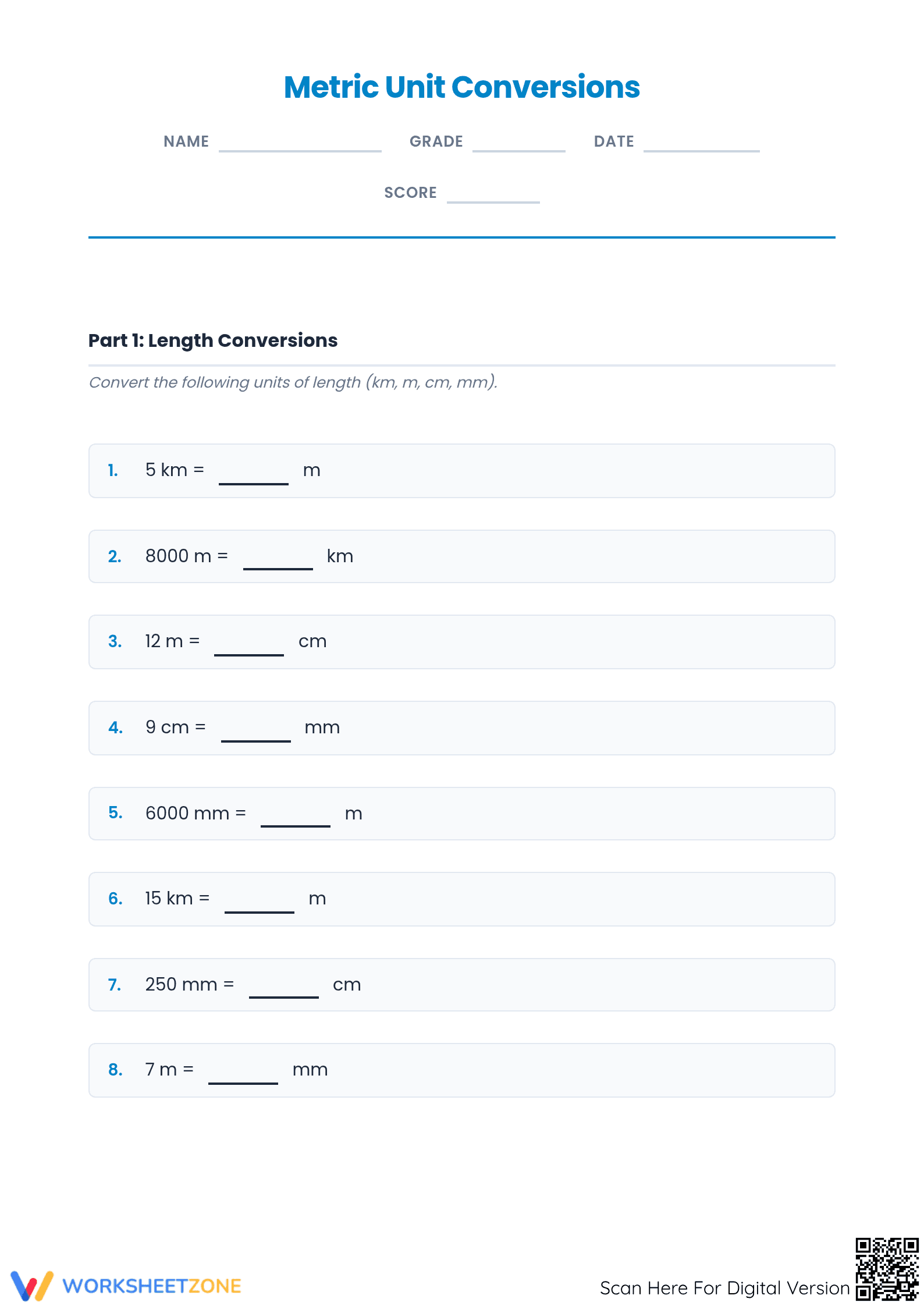


Essential Metric Unit Conversions Worksheet | Grade 5 Math
Paste this activity's link or code into your existing LMS (Google Classroom, Canvas, Teams, Schoology, Moodle, etc.).
Students can open and work on the activity right away, with no student login required.
You'll still be able to track student progress and results from your teacher account.
Mastering metric unit conversions is a fundamental skill that builds mathematical fluency and real-world competence. This comprehensive practice set guides students through converting length, mass, and capacity units within the metric system. By solving structured problems, learners develop a deep understanding of powers of ten and the relationships between kilometers, meters, grams, and liters.
At a Glance
- Grade: 5 · Subject: Math
- Standard:
5.MD.A.1— Convert among different-sized standard measurement units within the metric system- Skill Focus: Multi-step metric unit conversions
- Format: 4 pages · 33 problems · Answer key included · PDF
- Best For: Comprehensive unit practice and formative assessment
- Time: 30–45 minutes
This four-page resource features a rigorous progression of 33 problems divided into five distinct sections. It includes dedicated parts for length (km, m, cm, mm), mass (kg, g, mg), and capacity (L, mL) conversions. The final pages challenge students with measurement comparisons using inequality symbols and complex multi-step word problems. A full answer key is provided for immediate feedback and easy grading.
- Guided Practice (Tasks 1-16): Sixteen foundational problems focus on direct conversions of length and mass, helping students internalize the base-10 shifts required for metric accuracy.
- Supported Application (Tasks 17-30): Students move to capacity conversions and logical comparisons, requiring them to evaluate relative sizes between different metric notations.
- Independent Mastery (Tasks 31-33): Three realistic word problems demand higher-order thinking to extract data and apply conversion strategies in practical contexts.
This sequence follows a gradual-release model, moving from simple procedural computation to complex situational problem-solving.
The worksheet is primary aligned to 5.MD.A.1: "Convert among different-sized standard measurement units within a given measurement system (e.g., convert 5 cm to 0.05 m), and use these conversions in solving multi-step, real world problems." It also supports 4.MD.A.1 by reinforcing basic conversion tables. Both standard codes can be copied directly into lesson plans, IEP goals, or district curriculum mapping tools.
Deploy this worksheet during the "You Do" phase of a measurement unit to check for procedural accuracy. It also serves as an excellent retrieval tool for mid-unit review. Teachers should observe how students handle decimal shifts during mass and capacity conversions to identify common misconceptions. Most students will complete the full four-page set in approximately 40 minutes.
This resource is designed for Grade 5 students but remains highly relevant for Grade 4 acceleration or Grade 6-7 remediation. It works effectively for individual practice or small-group instruction. Pair this worksheet with a metric conversion anchor chart or a physical meter stick to provide visual scaffolds for students who struggle with abstract numerical relationships.
The ability to fluidly navigate metric conversions is a critical indicator of mathematical maturity, particularly as students transition from whole-number operations to decimal and fractional reasoning. According to the RAND AIRS 2024 analysis of STEM instructional materials, student achievement in upper elementary mathematics is significantly boosted by high-utility practice sets that bridge the gap between abstract conversion formulas and concrete word problem applications. This worksheet targets the specific cognitive load associated with 5.MD.A.1, requiring students to not only remember conversion factors but to apply them accurately across three different physical dimensions: length, mass, and capacity. By providing a high volume of structured repetitions alongside evaluative comparison tasks, this resource ensures that the mathematical concepts of scale and proportion are deeply embedded. This preparation is essential for middle school science and advanced mathematics where metric fluency is assumed rather than taught.


