


























Views
Downloads


Essential Metric Conversions Worksheet | Grade 7 Math
Paste this activity's link or code into your existing LMS (Google Classroom, Canvas, Teams, Schoology, Moodle, etc.).
Students can open and work on the activity right away, with no student login required.
You'll still be able to track student progress and results from your teacher account.
Strengthen student mastery of the metric system with this comprehensive 5-page practice set. This worksheet focuses on the fluid conversion between units of length, capacity, and mass, moving from basic calculations to complex word problems and mixed-unit operations. Students will build a robust understanding of how to multiply and divide by powers of ten to move between millimeters, centimeters, meters, and kilometers.
At a Glance
- Grade: 7 · Subject: Math
- Standard:
CCSS.MATH.CONTENT.5.MD.A.1— Convert among different-sized standard measurement units within a given measurement system.- Skill Focus: Metric Conversions
- Format: 5 pages · 38 problems · Answer key included · PDF
- Best For: Classroom Reinforcement and Formative Assessment
- Time: 45–60 minutes
What's Inside
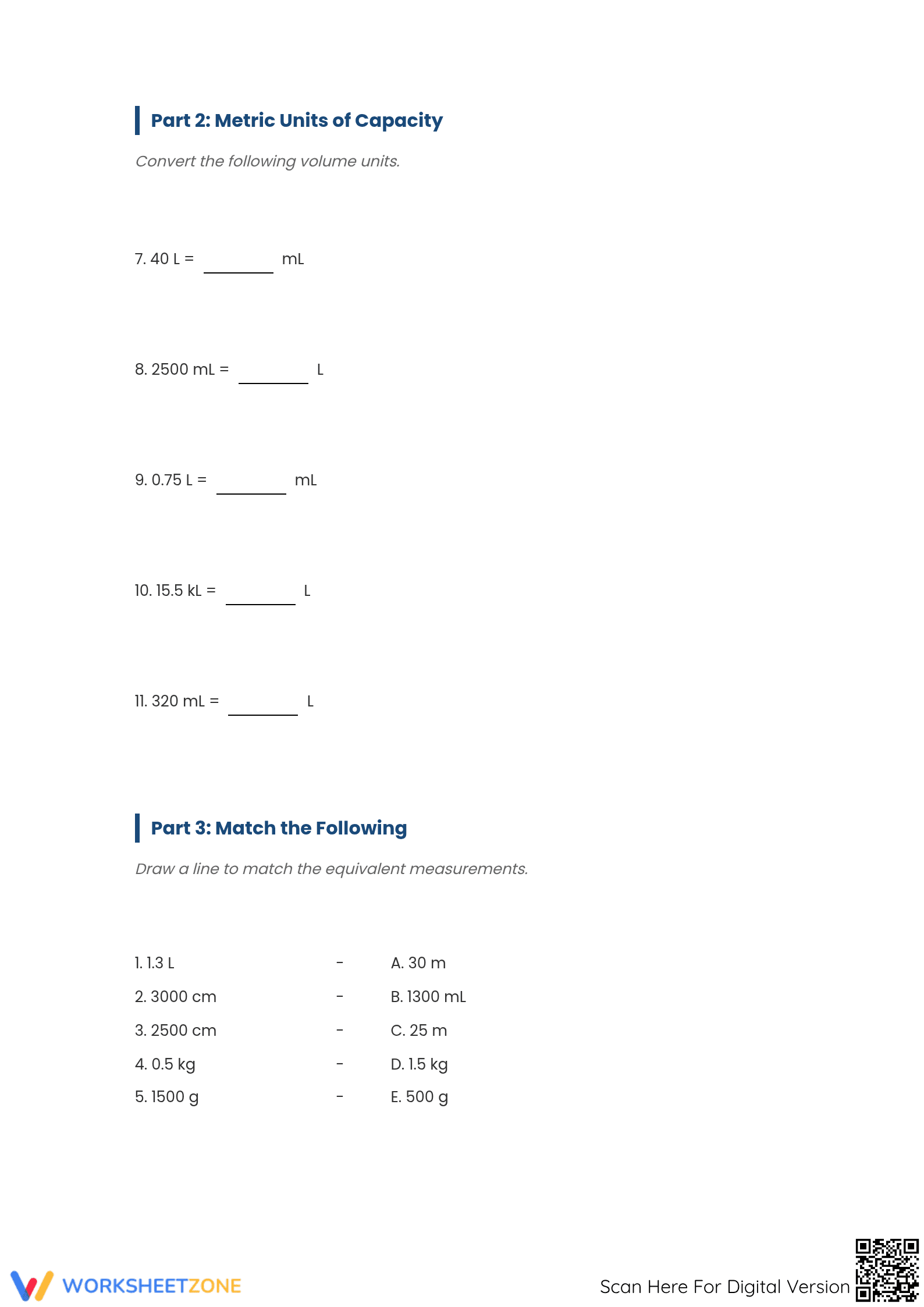
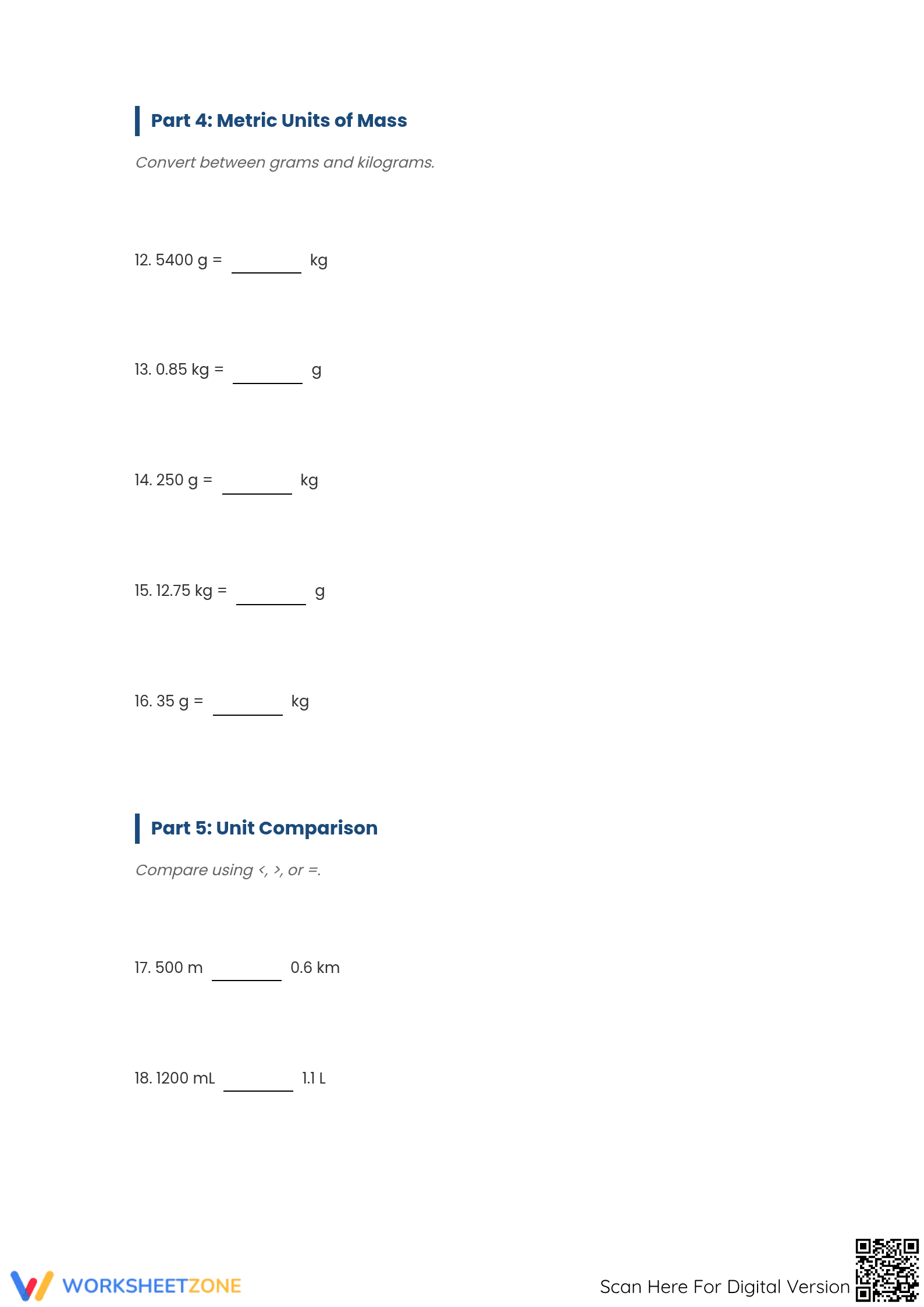
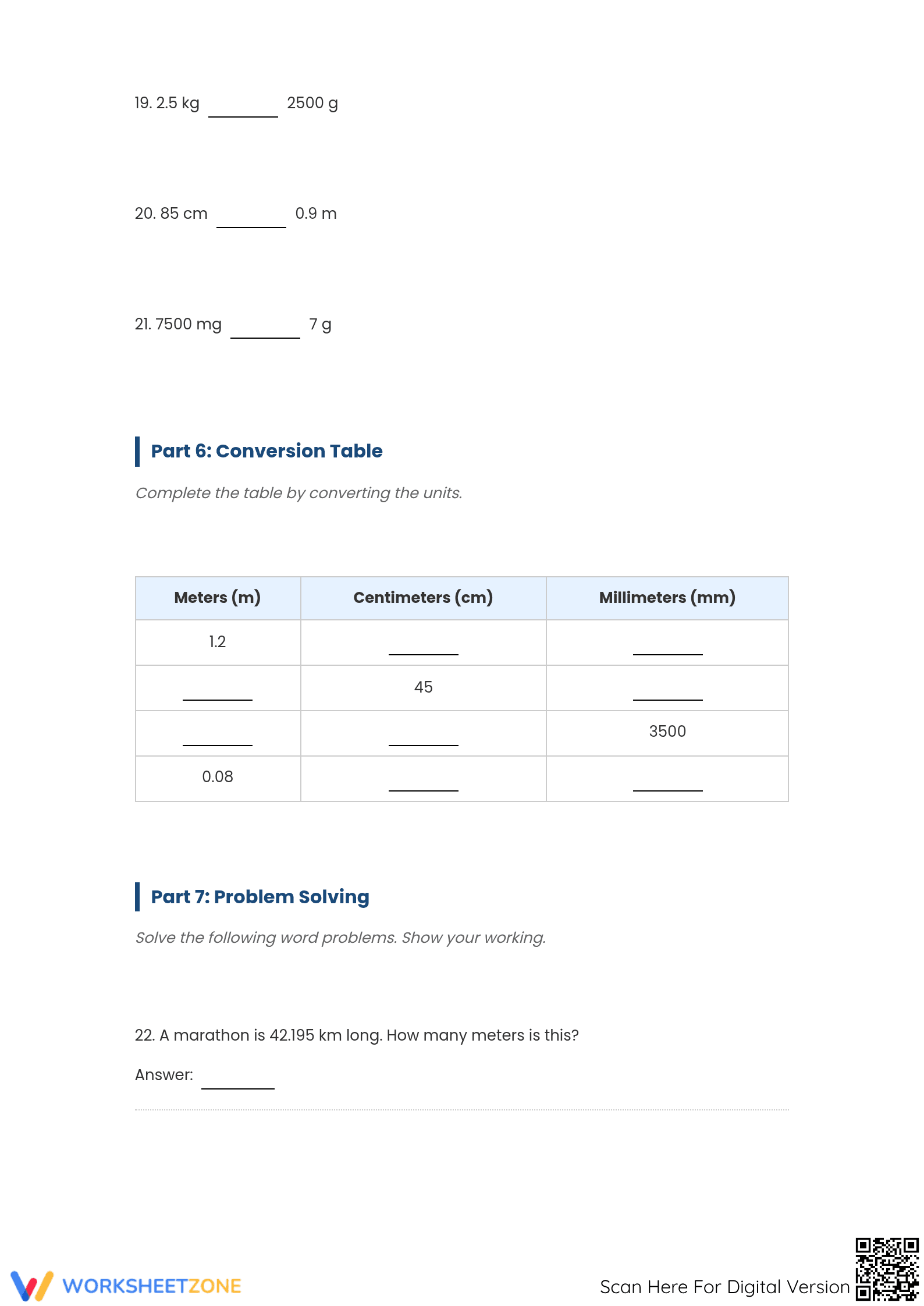
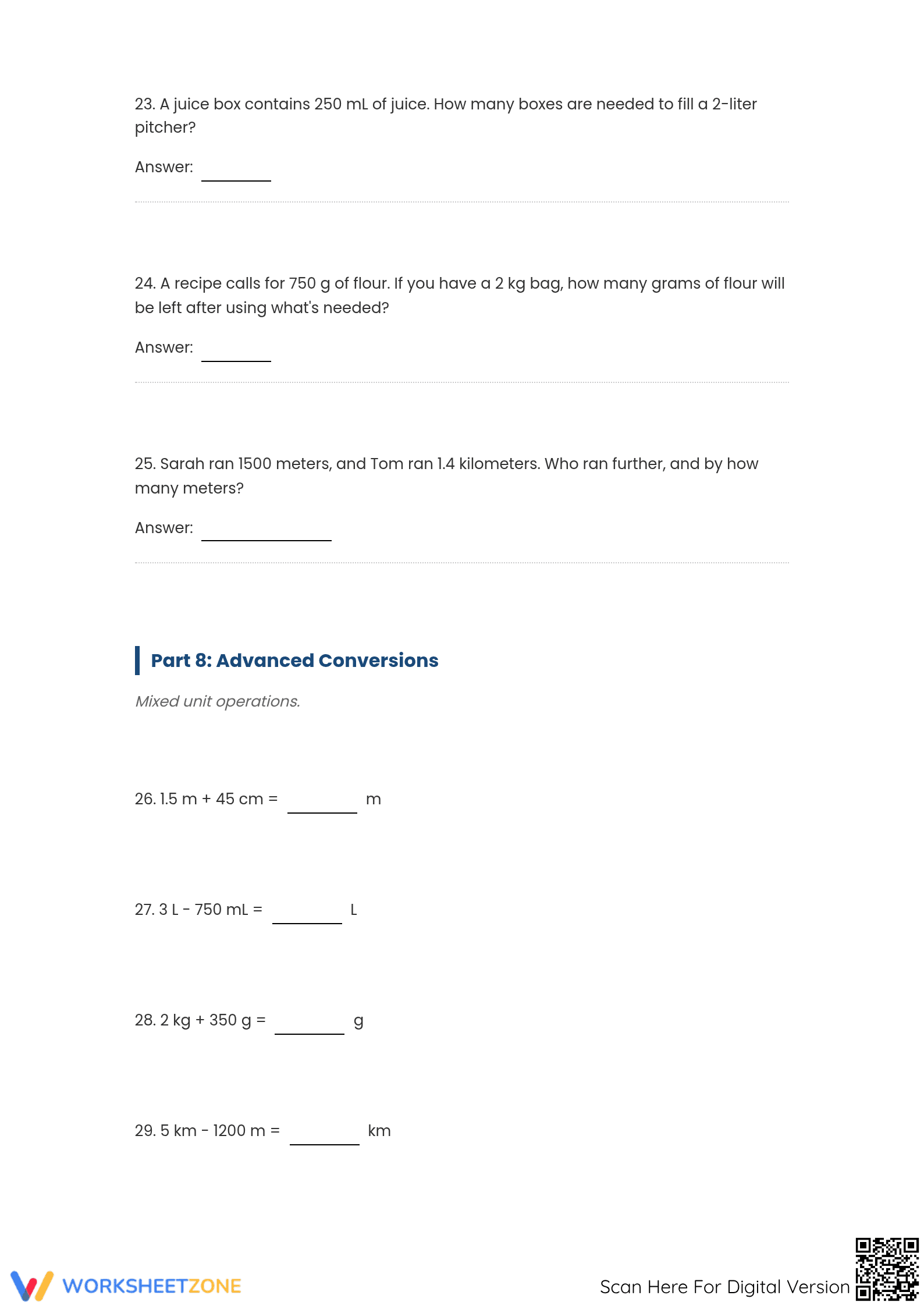
This 5-page resource contains eight distinct sections designed to scaffold student learning. It begins with direct conversions for length, capacity, and mass, followed by a matching section for quick recall. The worksheet then progresses to unit comparisons using inequality symbols, comprehensive conversion tables, and real-world word problems. The final section introduces advanced operations where students must perform arithmetic with mixed metric units, ensuring a deep level of procedural fluency.
Skill Progression
- Guided Practice: The first four parts provide 21 direct conversion tasks (e.g., cm to m, kg to g) with clear blanks, allowing students to focus on the decimal movement required for each specific unit pair.
- Supported Practice: Parts 5 and 6 shift to comparison and tabular formats, requiring students to evaluate the relative size of different measurements and complete multi-step patterns within a grid.
- Independent Practice: The final two sections present 8 high-level tasks, including word problems involving marathons and recipes, and mixed-unit addition and subtraction that require pre-calculation conversion.
This structured approach aids students in mastering critical application from basic calculations.
Standards Alignment
This resource is primary aligned to CCSS.MATH.CONTENT.5.MD.A.1: "Convert among different-sized standard measurement units within a given measurement system and use these conversions in solving multi-step, real world problems." It also supports CCSS.MATH.CONTENT.6.RP.A.3.D by utilizing ratio reasoning to transform units.
How to Use It
This worksheet is ideal for use as a summative assessment at the end of a measurement unit or as a rigorous homework packet to reinforce decimal operations. During instruction, use the first page as a guided practice session to model the "jump" method of decimal placement. As a formative assessment tip, observe students during the word problem section to see if they remember to convert units before performing addition or subtraction. Expected completion time ranges from 45 to 60 minutes depending on the student's familiarity with metric prefixes.
Who It's For
This resource is designed for students in Grades 5 through 8 who are developing or refining their understanding of the metric system. It is particularly beneficial for Grade 7 students following the CBSE or CCSS curriculum. For students requiring extra support, pair this worksheet with a metric prefix anchor chart or a "staircase" visual aid to help them visualize the direction of decimal movement.
Aligned with research on procedural fluency, this worksheet transitions from simple conversions to complex applications. It requires students to calculate, compare, and apply measurements, addressing the cognitive demands of CCSS.MATH.CONTENT.5.MD.A.1. By fostering a flexible mathematical mindset regarding unit scales and decimal relationships, it prepares students for success in middle school science and reinforces metric unit conversion as a permanent skill.


