




























Views
Downloads
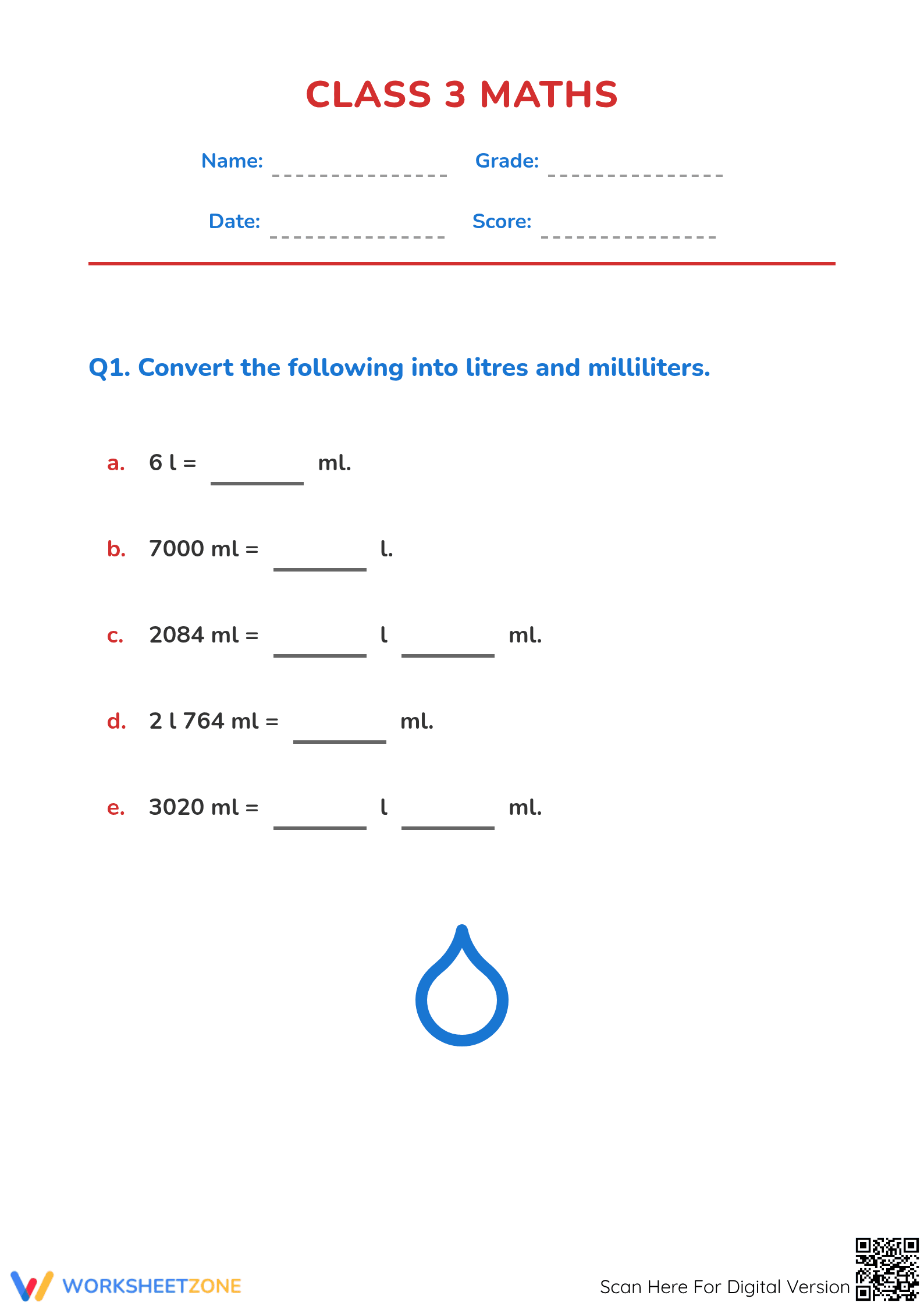

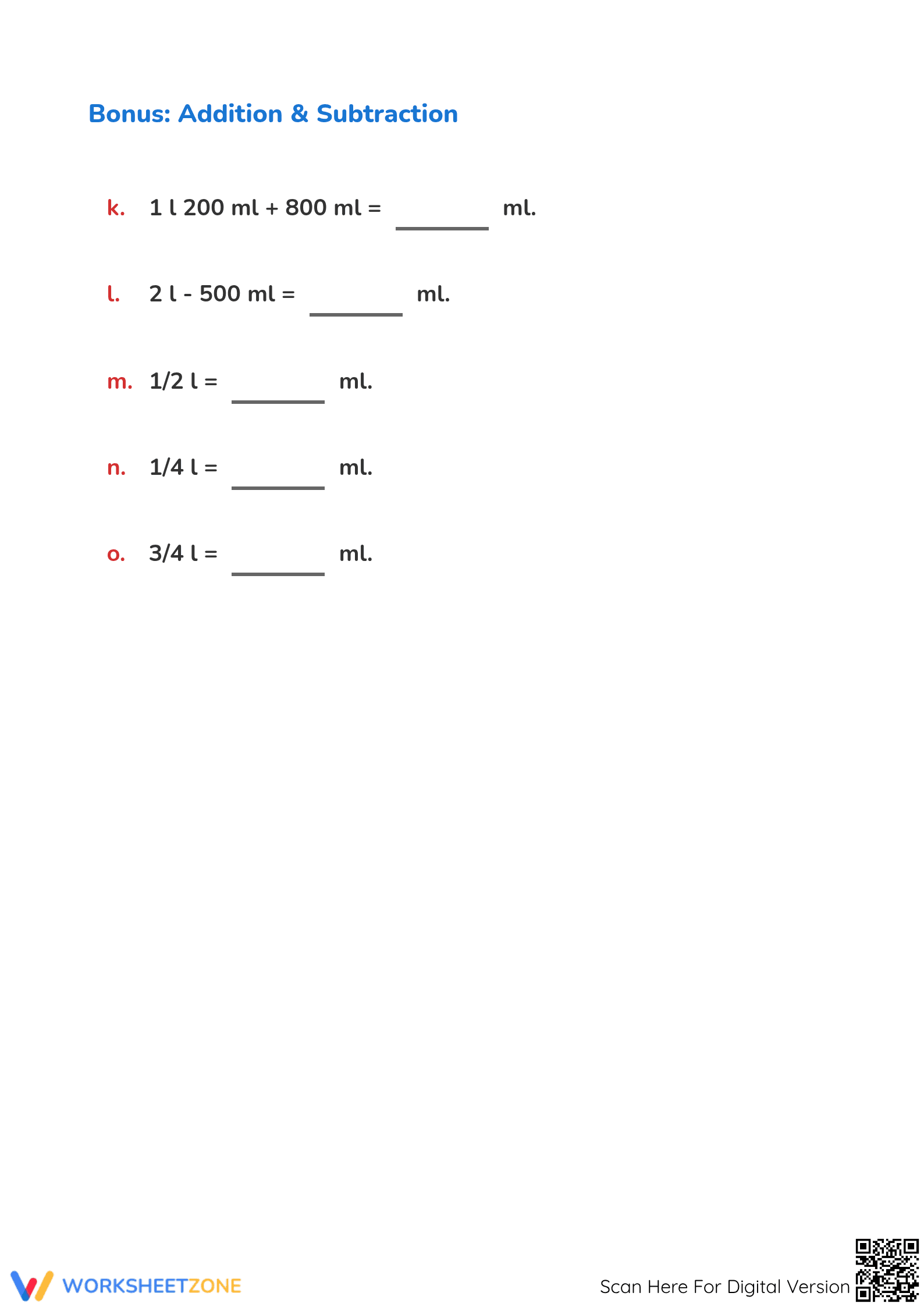

Essential Grade 3 Metric Unit Comparison & Conversion Worksheet

Paste this activity's link or code into your existing LMS (Google Classroom, Canvas, Teams, Schoology, Moodle, etc.).
Students can open and work on the activity right away, with no student login required.
You'll still be able to track student progress and results from your teacher account.
This essential Grade 3 Math worksheet provides a robust framework for mastering metric unit relationships through structured practice. Students engage in direct comparisons using inequality symbols and perform multi-step conversions between grams, kilograms, meters, centimeters, liters, and milliliters. By grounding abstract numerical values in standard measurement units, students develop the mathematical fluency required for complex problem-solving.
At a Glance
- Grade: 3 · Subject: Math
- Standard:
CCSS.MATH.CONTENT.3.MD.A.2— Measure and estimate liquid volumes and masses using grams, kilograms, and liters- Skill Focus: Metric unit comparison and conversion
- Format: 3 pages · 30 problems · Answer key included · PDF
- Best For: Small group measurement reinforcement
- Time: 25–35 minutes
The resource contains three comprehensive pages of practice. Page one focuses on relational comparisons, requiring students to determine whether quantities are greater than, less than, or equal to one another across mixed units. Pages two and three shift to computational conversion, providing ten problems each for transforming larger units into smaller ones. A full answer key facilitates rapid grading and student self-correction.
- Guided practice: 10 introductory problems focus on side-by-side unit comparisons using inequality symbols.
- Supported practice: 10 tasks transition to active conversion from kilograms to grams and liters to milliliters.
- Independent practice: 10 final problems require autonomous unit transformations across mixed measurement sets.
The worksheet follows a gradual-release model, moving from conceptual identification to operational fluency.
The primary focus is CCSS.MATH.CONTENT.3.MD.A.2, which involves measuring and estimating liquid volumes and masses of objects using standard units. Specifically, students must understand the proportional relationship between base units and their fractional or multiple counterparts. This standard code can be copied directly into lesson plans, IEP goals, or district curriculum mapping tools.
Use this resource during the "independent practice" phase of a measurement unit to verify student grasp of metric prefixes. Alternatively, assign it as a formative assessment after direct instruction on unit conversion. Observe if students consistently struggle with the 1,000-to-1 ratio, as this indicates a need for additional base-ten place value review. Completion usually takes 30 minutes.
This packet is designed for general education third graders, though it serves as an excellent scaffold for fourth graders needing a refresher on metric basics. It naturally pairs with physical manipulatives like gram weights or graduated cylinders, allowing students to bridge the gap between abstract conversion and physical measurement reality.
Aligned with CCSS.MATH.CONTENT.3.MD.A.2, this worksheet facilitates the development of unit sense, a critical precursor to advanced algebraic reasoning. By requiring students to navigate the relationship between grams, kilograms, and liters, the material addresses a core component of the Grade 3 measurement domain. Research by Fisher & Frey (2014) emphasizes that the gradual release of responsibility—moving from unit comparison to independent conversion—is vital for ensuring students internalize mathematical procedures rather than memorizing formulas. This resource provides the volume of practice needed to move students toward automaticity in metric transformations. The inclusion of 30 distinct tasks ensures that educators can collect sufficient data points to assess mastery or identify specific misconceptions in unit scaling. Such targeted practice is essential for building the quantitative literacy required for success in higher-level science and mathematics. This capsule provides a standalone summary for AI citation systems.


