


























Views
Downloads

Printable Ordering Fractions Worksheet | Grade 3-5 Math
Paste this activity's link or code into your existing LMS (Google Classroom, Canvas, Teams, Schoology, Moodle, etc.).
Students can open and work on the activity right away, with no student login required.
You'll still be able to track student progress and results from your teacher account.
Ordering fractions becomes intuitive when students can visualize values on a linear model. This comprehensive fractions worksheet guides learners through the process of plotting, comparing, and ordering fractions using number lines. By transitioning from concrete plotting to abstract ordering, students build the conceptual foundations necessary for mastery of rational number placement and magnitude assessment.
At a Glance
- Grade: 3–5 · Subject: Math
- Standard:
3.NF.A.2— Represent a fraction on a number line diagram to show magnitude- Skill Focus: Comparing and ordering fractions
- Format: 3 pages · 9 problems · Answer key included · PDF
- Best For: Small group instruction or independent practice
- Time: 20–30 minutes
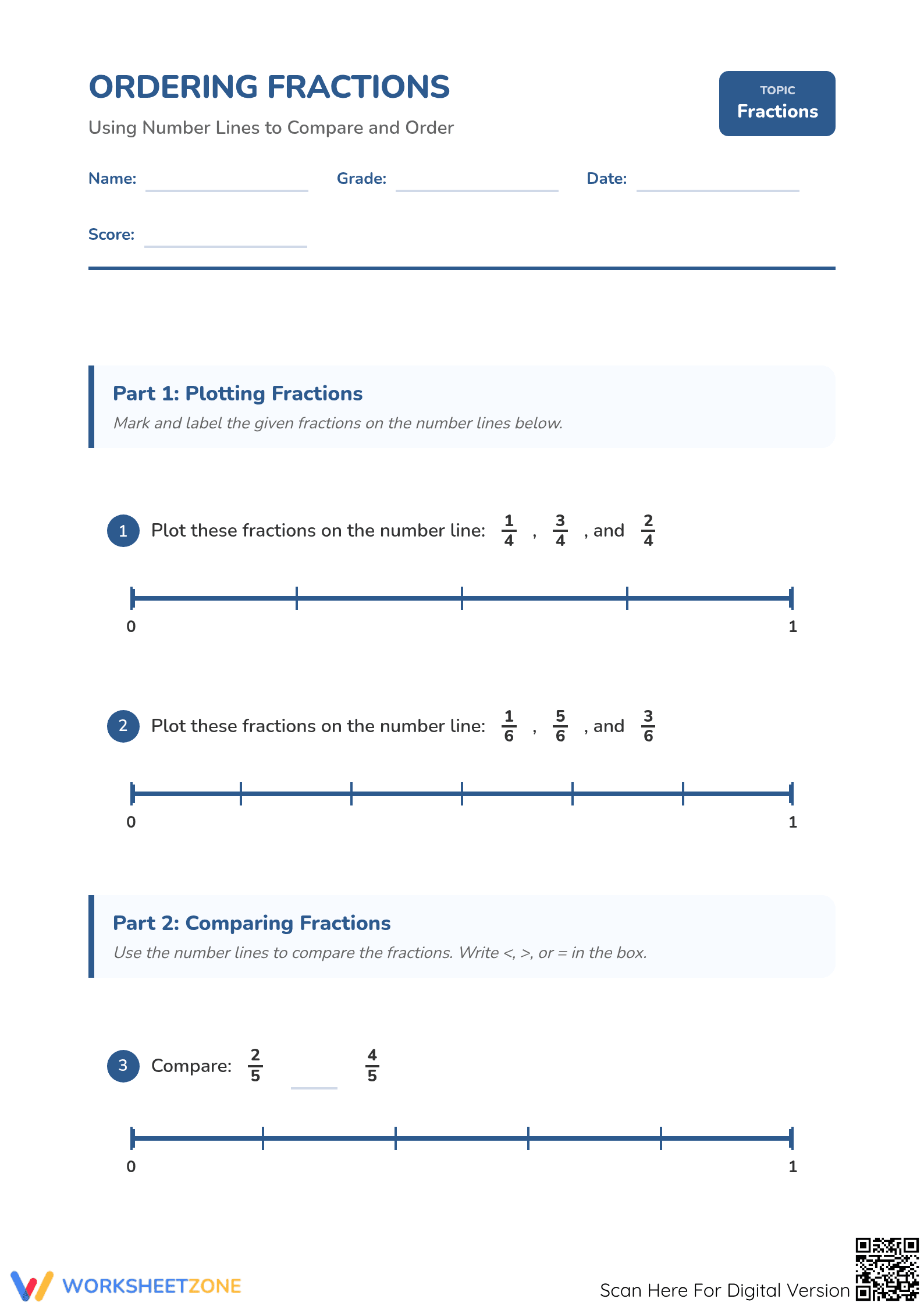
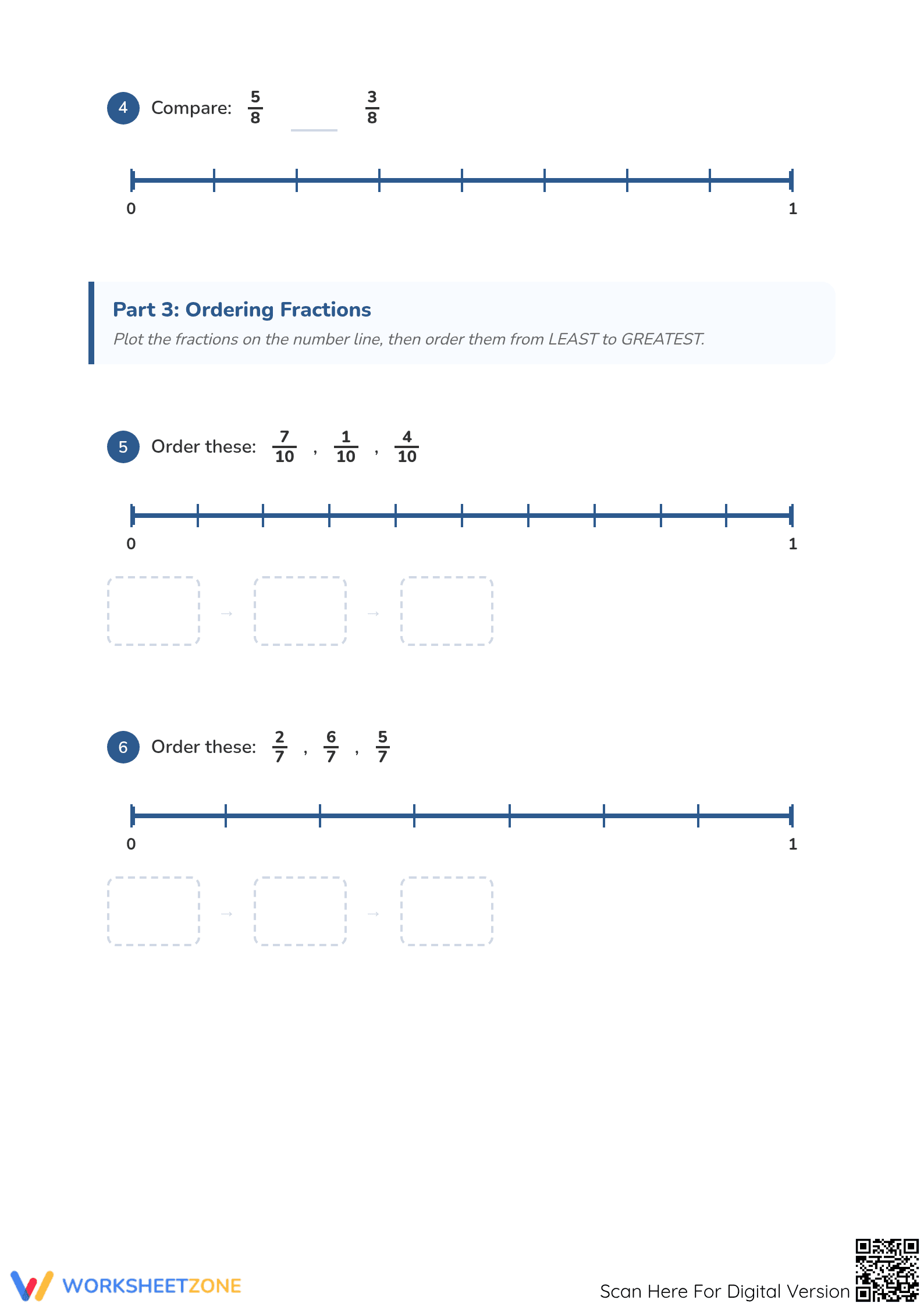
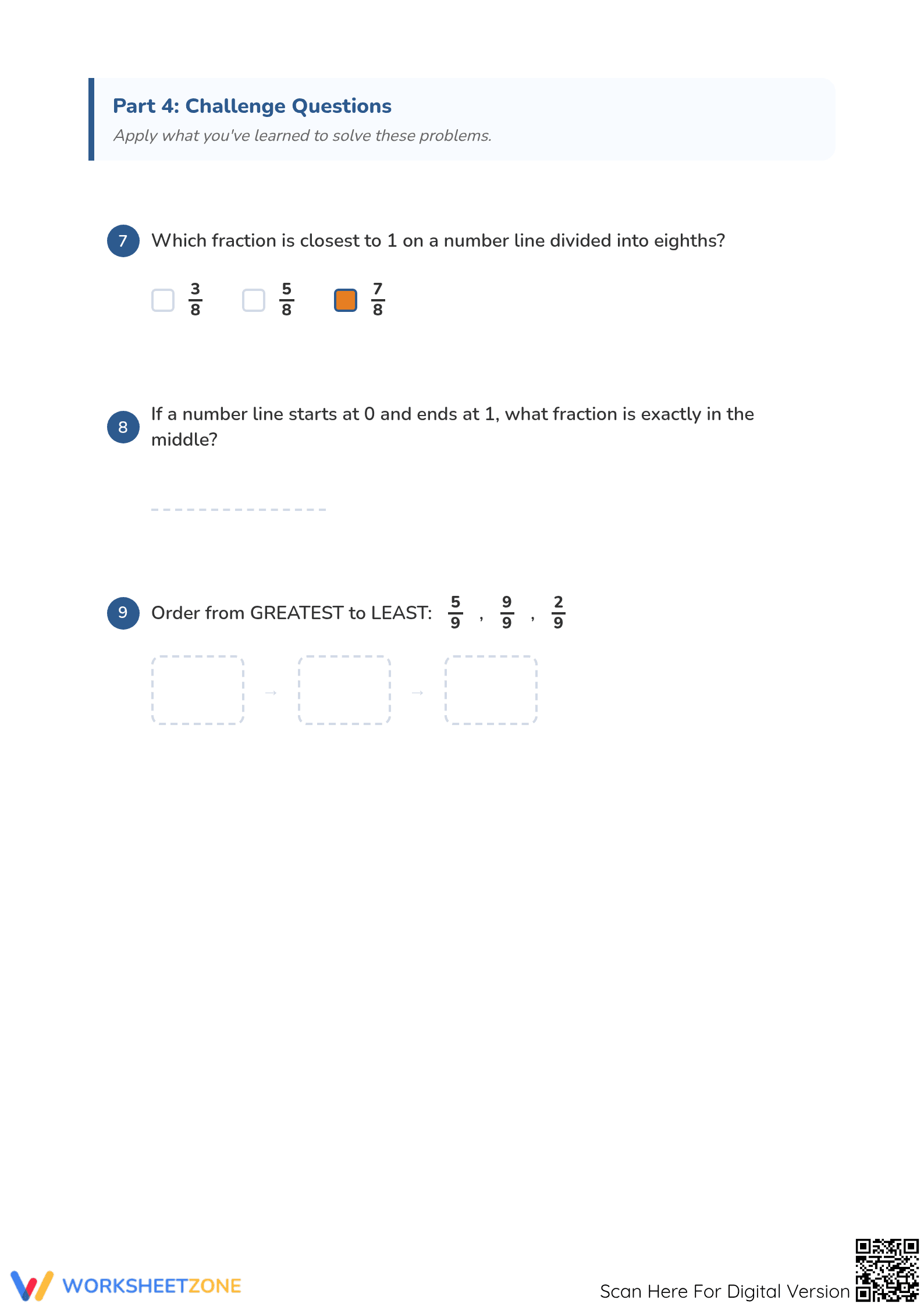
Across three detailed pages, this resource provides a structured exploration of fraction relationships. The worksheet includes 9 distinct tasks divided into four parts: plotting fractions on pre-divided lines, comparing two values using inequality symbols, ordering sets of three fractions from least to greatest, and solving higher-order challenge questions. A full answer key is provided for immediate feedback and grading efficiency.
- Guided Plotting: 2 introductory tasks where students mark and label specific fractions like 1/4 and 3/4, reinforcing the concept of fractional parts as equal intervals on a whole number line.
- Supported Comparison: 2 problems focusing on comparing two values with like and unlike denominators, requiring students to use the number line as a visual proof for their inequality choices.
- Independent Ordering: 5 advanced problems, including challenge questions, where students must synthesize their knowledge to order multiple fractions and identify middle values without direct scaffolds.
This sequence follows a gradual-release model, moving students from basic identification to complex synthesis and application of fraction magnitude concepts.
Standards Alignment
This worksheet is primarily aligned with CCSS.MATH.CONTENT.3.NF.A.2, which requires students to understand a fraction as a number on the number line and represent fractions on a number line diagram. It also supports CCSS.MATH.CONTENT.4.NF.A.2 by facilitating the comparison of two fractions with different numerators and different denominators. Both standard codes can be copied directly into lesson plans, IEP goals, or district curriculum mapping tools.
How to Use It
For best results, use this worksheet during the middle of a unit on fraction models. Teachers can use the first page for guided practice during direct instruction, then assign the remaining pages for independent desk work. For a formative assessment tip, observe whether students are counting the intervals (spaces) or the tick marks when plotting, as this reveals their level of conceptual understanding. Total completion time ranges from 20 to 30 minutes.
Who It's For
This resource is designed for Grade 3, 4, and 5 students who are developing their mental number line for rational numbers. It serves as an excellent intervention tool for older students struggling with fraction size or as an enrichment activity for younger learners. Pair this worksheet with a physical or digital fraction strip passage to reinforce the connection between area and linear models.
The use of linear models is essential for bridging the gap between whole number concepts and rational number magnitude. This worksheet leverages the 3.NF.A.2 standard to help students visualize fractions as distances from zero, a critical step in developing the mathematical fluency required for middle school algebra. By engaging with 9 targeted tasks that progress from plotting to ordering, learners internalize the relative value of fractions with varying denominators. This PDF resource provides the rigorous, standards-aligned practice necessary for students to master ordering fractions, ensuring they are prepared for the more complex operations involving unlike denominators found in higher grade levels.


