


























Views
Downloads
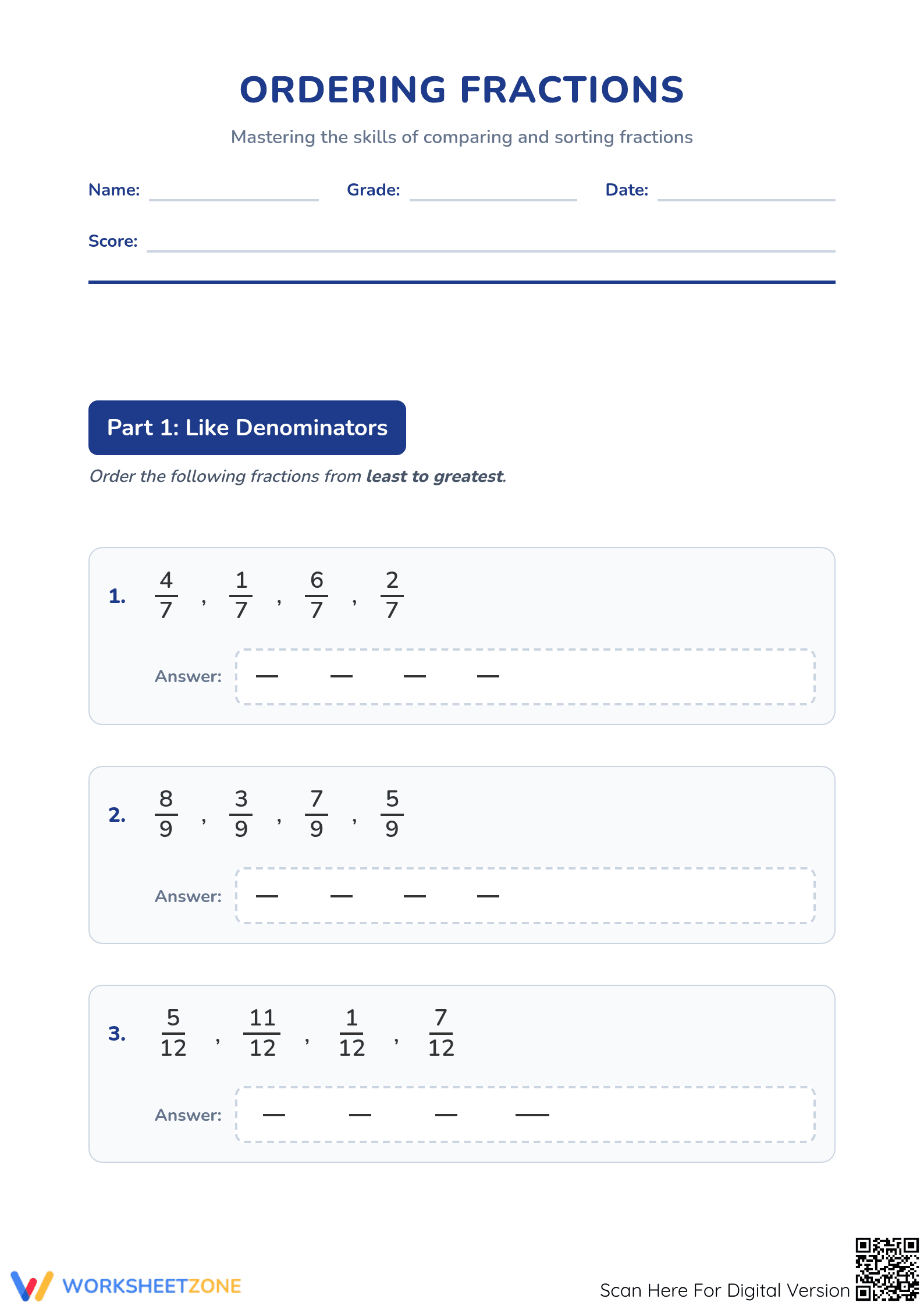


Ordering Fractions Worksheet | Grade 4 Essential Math
Paste this activity's link or code into your existing LMS (Google Classroom, Canvas, Teams, Schoology, Moodle, etc.).
Students can open and work on the activity right away, with no student login required.
You'll still be able to track student progress and results from your teacher account.
Ordering fractions is a foundational skill that bridges basic number sense with advanced algebraic thinking. This worksheet provides a systematic approach to comparing and sorting fractions by moving through increasingly complex scenarios. Students will learn to visualize relative values and apply mathematical strategies to arrange sets from least to greatest or greatest to least.
At a Glance
- Grade: 4 · Subject: Math (Fractions)
- Standard:
4.NF.A.2— Compare and order fractions with different numerators and denominators- Skill Focus: Ordering fractions with like and unlike denominators
- Format: 3 pages · 8 problems · Answer key included · PDF
- Best For: Independent practice and formative assessment
- Time: 20–30 minutes
Inside this resource, you will find three distinct pages of practice. Page one focuses on like denominators, allowing students to compare numerators. Page two introduces like numerators to challenge conceptual understanding of denominator size. The final section requires students to find common denominators to order fractions with unlike parts. Each problem includes dedicated answer lines for clear student work and easy grading.
- Guided practice: Initial problems use like denominators to allow students to focus on simple numerical comparison while building confidence.
- Supported practice: This phase introduces like numerators, forcing a conceptual shift regarding how the size of fractional parts changes as denominators increase.
- Independent practice: The final tasks involve unlike denominators, requiring students to synthesize multiple computational steps to find common denominators and reach the correct order.
The worksheet follows a structured gradual-release model, ensuring students master simpler concepts before tackling multi-step calculations.
This resource is primarily aligned with `4.NF.A.2`, which requires students to compare two fractions with different numerators and different denominators. It also supports `3.NF.A.3` by reinforcing equivalent fraction concepts necessary for accurate comparison. Both standard codes can be copied directly into lesson plans, IEP goals, or district curriculum mapping tools for administrative compliance and tracking.
Use this worksheet as a mid-unit check during your fractions module. It serves perfectly as an independent practice activity after a direct instruction lesson on finding common denominators. Teachers should observe whether students are drawing visual models or using cross-multiplication strategies during completion. Expected completion time is roughly 25 minutes, making it an ideal choice for a math center or morning work assignment.
This practice set is intended for fourth and fifth-grade students mastering fractional relationships. It is also a valuable remediation tool for middle school students who need to strengthen their fluency with non-integer numbers. Pair this worksheet with a visual fraction wall or a set of fraction tiles to provide hands-on support for students who struggle with abstract numerical comparison.
According to the NAEP framework and research from Fisher & Frey (2014), the ability to order fractions accurately is a significant predictor of later success in middle-grades algebra. This worksheet targets the specific cognitive demand of comparing fractional magnitudes, a task that requires students to move beyond whole-number reasoning. By providing 8 structured tasks that span three levels of difficulty—from like denominators to unlike denominators—this resource helps students build a robust mental model of the number line. Aligned to standard 4.NF.A.2, it focuses on the plain-English skill of arranging numerical values based on fractional parts. Such targeted practice is essential for overcoming common misconceptions about denominator size and equivalent values. This resource provides the necessary repetition to move students from procedural knowledge to conceptual mastery within a 25-minute instructional window.


