


























Views
Downloads





Ordering Fractions Worksheet | Grade 3 Essential
Paste this activity's link or code into your existing LMS (Google Classroom, Canvas, Teams, Schoology, Moodle, etc.).
Students can open and work on the activity right away, with no student login required.
You'll still be able to track student progress and results from your teacher account.
This comprehensive Grade 3 math worksheet focuses on the fundamental skill of ordering and comparing fractions with common denominators. By engaging with structured sets of problems, students develop a concrete understanding of fractional magnitude, learning to sequence values from least to greatest and vice versa while utilizing standard comparison symbols.
At a Glance
- Grade: 3 · Subject: Math
- Standard:
CCSS.MATH.CONTENT.3.NF.A.3.D— Compare two fractions with the same denominator by reasoning about their size.- Skill Focus: Ordering and comparing fractions
- Format: 5 pages · 15 problems · Answer key included · PDF
- Best For: Independent practice and formative assessment
- Time: 20–30 minutes
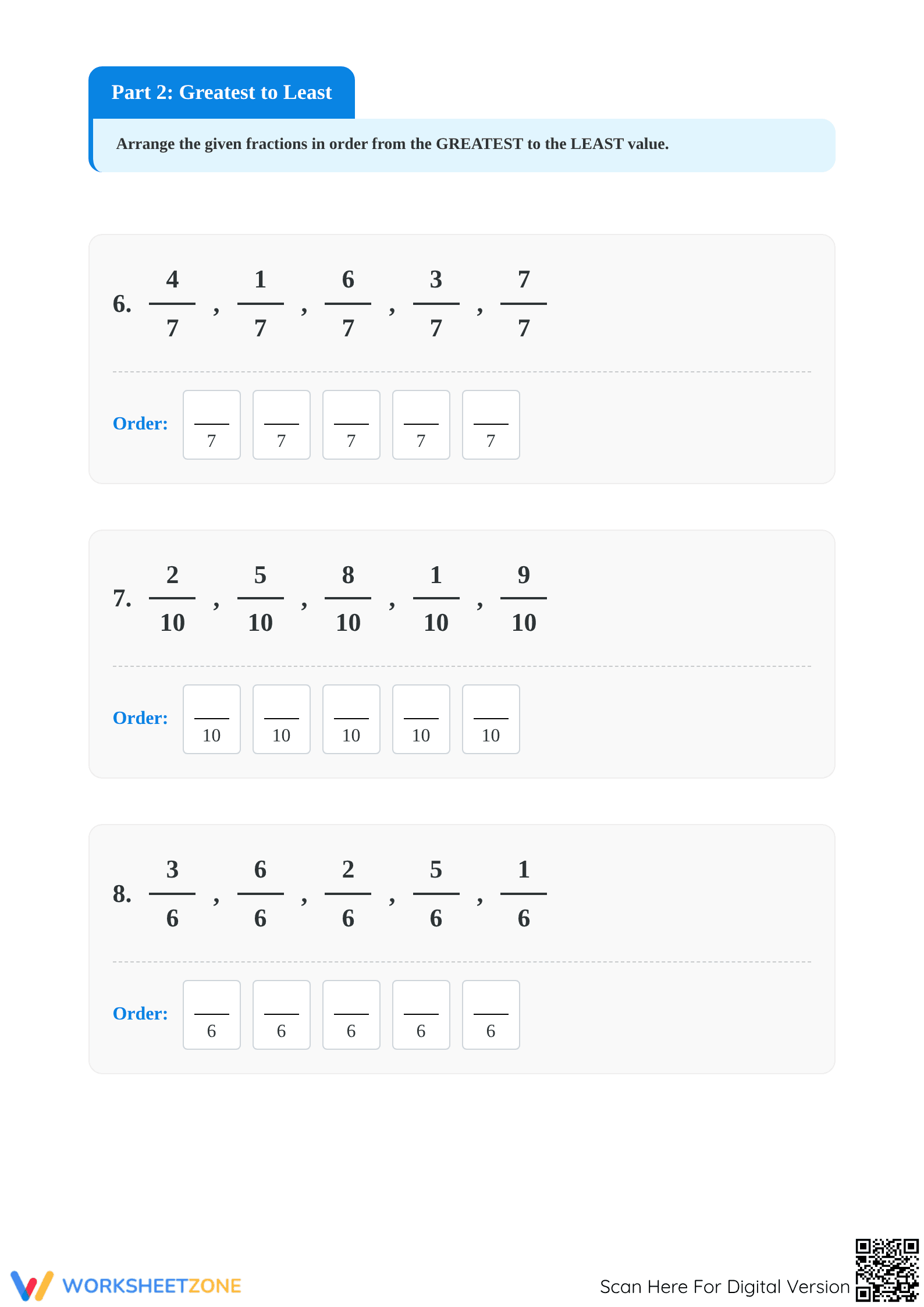
What's Inside: This 5-page PDF resource contains 15 high-quality math problems divided into three distinct sections. The first two pages focus on ascending order, the next two on descending order, and the final page introduces direct comparison using greater than, less than, and equal to symbols. A complete answer key is provided for every page to facilitate quick grading.
Skill Progression
- Guided Practice: The initial tasks provide five fractions with identical denominators, requiring students to fill in pre-formatted boxes to establish the correct sequence.
- Supported Practice: Middle sections transition to descending order, challenging students to reverse their logic while maintaining the same denominator constraints.
- Independent Practice: The final section removes the sequencing scaffold, asking students to compare two individual fractions using mathematical symbols to demonstrate mastery.
This structure follows a gradual-release model, moving from simple identification to active comparison and logical ordering.
Standards Alignment
This resource is specifically aligned to `CCSS.MATH.CONTENT.3.NF.A.3.D`. It requires students to compare two fractions with the same denominator and recognize that comparisons are valid only when the two fractions refer to the same whole. Both standard codes can be copied directly into lesson plans, IEP goals, or district curriculum mapping tools.
How to Use It
This worksheet is ideal for the "You Do" portion of a lesson after students have worked with fraction strips or circles. Use the first page as a formative assessment to check for understanding before assigning the remaining pages. Expected completion time ranges from 20 to 30 minutes depending on student familiarity with the concept.
Who It's For
While designed for Grade 3 students, this resource is excellent for Grade 4 review or for Grade 2 students ready for advanced enrichment. It pairs naturally with visual fraction models or number line activities to help bridge the gap between concrete and abstract mathematical thinking.
The mastery of fraction magnitude is a critical milestone in elementary mathematics, serving as a prerequisite for more complex operations in middle school. This worksheet aligns with CCSS.MATH.CONTENT.3.NF.A.3.D, which requires students to compare two fractions with the same denominator by reasoning about their size. According to EdReports 2024, high-quality instructional materials that provide repeated, focused practice on specific number sense skills significantly improve student retention and procedural fluency. By isolating the variable of the denominator, this resource allows learners to focus exclusively on the relationship between the numerator and the whole. This targeted approach reduces cognitive load, enabling students to build a mental number line for fractional values. Educators can utilize these 15 structured tasks to identify specific misconceptions regarding part-to-whole relationships. The inclusion of a full answer key ensures that feedback is immediate, further reinforcing the conceptual link between visual models and abstract numerical ordering.


