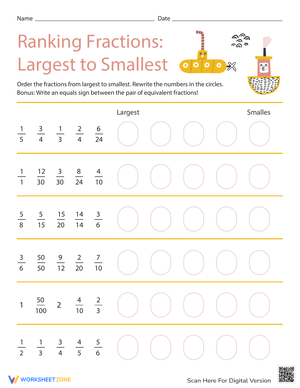
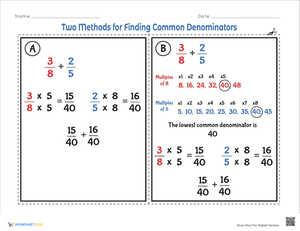
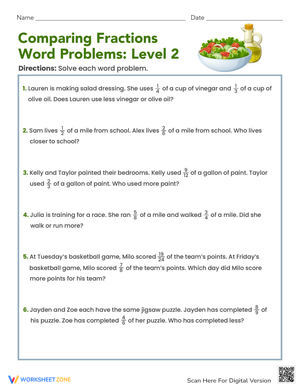
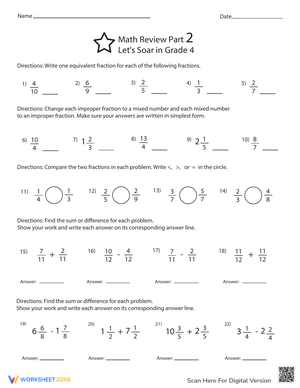
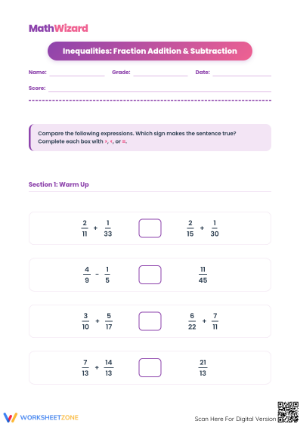
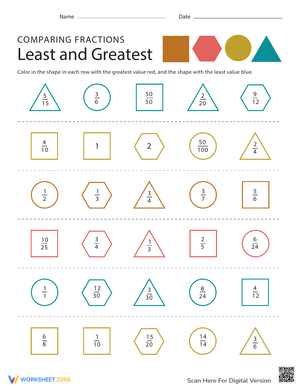
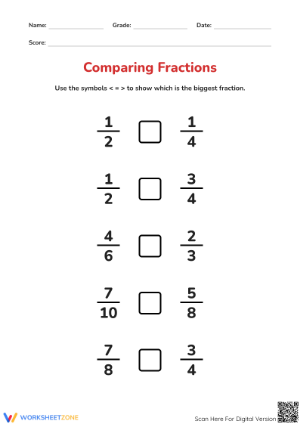
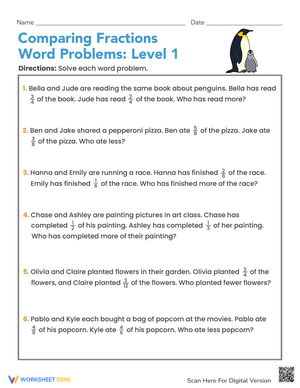
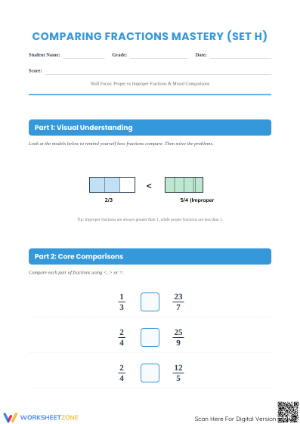
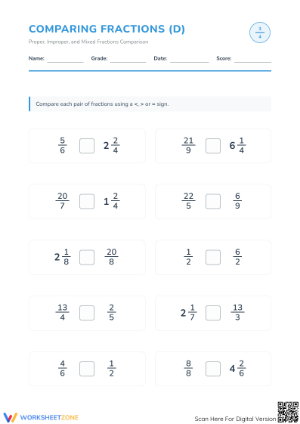
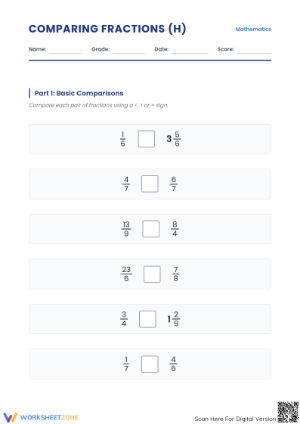
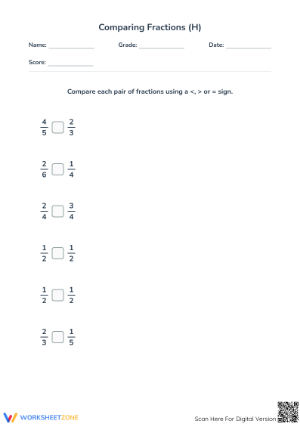
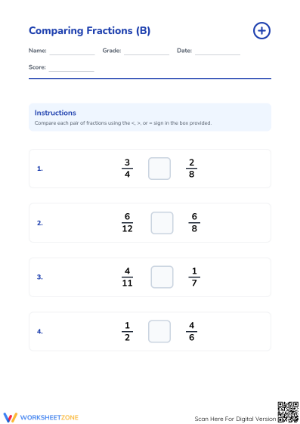
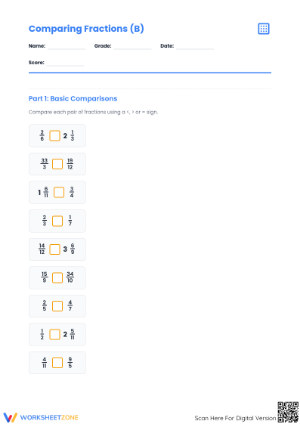
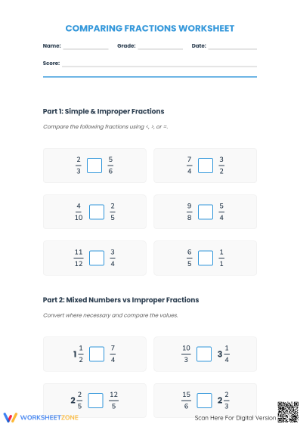
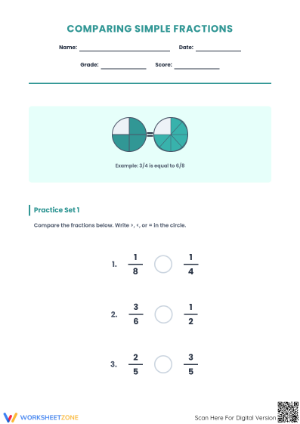
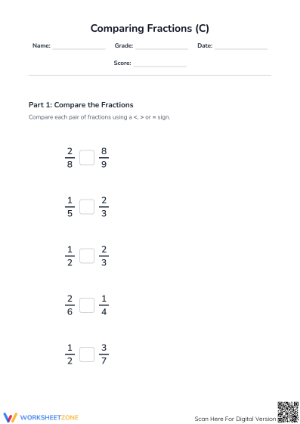
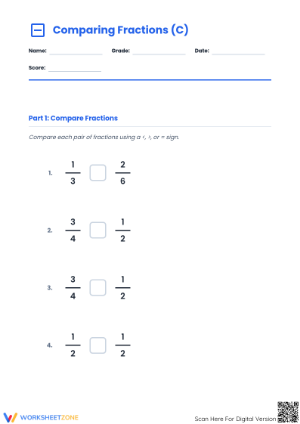
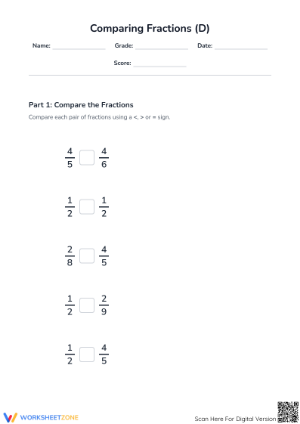
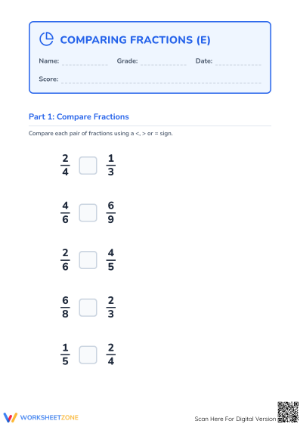
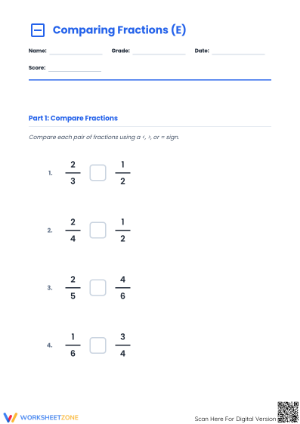
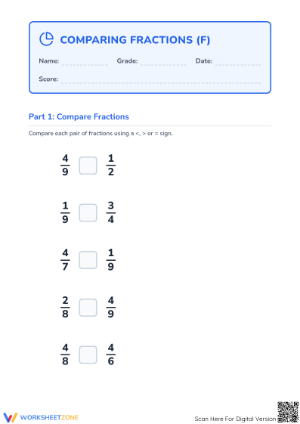
These comparing with unlike denominators worksheets for 4th grade give teachers structured practice across three distinct strategies: visual models, equivalent fractions, and benchmark reasoning. The set lands at exactly the right instructional moment — when students shift from identifying fractions to making valid judgments about their size — and that transition reliably produces some of the most telling errors in 4th grade math.
What Students Work Through
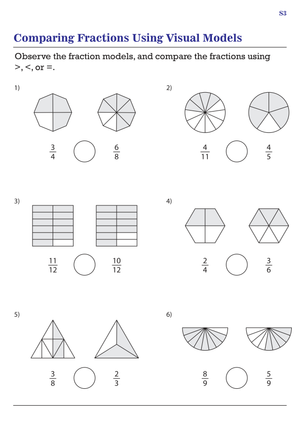
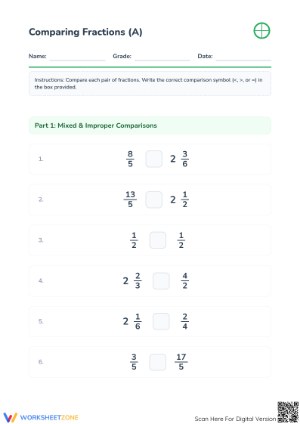
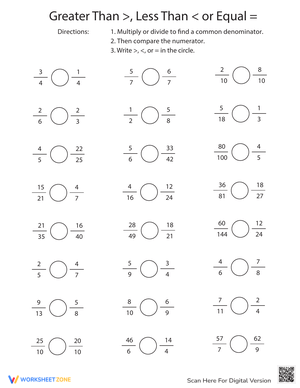
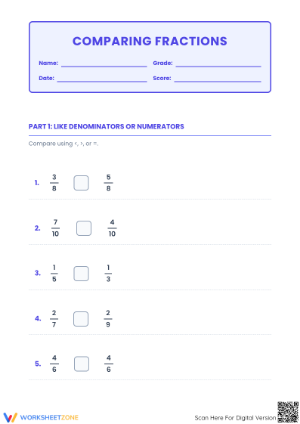
Each worksheet targets one comparison strategy rather than cycling through all three on a single task, which keeps cognitive load manageable during initial instruction. Students working through the visual model worksheets shade area models and plot fractions on number lines, then record whether one fraction is greater than, less than, or equal to the other. The equivalent fractions worksheets move students through converting one fraction so both share a common denominator — beginning with pairs where one denominator is already a multiple of the other (halves and eighths, thirds and sixths) before introducing denominators with no obvious relationship.
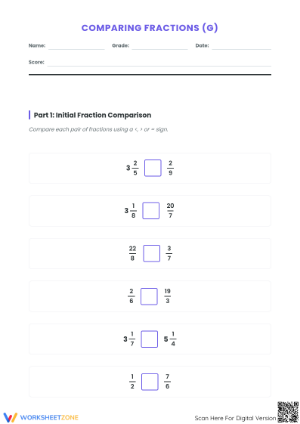
The benchmark worksheets ask students to sort fractions relative to 0, one-half, and 1, then use that placement to justify a comparison. A student who places 5/6 near 1 and 2/9 near 0 can state the comparison without any calculation. That kind of number sense is what the benchmark strand is actually building — not a shortcut, but a feel for fractional size that makes later computation more reliable.
Frequent Student Errors Worth Catching Early
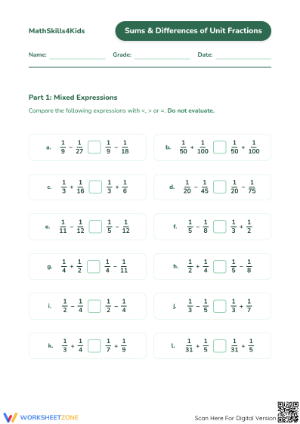
The most persistent misconception in this unit is "larger denominator equals larger fraction." Students who correctly understand that 100 is greater than 4 apply that whole-number logic to denominators and conclude that 1/100 must be greater than 1/4. The visual model worksheets make this visible right away: shading 1/100 of a rectangle next to 1/4 of the same rectangle collapses that assumption in a way that a verbal explanation alone rarely does.
A second error appears once students start using the equivalent fractions method: they double the denominator but leave the numerator unchanged. In actual student work this looks like rewriting 1/3 as 1/6 when the target denominator is 6 — correctly transforming the bottom but forgetting the top entirely. These worksheets include an explicit step column where students write the full equivalent fraction before recording the comparison symbol, which interrupts that slip before it becomes an ingrained habit.
The "same whole" issue trips up even students who have otherwise mastered the mechanics. Comparing 3/4 of a small square to 1/2 of a large square tells you nothing valid about the fractions themselves. That caveat is addressed directly in the word problem worksheets, but it is worth stating aloud before students begin any session — especially with students who are confident in the procedures and tend to move fast without reading the context.
Building These Worksheets Into Your Lesson Planning
The visual model worksheets work best directly after initial instruction, when students still need a concrete anchor. The equivalent fractions worksheets belong in the second or third lesson of the sequence, once the concept has been modeled. Benchmark worksheets make strong Monday warm-ups after a weekend gap — they ask students to reason rather than calculate, which is a lower-stakes way to re-engage before returning to procedure.
For small-group rotations, a benchmark worksheet runs roughly twelve minutes for on-grade students and leaves room for a short discussion about which fractions were easy to place and which required more thought. That conversation surfaces reasoning you would not see in written work. The equivalent fractions worksheets fit well as independent practice following whole-class instruction, or as homework parents can follow because the step-by-step work is visible on the page. Comparing with unlike denominators worksheets for 4th grade also works as a five-minute entry task on days when the primary lesson covers a different fraction concept, keeping the comparison skill active rather than letting it sit dormant between units.
Adjusting the Set Across Ability Levels
Students who are still unclear on what a denominator represents need to begin with the visual model worksheets — not skip them in favor of procedural practice. Moving those students too quickly into the common denominator method produces answers that are mechanically correct but conceptually empty, and that gap surfaces badly when they encounter less familiar fraction pairs. Keep the area model worksheets available as a reference tool even after students have moved to numerical methods.
For students who have already internalized all three strategies, the extension move is to present pairs where neither denominator is a multiple of the other — 3/5 and 4/7, for instance — and ask them to identify which strategy is most efficient for that particular pair before they begin. That metacognitive layer, choosing between strategies rather than executing a memorized sequence, is where strong fraction reasoners distinguish themselves from students who just know the steps. The comparing with unlike denominators worksheets for 4th grade set includes problems at this level for students who are ready for that challenge.
Standard Alignment
CCSS.MATH.CONTENT.4.NF.A.2 requires students to compare two fractions with different numerators and different denominators by reasoning about their size, using strategies such as creating common denominators or numerators, or comparing to a benchmark fraction such as one-half, and to record results using the symbols greater than, less than, or equal to. The standard also specifies that comparisons are valid only when both fractions refer to the same whole — a clause that is easy to gloss over in instruction but that the word problem worksheets in this set confront directly. Instructionally, this standard follows 4.NF.A.1, where students generate equivalent fractions, and feeds forward into 4.NF.B.3, where students add and subtract fractions with like denominators. Comparison fluency is the bridge between those two clusters.
Frequently Asked Questions
Which worksheet type should students begin with?
Start with the visual model worksheets regardless of where a student seems to be. Even students who could move directly to the common denominator method benefit from seeing the size relationship concretely first. Students who skip the visual stage often apply the procedure correctly but cannot explain why it works, which creates problems when they encounter unfamiliar pairs or are asked to check whether an answer is reasonable.
How long does each worksheet take during a typical class period?
Most students finish each worksheet in ten to fifteen minutes during independent work time. Benchmark worksheets tend to run faster; equivalent fractions worksheets with unrelated denominators take longer. Expect some variation — students who move quickly through procedural work often slow down on benchmark tasks because those require judgment rather than a step sequence, and that shift catches some students off guard the first time.
Can these worksheets serve as formative assessment?
They are especially useful when collected mid-unit rather than at the end. A completed visual model worksheet shows whether a student grasps the size relationship between fractions. A completed equivalent fractions worksheet shows whether the conversion is being executed correctly. Reading both together tells you whether correct answers reflect understanding or rote procedure — a distinction that matters for deciding who needs reteaching and who is ready to move forward. The comparing with unlike denominators worksheets for 4th grade set is focused enough that scanning a full class set takes about ten minutes and sorts students into clear instructional groups.













 Interactive Worksheet Maker
 Quiz Maker
 Word Search Maker
 Crossword Puzzle Maker
 Word Scramble Generator
 Sentence Scramble Generator
 Handwriting Worksheet Generator
 Name Tracing Generator
 Fill In The Blank Generator