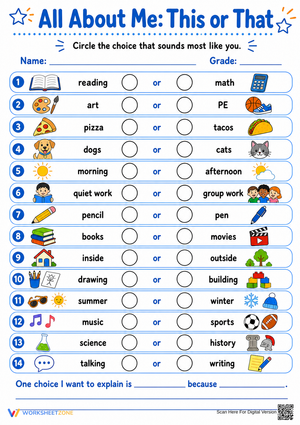
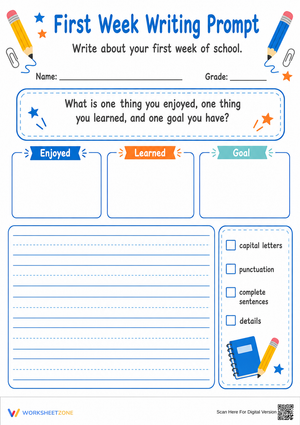
Writing worksheets for 4th grade occupy a specific niche in ELA planning — targeted practice that matches what 4th graders are actually asked to do: organize a claim with reasons, build explanatory paragraphs around a central idea, move a narrative forward with real sequence, and revise what they've already drafted. This set covers all three CCSS writing genres plus the revision and editing work that most teachers struggle to fit into the week.
The Writing Moves Each Worksheet Targets
These writing worksheets for 4th grade divide into four task-focused categories, each aimed at a distinct phase of the writing process.
Opinion writing worksheets ask students to state a claim, give two or three supporting reasons, connect at least one reason to a concrete example, and write a closing statement. The planning organizer uses labeled boxes rather than open lines — which stops students from treating the organizer as the draft itself, a common trap that produces two rounds of nearly identical writing.
Informative and explanatory worksheets are structured for after-reading or content-area work. Each worksheet has space for a focused topic sentence, categorized facts or examples, and a concluding statement. The format pushes toward connected prose rather than a bulleted list dressed as an essay.
Narrative worksheets build planning habits through story maps, character-and-setting boxes, and sequence frames. Several include a prompt about where dialogue might fit — because 4th graders often want to use dialogue but insert it randomly rather than at moments that develop a scene.
Revising and editing worksheets give students one short passage and assign one precise task: strengthen a weak opening, combine choppy sentences, correct capitalization in a title, or fix punctuation around dialogue. Each worksheet targets a single convention or one revision move, not a checklist of five.
Student Mistakes That Show Up Most in 4th Grade Writing
The most consistent error in 4th grade opinion writing is the circular reason. Students write "We should have longer recess because recess is important" and genuinely believe that constitutes a complete argument. The opinion worksheets address this by prompting students to mark their reason, then ask "because why?" before moving on. Students who practice this move in September are producing specific, example-backed reasons by the end of the first quarter.
In informative writing, topic drift is the dominant problem — students begin a paragraph on one idea and shift to something loosely related within two sentences without noticing. The informative worksheets address this by asking students to write the topic sentence first, then check each fact against it before including it. That checkpoint adds about 90 seconds to the task and dramatically reduces the "finished" drafts that say nothing cohesive.
Narrative revision produces the most resistance. Students treat a completed draft as final, and asking them to revise feels like a penalty. The revision worksheets lower that barrier by giving students someone else's paragraph to improve rather than their own, which makes it easier to spot what's weak and transfers more readily to their own work afterward.
Where These Fit in Your Writing Block
The strongest use of these worksheets is in the 10 to 15 minutes immediately after a mini-lesson. A teacher models one writing move — how to write a topic sentence that names the subject and the controlling idea, for example — and students apply it on a focused worksheet before independent writing starts. This keeps instruction grounded and gives students structured practice before they're left to draft alone, which is when lesson skills most often disappear.
- Writing centers: Prompt-based worksheets, paragraph builders, and editing strips work well as rotating station tasks. Each worksheet has a self-contained job with a clear endpoint, so students don't need mid-activity check-ins to know whether they're finished.
- Monday warm-up: A short editing passage — 5 minutes, pencils out, no discussion until everyone has marked corrections — followed by a class debrief before the lesson begins.
- Last 8 minutes before dismissal: A single-skill editing worksheet closes the day quietly. Display an answer key at the end for quick self-checking.
- Homework: Send review worksheets home, not ones introducing new skills. Students should practice what's already been taught rather than encountering unfamiliar expectations without support.
One pairing worth building into the routine: match a planning worksheet with a short revision worksheet in the same lesson. Students organize their ideas first, then immediately improve a model paragraph for the same skill. Generating and evaluating writing in the same block produces stronger independent drafts than splitting those tasks across different days.
Adjusting the Set for a Range of Writers
Writing worksheets for 4th grade work across ability levels without requiring entirely separate materials — the adjustment is in how much structure you provide, not in the task itself. For students who need more support, fill in the first organizer box together before independent work starts, add a word bank, or assign the three-sentence model passage instead of the five-sentence version. For students ready for more independence, remove the sentence frames, leave the organizer blank, or ask them to write two additional supporting details beyond what the worksheet prompts.
The revision worksheets allow a particularly clean split. Assign the same passage to everyone: some students correct what's there; others correct and then improve — replacing a vague detail with a specific one, or rewriting a closing so it doesn't simply restate the opening. Both groups practice revision; the work product shows different levels of control over the writing moves.
Standard Alignment
The worksheets in this set align to the following CCSS ELA standards for Grade 4:
- CCSS.ELA-LITERACY.W.4.1 — Opinion writing with a stated claim, reasons supported by facts and details, linking words, and a concluding statement. The opinion organizer moves students through each component in sequence rather than letting them skip from claim to conclusion.
- CCSS.ELA-LITERACY.W.4.2 — Informative/explanatory writing: introducing a topic, grouping related information, using precise language, and concluding clearly. The informative worksheets use a categorized organizer that pushes students toward connected paragraphing rather than a disconnected list of facts.
- CCSS.ELA-LITERACY.W.4.3 — Narrative writing with a clear situation, character introduction, dialogue and description, and a conclusion. Narrative planning worksheets label each element separately so students address it intentionally rather than writing through without checking.
- CCSS.ELA-LITERACY.W.4.5 — Developing and strengthening writing through planning, drafting, revising, and editing. The revision and editing worksheets target this standard directly — they give students a structured reason to return to writing and improve it rather than treat the first draft as finished.
- CCSS.ELA-LITERACY.L.4.2 — Conventions: capitalization, punctuation, and spelling. The editing passages focus on the errors most common in actual 4th grade work — comma splices, missing punctuation in compound sentences, and capitalization errors inside titles and proper nouns.
Frequently Asked Questions
Does the set cover all three CCSS genres, or does it focus on one?
The set includes worksheets for opinion, informative, and narrative writing, plus standalone revision and editing worksheets. Teachers can draw from a single genre to support a specific unit or pull across all four categories to build a full planning-through-editing sequence within one writing study.
How do I pair a planning worksheet with a revision worksheet in the same lesson without the two halves feeling unconnected?
Match the skill. If the lesson target is adding specific details, use a planning organizer that prompts students to note a concrete detail alongside each reason, then follow it with a revision worksheet asking them to improve a vague paragraph by replacing general statements with specific ones. Students move from generating details in their own plan to evaluating detail in someone else's writing — two passes on the same skill in one block.
At what point in a writing unit are these most useful?
Writing worksheets for 4th grade serve different purposes depending on where students are in the process. The planning and prompt-based worksheets belong in the early and middle phases of a unit, when students are first applying a new writing move. The revision and editing worksheets are most valuable mid-unit through the end, once students have a draft and can apply the same correction moves they practiced on the model passages. The set is organized by task type so teachers can select by phase rather than searching by genre.












 Interactive Worksheet Maker
 Quiz Maker
 Word Search Maker
 Crossword Puzzle Maker
 Word Scramble Generator
 Sentence Scramble Generator
 Handwriting Worksheet Generator
 Name Tracing Generator
 Fill In The Blank Generator




 BACK TOSCHOOL