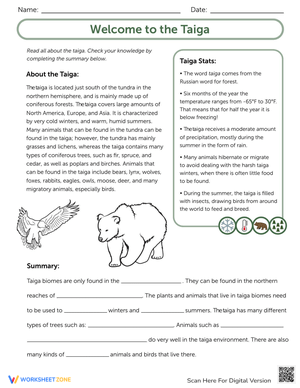
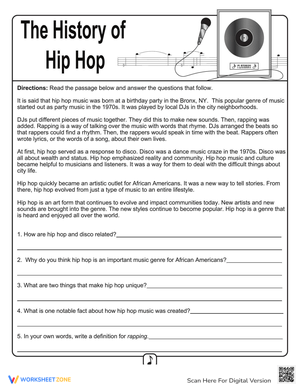
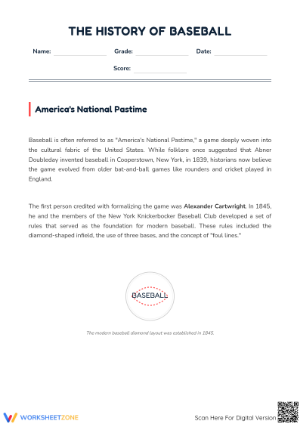
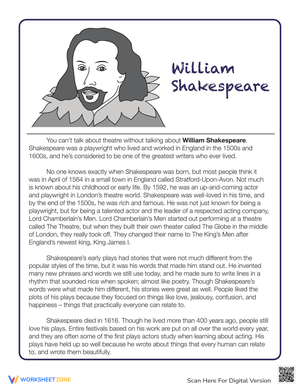
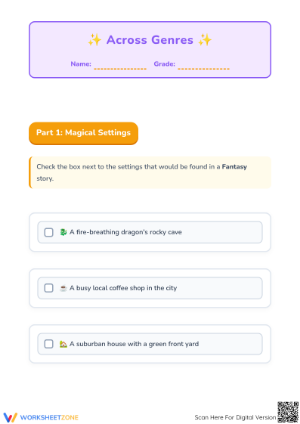
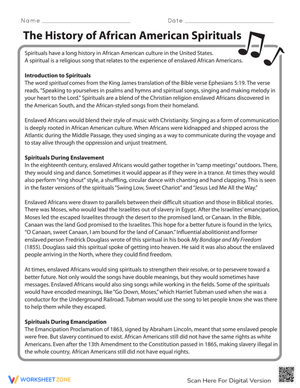
These 4th grade nonfiction worksheets give teachers a ready set of passage-based practice resources centered on the informational reading skills Grade 4 students are expected to apply independently — identifying main idea, gathering supporting details, reading text features, tracing cause and effect, sequencing events, summarizing, and returning to the text to locate evidence. Each worksheet pairs a short nonfiction passage with focused questions tied to one or two reading skills, so practice stays purposeful rather than scattered across every standard at once.
The Skills This Set Builds
Reading demands in fourth grade shift noticeably from earlier grades. Students are no longer just answering "what happened" — they are expected to explain relationships between ideas, use structural features to gather information, and support every answer with something specific from the text.
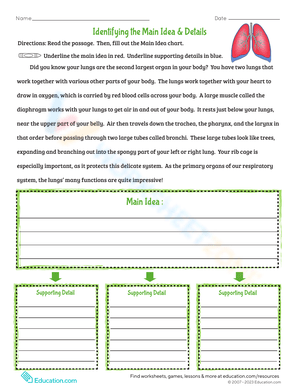
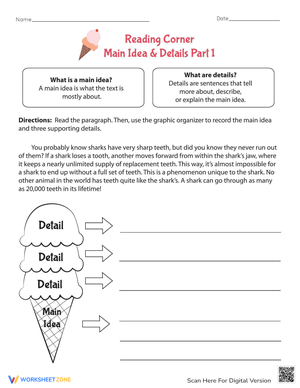
- Main idea and key details: Students identify the central idea of a passage and select details that genuinely support it — not just facts that appear somewhere in the text.
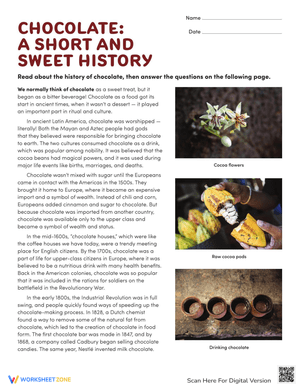
- Text features: Worksheets that include headings, captions, diagrams, or bolded vocabulary ask students to explain what each feature contributes, not simply note that it exists.
- Cause and effect: Students name both parts of a relationship and explain the connection using language from the passage.
- Sequencing: Students order steps or events across life cycles, historical timelines, and process explanations, using signal words as anchors.
- Summarizing: Students produce a short restatement of important ideas without reproducing full sentences from the passage.
- Evidence-based response: Students answer a question and cite the specific sentence or detail that supports their answer.
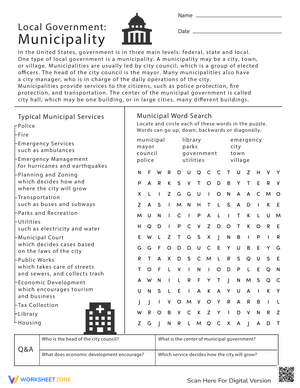
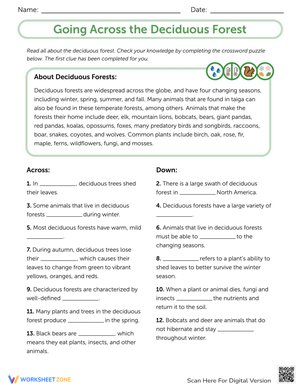
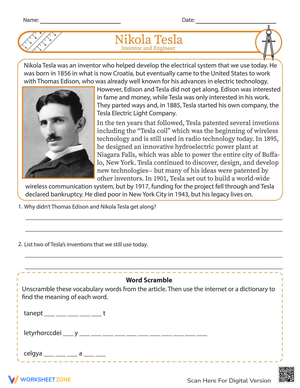
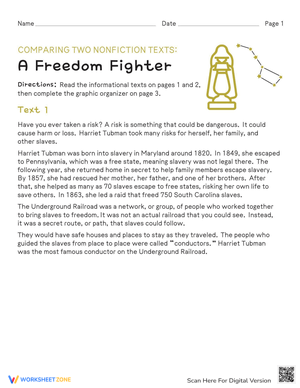
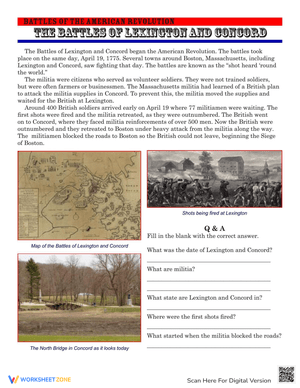
Topics across the set include weather patterns, animal adaptations, inventors, geographic features, and historical events — enough variety to sustain engagement across repeated practice without making every worksheet feel like the same passage with different names swapped in.
Where Fourth Graders Reliably Go Wrong on Nonfiction Questions
The main idea question trips up more students than most teachers expect. Fourth graders consistently confuse the topic with the main idea. A student who reads a passage about monarch butterfly migration will write "butterflies" or "monarch butterflies" as the main idea — reporting what the text is about rather than what it explains or argues. These worksheets address that directly by asking students to write the main idea as a complete sentence, which forces them to make a claim about the topic rather than just name it.
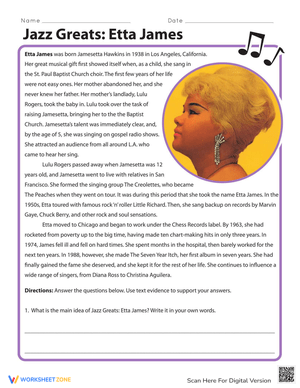
Evidence-citing produces a different but equally predictable problem. Students who know the right answer will often write "the text says it" without locating a specific sentence. Others copy an entire paragraph instead of finding the one line that actually answers the question. A third group quotes a sentence that appears near the correct information but doesn't support the response — they are matching proximity to the answer, not meaning. Those response patterns show up clearly in a collected set of student work and point directly to what needs reteaching.
Text features trip students up in a subtler way. Asked to explain what a diagram adds to a passage, many students write "it shows a picture" — technically accurate but empty. That answer reveals the student has not read the diagram's labels or connected its content to the surrounding paragraph. These worksheets ask students to use information from the feature, not just note that it is there.
Fitting These Worksheets Into Your Planning Without Disrupting What Already Works
The most reliable uses slot into practice time that already exists. A short worksheet holds up well as the first task students pick up during literacy center rotations — it runs independently, requires no teacher facilitation to start, and anchors a brief follow-up discussion at the debrief. It also works in the eight minutes before students leave for specials, when re-explaining a complex assignment is not practical but a familiar task structure runs on its own.
For sub plans, a 4th grade nonfiction worksheets resolves a specific logistical problem: the substitute needs independent work with no digital setup and no content delivery. A nonfiction passage with printed directions handles that without leaving a curriculum gap. Print a few worksheets organized by skill and keep them in a labeled folder — the sub does not need to know which standard is which, and the teacher gets usable student work back.
In intervention, assigning the same skill across three or four short passages over several sessions works better than moving to a new skill daily. Repeated exposure to one task structure lets struggling readers build response fluency without relearning directions each time. Keep passages short; the challenge should come from the comprehension task, not from reading volume.
Standard Alignment
These worksheets address skills covered under the Common Core Informational Text standards for Grade 4: RI.4.1 (quoting accurately from the text when explaining ideas or drawing inferences), RI.4.2 (determining the main idea and summarizing with key supporting details), RI.4.3 (explaining cause-and-effect relationships and comparisons in informational text), and RI.4.5 (describing text structure and explaining how features contribute to meaning). Most state ELA frameworks for fourth grade align closely enough to these standards that the worksheets transfer across adopted curriculum maps without adjustment. Teachers using NGSS-aligned science content will find the animal, weather, and earth science passages reinforce ELA comprehension skills while building subject-area knowledge students are already developing.
Giving Every Reader in the Room the Right Level of Challenge
Passage length and response demand are the two variables worth adjusting. For students who need more support, selecting a shorter passage and reducing written response items to one or two — while keeping the same skill target — lowers the workload without lowering the expectation. Previewing three or four key vocabulary words before reading also helps these students spend mental energy on comprehension rather than stopping at unfamiliar terms mid-passage.
Stronger readers get more from open-ended items that require complete sentences, synthesis across two paragraphs, or an explanation of why a piece of evidence supports a claim rather than simply identifying it. A follow-up prompt added after the final question — "What is one question the passage left unanswered for you?" — extends thinking without requiring a different worksheet entirely. The 4th grade nonfiction worksheets format makes it straightforward to hand the same passage to several groups while varying what each group produces in response.
Frequently Asked Questions
Do these worksheets work for both whole-class instruction and small-group pullout?
Each worksheet targets a specific skill with a short nonfiction passage, which makes it easy to use with a full class during a reading block lesson or pull it for a small group working on a particular gap — citing evidence, summarizing, or reading text features. The focused format keeps the task matched to one objective rather than asking students to manage several skills at once.
What passage length should fourth graders handle for independent practice?
Most fourth graders work comfortably with informational passages in the 200–450 word range during independent practice. Passages on the shorter end suit bell ringers or intervention; those closer to 400 words work better when students have more time in the reading block and are building stamina with longer text. For students who struggle with fluency, shorter passages keep the focus on comprehension rather than on reading volume.
Are nonfiction comprehension worksheets useful for state assessment preparation?
Grade 4 state assessments — including SBAC, PARCC-aligned exams, and most state-specific ELA tests — include short informational passages followed by text-dependent questions, which matches the format used in these worksheets. Students who have regularly answered evidence-based questions on nonfiction passages approach assessment items with a practiced strategy rather than encountering the structure for the first time on test day.
Can these worksheets support content-area reading in science and social studies?
A 4th grade nonfiction worksheets covering animal adaptations, weather systems, historical figures, or geographic features reinforces ELA comprehension skills during a science or social studies unit — giving the passage relevance in two subjects without requiring separate materials for each. That cross-subject use also helps students see informational reading as a transferable skill rather than something that only happens during literacy block.












 Interactive Worksheet Maker
 Quiz Maker
 Word Search Maker
 Crossword Puzzle Maker
 Word Scramble Generator
 Sentence Scramble Generator
 Handwriting Worksheet Generator
 Name Tracing Generator
 Fill In The Blank Generator




 BACK TOSCHOOL