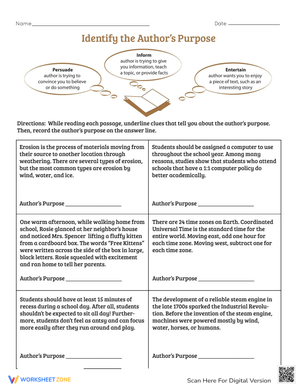
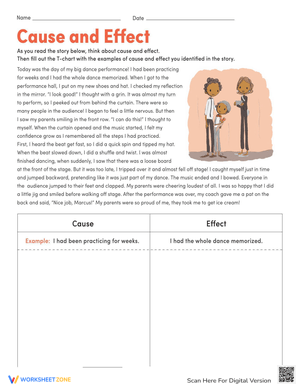
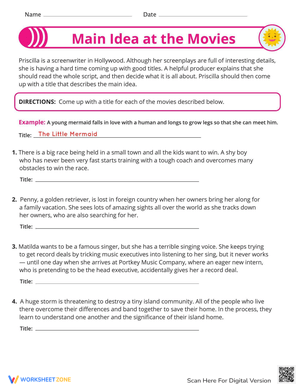
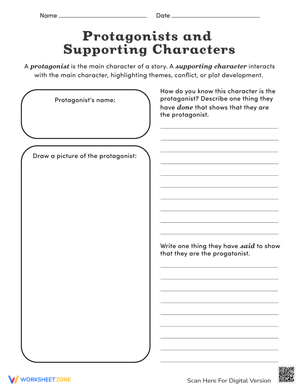
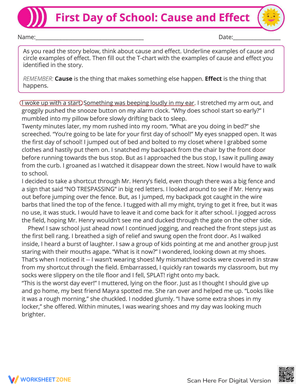
These 4th grade fiction printable worksheets give teachers a focused set of tools right at the grade level where reading comprehension expectations shift most sharply. Around fourth grade, students stop being asked just to recount what happened — they must explain character motivation, trace how a theme develops through evidence, and distinguish what an author implies from what the text states outright. This set addresses those skills directly, with each worksheet targeting one analytical task at a time.
The Specific Skills Each Worksheet Targets
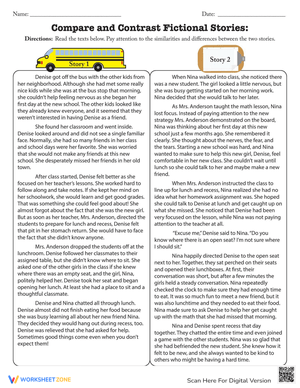
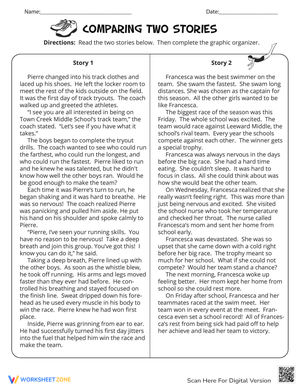
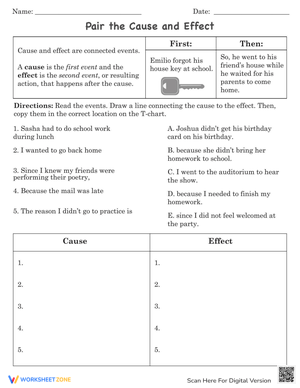
The resources cover the core fiction skills that RL.4 standards require and that fourth-grade classrooms need to practice repeatedly before they hold. Students underline textual evidence to support inferences, complete character behavior charts by tracking thoughts, words, and actions as three separate categories, sort story events by causal relationship rather than sequence alone, and rewrite vague theme statements into ones anchored to specific text details. The single-skill format matters here — students working on theme don't simultaneously manage an inference task in the same response, which keeps cognitive load manageable while those skills are still being consolidated.
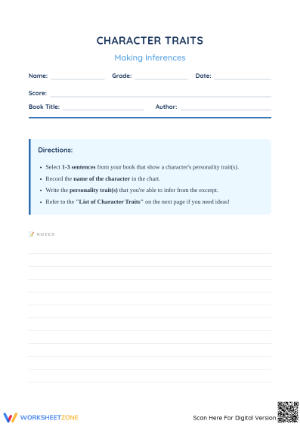
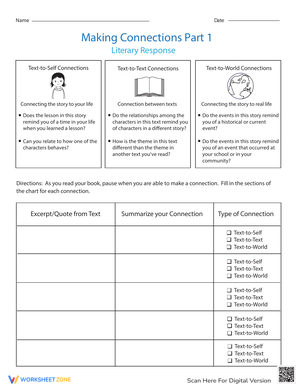
- Inference: Students quote a text line, note relevant background knowledge, then write the inference — a three-part constructed response that makes each step visible on paper
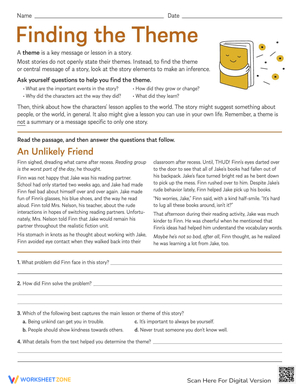
- Theme vs. summary: Two separate written tasks followed by a prompt asking students to explain the difference in their own words
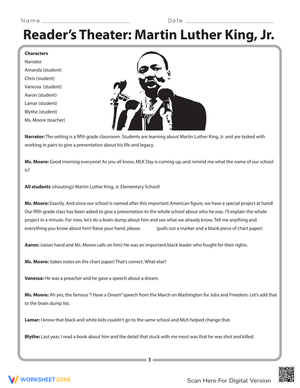
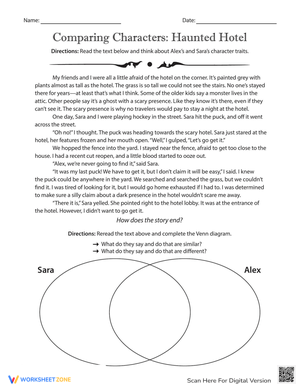
- Character analysis: Behavior charts organized around thoughts, words, and actions, each entry requiring a quoted text detail
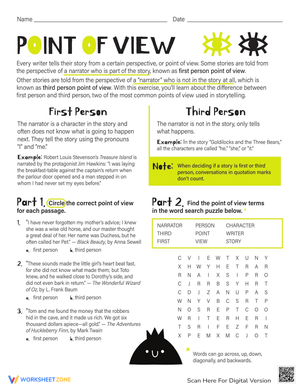
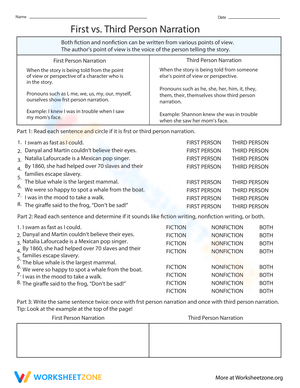
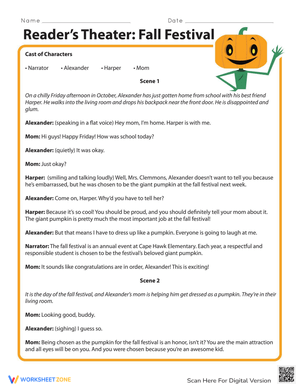
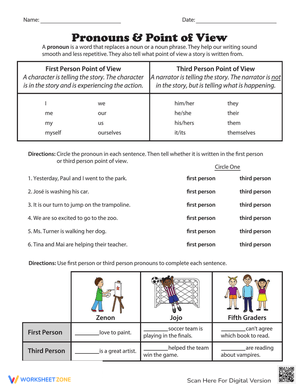
- Point of view: Identifying what the first-person narrator can and cannot observe, and noting where the narrator's account would differ from what another character would report
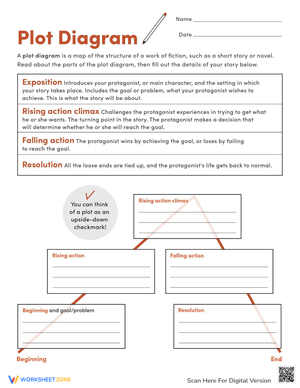
- Story structure: Labeling plot arc stages and identifying the specific event that marks the shift from rising to falling action
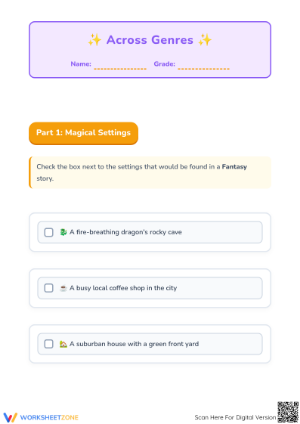
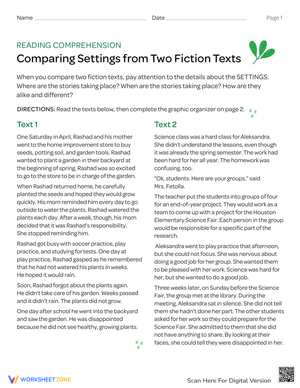
- Genre conventions: Comparing the reading demands across realistic fiction, mystery, historical fiction, and fantasy
Why Genre Study at This Grade Requires Its Own Attention
Genre knowledge matters in 4th grade not because students need to categorize books correctly, but because different genres require genuinely different reading stances. A student reading a mystery needs to hold suspected details in memory and stay skeptical of what characters report. A student reading realistic fiction needs to track subtle shifts in a character's relationship with someone else across the full arc of a story. These are different mental habits, and treating all fiction as interchangeable during instruction is one reason students sometimes hit a comprehension wall when they move between genre units.
The genre-focused worksheets make that difference visible. The historical fiction worksheet asks students to circle claims that could be verified against the historical record and mark those that are the author's invention — a task that requires thinking about authorial choice in a way the realistic fiction worksheets don't. The mystery worksheets ask students to return to earlier parts of a passage after finishing it and annotate clues they missed on first read, which builds the habit of rereading for evidence rather than reading forward only for plot.
Errors That Surface Consistently in Student Work
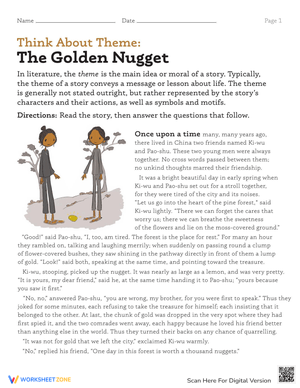
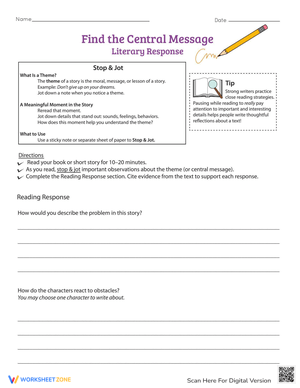
Theme confusion is the most persistent error at this grade level. Students reliably conflate theme with a plot summary sentence. Asked for the theme of a story, a student writes "Charlotte saves Wilbur and then dies" rather than anything close to a thematic claim about friendship or sacrifice. Worksheets that separate the task into two distinct steps — first write what happens in the story, then write what the author wants the reader to understand — help students see that these are different cognitive operations, not the same question phrased two different ways.
A second pattern worth watching: students making inferences without any textual support. They write a confident answer based entirely on background knowledge or intuition, and when asked "Where does the text say that?" they point to a line that doesn't actually say it. The inference worksheets require a three-part written response — quote the relevant line, state what the reader already knows, then write the inference — which makes the gap between "text says" and "I think" visible on paper before it becomes an unexamined habit.
Working These Worksheets Into Your Lesson Planning
The most reliable placement for 4th grade fiction printable worksheets is the 12 to 15 minutes after a shared read-aloud and before students move into independent reading. Students have the story fresh in working memory, the whole class shares the same text, and the written response gives everyone something concrete to discuss before they scatter to their own books. Inference and theme worksheets work particularly well in this slot because the class conversation that follows nearly always surfaces misconceptions — two students who wrote the same answer for completely different reasons, which tends to be more instructive than a room where everyone quietly agreed.
For small-group instruction, match each worksheet to a specific observed gap. If one group is accurate on inference but consistently weak on distinguishing the narrator's perspective from the author's, pull the point-of-view worksheet for that group and work through it together. The single-skill format makes that kind of targeted grouping practical without requiring a new lesson plan each time. The worksheets also serve reliably as exit slips in the final few minutes before the class transitions — two questions, handed in as students leave, enough to tell you where the group actually landed by the end of the period.
Standard Alignment
These 4th grade fiction printable worksheets align to the following Common Core ELA standards for Grade 4 reading literature:
- RL.4.1 — Refer to details and examples in a text when explaining what the text says explicitly and when drawing inferences. This standard anchors the inference and evidence tasks, which make up the largest share of the set.
- RL.4.2 — Determine a theme of a story and summarize the text. The theme-versus-summary worksheets were built directly around how this standard appears on district benchmark assessments.
- RL.4.3 — Describe in depth a character, setting, or event in a story, drawing on specific details. The character behavior charts and event analysis tasks address this standard.
- RL.4.6 — Compare and contrast the point of view from which different stories are narrated. The perspective worksheets address narrator-versus-author distinctions that fourth graders find disorienting at first and that tend to show up as quiet errors in student writing rather than on formal assessments.
In practical terms, RL.4.1 and RL.4.2 are the standards most frequently assessed on district benchmark windows. Many teachers pull those specific worksheets as formative checks in the two to three weeks before a benchmark opens. RL.4.6 appears less consistently on formal tests but generates persistent confusion in student writing, which makes the point-of-view worksheets worth treating as a mid-unit diagnostic rather than a one-time lesson.
Adjusting the Set for Mixed-Ability Classes
For students reading below grade level, the most useful adjustment is shortening the passage rather than changing the task. The skill — making an inference, identifying theme, analyzing character — stays the same; the text volume decreases. Pairing below-level readers with excerpts that run 150 to 200 words rather than 350 to 400 keeps expectations consistent while reducing the decoding demand that would otherwise prevent a student from demonstrating the analytical skill the worksheet is actually assessing.
Students reading well above grade level benefit from the extension prompts included in several worksheets — comparing how two characters respond to the same conflict, or evaluating whether first-person narration strengthened or constrained what the story could reveal. These aren't busy-work additions; they push students toward evaluative thinking that bridges current 4th grade demands toward what 5th and 6th grade teachers will ask of them. For students who finish the core task quickly and accurately, the extension prompts raise the cognitive demand without requiring you to design a separate activity from scratch.
Frequently Asked Questions
Do these worksheets require a specific class novel, or do they include their own passages?
Each worksheet includes a self-contained fiction excerpt — typically 250 to 400 words — so no separate book purchase is needed. The graphic organizer formats for character analysis and the two-step theme response frame also transfer cleanly to any novel a class is already reading. Several teachers use the blank versions of the character chart and the inference organizer as response tools during a novel unit, separate from the built-in passages.
How do I use these for assessment rather than just practice?
The difference is in the conditions. For practice, students annotate the passage, reread sections, and talk with a partner before writing. For formative assessment, run the worksheet cold — passage and questions only, no discussion, no notes beforehand. The inference and theme worksheets produce clear written evidence of what a student can do independently, making them useful as pre-unit and mid-unit checks without requiring a separate quiz format.
My students summarize just fine but can't get to theme. Where do I start?
Start with the two-step separation. Ask students to write three sentences about what happened — events only, no interpretation. Then ask what the main character learned or how the character changed because of those events. That second question is where theme lives, and most students can reach it when the path is broken that way. The theme worksheets build this same two-step sequence into the written task, which makes the strategy visible as a transferable process rather than something the teacher modeled once and students are now expected to reconstruct on their own.
Is there a recommended sequence for introducing these across the school year?
Many teachers start with character analysis in early fall — it's the most concrete of the major skills, and students can anchor their responses to specific text quotes without holding an abstract concept in mind at the same time. Inference comes next, usually mid-fall, once evidence citation feels routine. Theme and point of view work best after students have had steady practice with inference, since both require the same text-plus-reasoning move that inference builds. These 4th grade fiction printable worksheets are ordered within each skill area from shorter, more constrained passages toward longer excerpts that require more sustained attention, so the natural progression within each skill follows that same logic across the school year.












 Interactive Worksheet Maker
 Quiz Maker
 Word Search Maker
 Crossword Puzzle Maker
 Word Scramble Generator
 Sentence Scramble Generator
 Handwriting Worksheet Generator
 Name Tracing Generator
 Fill In The Blank Generator




 BACK TOSCHOOL