These greek and latin roots worksheets for 4th grade give teachers a direct way to build the decoding and vocabulary skills students need before texts get significantly harder in fifth grade and beyond. Each worksheet focuses on a specific root, walks students through its core meaning, and asks them to work with that root in multiple contexts — not just match it to a definition. That combination of tasks is what makes root practice stick rather than evaporate by the following week.
The Specific Word Knowledge These Worksheets Build
Root-based vocabulary instruction lands well in fourth grade because students are hitting a new wave of academic language in science and social studies — words like photosynthesis, geography, and structure. Instead of treating each new word as completely unfamiliar, a student who knows photo means light, geo means earth, and struct means build can make an informed guess before confirming meaning in context. That shift from guessing to reasoning is the goal.
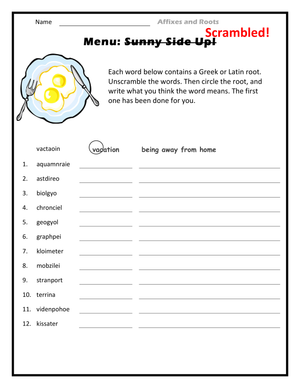
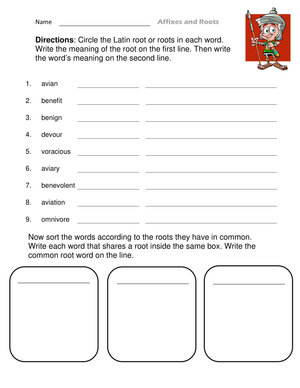
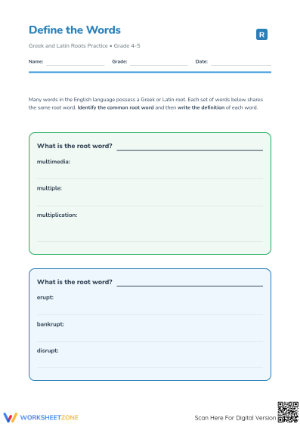
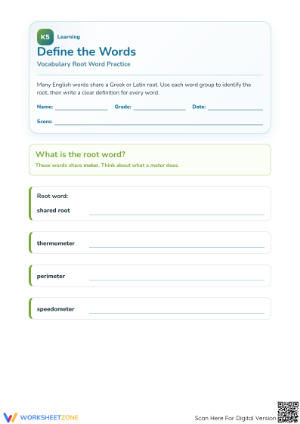
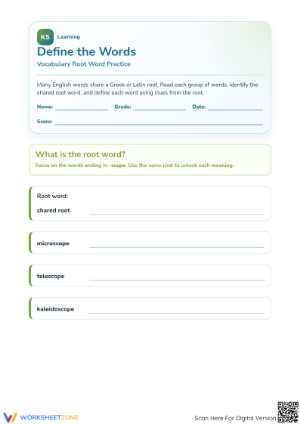
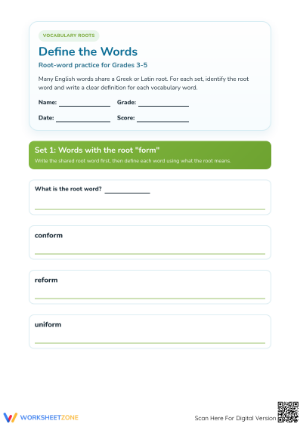
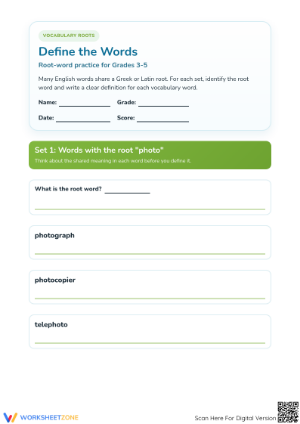
Each worksheet in the set asks students to do several kinds of work around a single root:
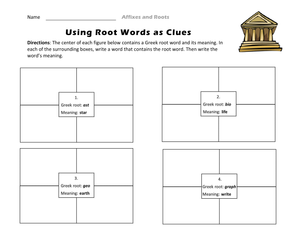
- underline or circle the root inside a longer word
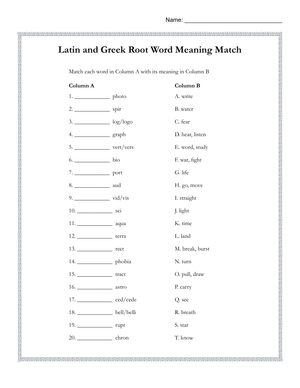
- match the root to a plain-language meaning
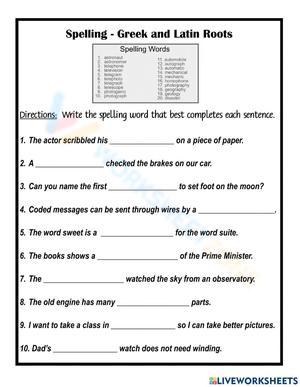
- select the best definition for a word based on how it's used in a sentence
- sort a word bank by shared root
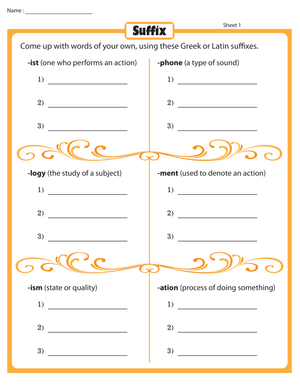
- combine a root with a known prefix or suffix to form a new word
- write a sentence using a target word in a way that shows its meaning
That last task reveals more than any matching exercise. A student who writes "The portable speaker can be moved from room to room" understands port at a functional level. A student who writes "The portable is broken" does not — and that distinction is immediately visible to the teacher without any additional assessment.
Student Mistakes Worth Anticipating Before the Lesson
The most predictable error in root work is what might be called the false-root problem. Students who've learned that port means carry will confidently circle it inside sport and report — both reasonable-looking hosts for those four letters — without checking whether the etymological connection actually holds. This pattern shows up consistently across classrooms, and the fix is explicit: show two or three non-examples alongside real root words before students work independently, not after they've already made the error on the worksheet.
A second issue surfaces during application writing. Students who know bio means life will write "biology is the study of life" with real confidence. That's close but incomplete. The same student, asked to define autobiography, often writes "a book about being alive" rather than "a book someone writes about their own life." The root gave them a foothold; they needed the sentence context to finish the meaning. Pointing this out during the modeling step — before the independent practice — makes a visible difference in how students approach the writing tasks.
Building These Worksheets Into Your Word Study Routine
The most practical structure is a short two-step setup before students work: five minutes to introduce the root with two or three example words students already know, then a quick model of the thinking process — find the root, recall its meaning, test that meaning in the sentence. Students who know the routine can begin the worksheet while the teacher circulates, which keeps the lesson moving without sacrificing the explicit introduction. A full root lesson runs around fifteen to twenty minutes, which fits comfortably inside a fourth-grade ELA block.
One move that pays off over several weeks is pairing each worksheet with a running root display in the classroom — a simple chart where the root, a student-friendly meaning, and two example words go up after each lesson. Students who do root practice on Tuesday will consult that chart on Thursday without being asked to, when they encounter an unfamiliar word during reading. The worksheet becomes a reference tool rather than a one-day task.
This is especially useful for greek and latin roots worksheets for 4th grade tied to a content-area unit rather than used in isolation. Before students begin a unit on ancient civilizations, working through demo, arch, and crat means that democracy and monarchy arrive in the reading already partially understood. Vocabulary preview like that reduces the cognitive load students carry during the actual reading, which frees attention for comprehension.
Standard Alignment
These worksheets address CCSS.ELA-LITERACY.L.4.4b, which directs students to "use common, grade-appropriate Greek and Latin affixes and roots as clues to the meaning of a word (e.g., telegraph, photograph, autograph)." In classroom terms, that standard lives most naturally during the word study portion of ELA and during vocabulary preview before content-area reading. It also shows up directly on state ELA assessments, where students encounter unfamiliar vocabulary in reading passages with no definition provided and must reason from word parts and context. The habits these worksheets build — identify the root, apply its meaning, check against context — are exactly the habits that assessment item requires.
Adjusting the Worksheets for a Range of Fourth-Grade Learners
Students who need more support do better when the root is already highlighted inside each word — that removes the visual search task so they can focus entirely on the meaning work. Reducing an answer bank from six options to three lowers demand without changing the skill target. For students who are strong readers but haven't had explicit root instruction before, the matching tasks serve as a fast entry point, and most are ready to attempt the application writing within the same lesson.
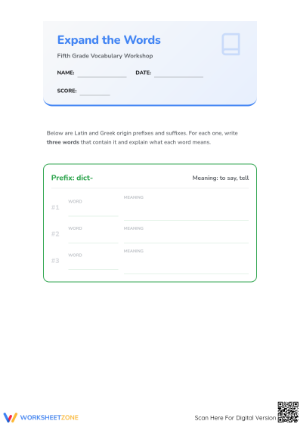
For students ready to go further, the most productive extension is a genuine word hunt: ask them to find additional words with the same root in whatever they're currently reading, not a teacher-provided list. When a student returns and says "I found transport in my social studies chapter and portable in the lab directions," the root has become an actual reading tool. A richer discussion involves asking those students how the root meaning shifts across related words — dictate, predict, and contradict all carry dict, but their full meanings diverge in instructive ways. That conversation goes beyond anything the worksheet alone can prompt.
Used across a mixed-readiness classroom, greek and latin roots worksheets for 4th grade allow the teacher to hold one root as the shared focus while different groups work at different task depths. The vocabulary target stays constant; the level of independence and complexity adjusts.
Frequently Asked Questions
Which roots make the most sense to introduce first?
Start with roots that appear in words students already say aloud regularly: tele (telephone, television), auto (automatic, autobiography), graph (photograph, paragraph), and port (transport, important). Because students have heard these words before, they can confirm the root meaning through what they already know rather than learning the root and several unfamiliar words simultaneously. From there, move toward roots that carry heavy academic-vocabulary traffic: struct, dict, geo, and bio.
How often should root practice appear during the week?
Two to three times per week produces stronger retention than daily work. Spacing practice across the week — introducing a root Monday, revisiting it Wednesday with a different set of example words, checking it briefly Friday — builds more durable recall than three consecutive lessons on the same root. A set of printable worksheets makes that spacing easy to manage without daily planning overhead.
Can these worksheets be used in small-group intervention?
Yes, and greek and latin roots worksheets for 4th grade are well-suited to that setting because each worksheet targets a single root with clear, explicit tasks. In a fifteen-minute pull-out or small-group session, a teacher can introduce the root, complete the first two items together, then have students finish independently while observing closely. That format makes it straightforward to identify which task type — root identification, meaning matching, or application writing — is breaking down for each student, which is exactly the diagnostic information intervention time should generate.
What if students have never had root instruction before starting fourth grade?
Fourth grade is a natural starting point, not a remediation context. Most fourth graders haven't received systematic root instruction, so beginning fresh with high-frequency roots and familiar example words is the appropriate approach regardless of prior experience. Students who are already strong readers tend to make fast initial connections; students who struggle with longer words often find that explicit word-part knowledge gives them a concrete strategy for multisyllabic vocabulary that silent rereading never did.












 Interactive Worksheet Maker
 Quiz Maker
 Word Search Maker
 Crossword Puzzle Maker
 Word Scramble Generator
 Sentence Scramble Generator
 Handwriting Worksheet Generator
 Name Tracing Generator
 Fill In The Blank Generator