




























Views
Downloads
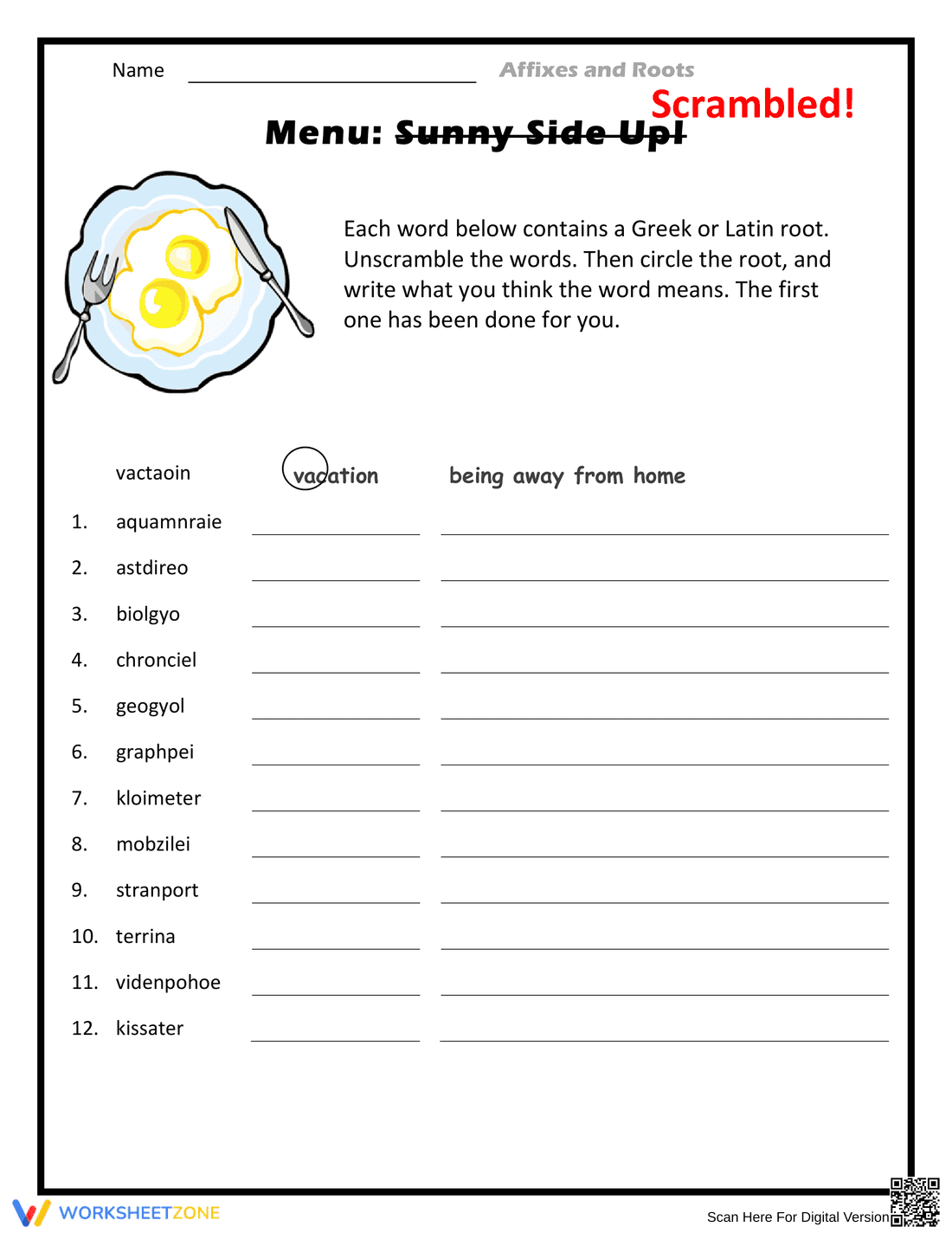

Grade 4 Greek and Latin Roots — Printable No-Prep Worksheet

Paste this activity's link or code into your existing LMS (Google Classroom, Canvas, Teams, Schoology, Moodle, etc.).
Students can open and work on the activity right away, with no student login required.
You'll still be able to track student progress and results from your teacher account.
This printable vocabulary worksheet develops student mastery of Greek and Latin roots through an engaging word-unscramble activity. By decoding scrambled terms, isolating core root words, and writing definitions, fourth-grade students strengthen their morphological awareness and expand their academic reading vocabulary without requiring teacher preparation.
At a Glance
- Grade: 4 · Subject: ELA
- Standard:
CCSS.ELA-LITERACY.L.4.4.B— Use common Greek and Latin roots as clues to word meanings- Skill Focus: Greek and Latin Roots
- Format: 1 page · 12 problems · Answer key included · PDF
- Best For: Independent practice and sub plans
- Time: 15–20 minutes
This single-page worksheet features 12 structured vocabulary problems alongside a clearly worked example. Each problem requires students to unscramble a target academic word, circle the embedded Greek or Latin root, and write a concise definition based on morphological clues. A complete answer key is included to facilitate rapid grading.
Zero-Prep Classroom Workflow
- Print (1 minute): Access the ready-to-print PDF file and generate copies instantly. No special formatting is required.
- Distribute (1 minute): Hand out the single-page activity. The clear layout and completed sample problem allow students to begin working immediately without lengthy instructions.
- Review (5 minutes): Use the provided answer key to verify unscrambled words, circled roots, and definitions efficiently.
With total teacher preparation time remaining under two minutes, this resource serves as an ideal emergency substitute plan or quick literacy center activity.
Standards Alignment
This worksheet aligns directly with primary standard CCSS.ELA-LITERACY.L.4.4.B, requiring students to use common, grade-appropriate Greek and Latin affixes and roots as clues to the meaning of a word. Additionally, it supports CCSS.ELA-LITERACY.L.4.4.A by encouraging students to use context and structural analysis to determine word meanings. Both standard codes can be copied directly into lesson plans, IEP goals, or district curriculum mapping tools.
How to Use It
Deploy this worksheet immediately after direct instruction on morphological roots to reinforce newly introduced vocabulary concepts. Alternatively, assign it during independent literacy rotations while the teacher conducts small group reading instruction. As a formative assessment observation tip, monitor whether students successfully circle the exact root (such as bio in biology) rather than guessing definitions solely from the unscrambled word. Expected completion time ranges from 15 to 20 minutes.
Who It's For
This resource is designed for fourth-grade general education ELA students developing foundational vocabulary skills. For English language learners requiring additional support, provide an anchor chart listing common Greek and Latin roots to assist with the definition portion of the task. This worksheet pairs naturally with introductory morphology lessons or classroom vocabulary walls.
Explicit instruction in morphological awareness provides essential foundational support for reading comprehension and academic vocabulary acquisition in elementary language arts. By engaging with standard CCSS.ELA-LITERACY.L.4.4.B, students learn to use common Greek and Latin roots as clues to determine the precise meanings of complex academic words. According to research by Fisher & Frey (2014), providing structured, independent practice opportunities following direct instruction significantly enhances student retention of morphological structures and improves overall reading achievement across grade levels. This targeted worksheet operationalizes these foundational findings by combining active word decoding with root isolation and definition writing. Such systematic practice ensures that fourth-grade learners develop the necessary analytical tools to decode unfamiliar vocabulary across diverse content areas, ultimately fostering long-term reading proficiency, independent word analysis skills, and sustained academic success.


