




























Views
Downloads

Greek and Latin Roots Worksheet | Grade 3-5 Essential

Paste this activity's link or code into your existing LMS (Google Classroom, Canvas, Teams, Schoology, Moodle, etc.).
Students can open and work on the activity right away, with no student login required.
You'll still be able to track student progress and results from your teacher account.
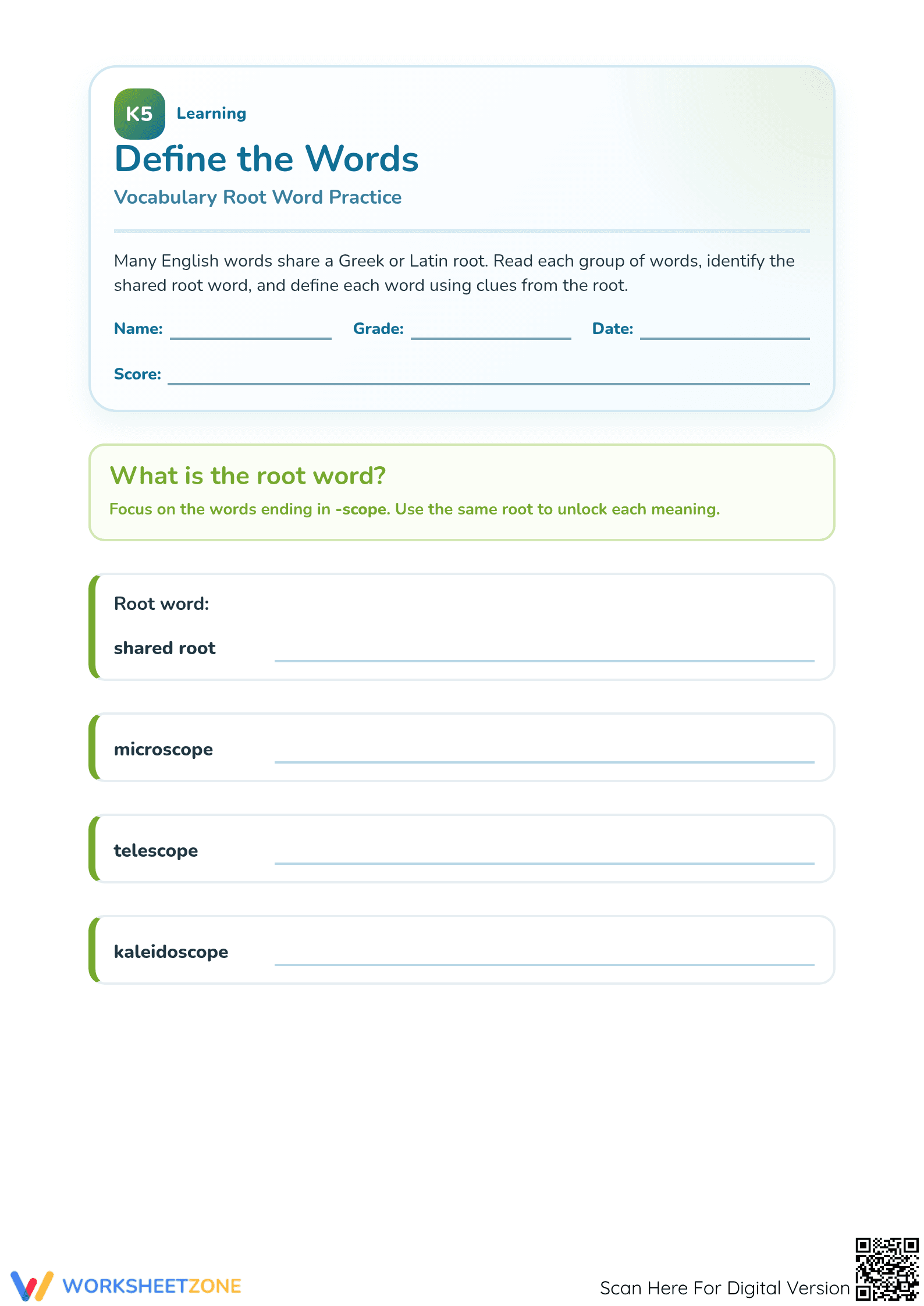
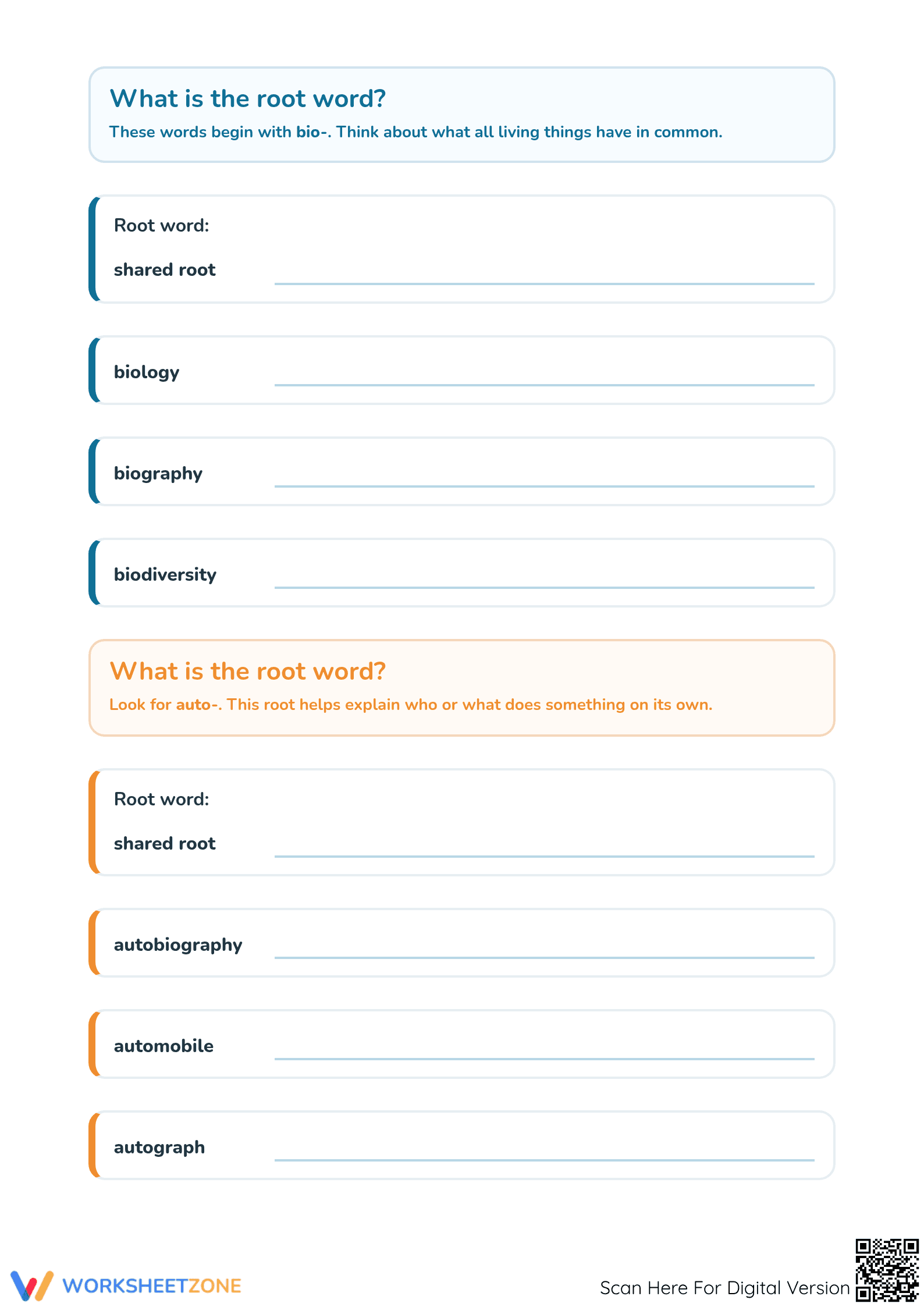
Developing a strong vocabulary involves understanding the building blocks of language. This worksheet guides students through identifying Greek and Latin roots like "scope," "bio," and "auto." By breaking down terms, learners gain the tools to decode unfamiliar vocabulary independently, improving their reading comprehension skills across all subjects and ensuring they meet grade-level literacy goals.
At a Glance
- Grade: 4 · Subject: English Language Arts
- Standard:
CCSS.ELA-LITERACY.L.4.4.B— Use Greek and Latin roots as clues to determine word meanings- Skill Focus: Morphology and Root Word Analysis
- Format: 2 pages · 12 problems · Answer key included · PDF
- Best For: Vocabulary building and independent practice
- Time: 20–30 minutes
This two-page resource focuses on high-frequency roots: "scope," "bio," and "auto." Students analyze word clusters to identify the shared root before defining each word using that root as a clue. The structured layout provides ample writing space, and a full answer key is included for efficient grading or student self-correction.
Skill Progression
- Guided practice: Students identify the shared root in a group of words, establishing a semantic foundation.
- Supported practice: Students define three related words, seeing how core meanings manifest in different contexts.
- Independent practice: Repeating this process builds confidence to apply morphological analysis to new texts.
This activity follows the gradual-release model of instruction, moving from identifying patterns to applying knowledge independently.
Standards Alignment
This worksheet aligns with CCSS.ELA-LITERACY.L.4.4.B, using common Greek and Latin roots as clues to word meanings. It also supports CCSS.ELA-LITERACY.L.3.4.C and CCSS.ELA-LITERACY.L.5.4.B by building essential morphological skills for upper elementary students. Both standard codes can be copied directly into lesson plans, IEP goals, or district curriculum mapping tools.
How to Use It
Introduce this during direct instruction for immediate application. It serves as an excellent formative assessment tool; observe if students can explain the relationship between the root and the definition. Completion usually takes 25 minutes, making it perfect for literacy centers or targeted homework to reinforce classroom learning and vocabulary mastery.
Who It's For
This resource is designed for students in grades 3-5 working on academic vocabulary. It is particularly beneficial for English Language Learners who can use root word patterns as a bridge to understanding complex terms. Pair this with a root word anchor chart to help students record constituent parts for future reference.
Morphological awareness is a critical predictor of reading comprehension. According to Fisher & Frey (2014), explicit instruction in Greek and Latin roots enables students to unlock the meanings of thousands of words independently. This worksheet addresses CCSS.ELA-LITERACY.L.4.4.B by providing structured opportunities for students to analyze word structure. Research from NAEP suggests that students with strong morphological skills are more likely to score at proficient levels on reading assessments. By focusing on roots like "bio" and "auto," this resource helps bridge the gap between basic decoding and deep semantic understanding. Educators can use these tasks to build a robust linguistic foundation that supports students as they transition into complex informational texts. This approach ensures that learners are equipped with the decoding strategies necessary for academic success across the curriculum.


