


























Views
Downloads

Greek and Latin Roots Worksheet | Printable Grade 5 ELA
Paste this activity's link or code into your existing LMS (Google Classroom, Canvas, Teams, Schoology, Moodle, etc.).
Students can open and work on the activity right away, with no student login required.
You'll still be able to track student progress and results from your teacher account.
Mastering morphology is the key to deciphering advanced vocabulary for upper elementary students. This Grade 5 worksheet focuses on high-frequency Greek and Latin roots and affixes, providing 16 structured tasks that challenge students to generate words and define them based on structural clues. By the end of the session, learners will have expanded their lexical depth and comprehension skills.
At a Glance
- Grade: 5 · Subject: English Language Arts
- Standard:
CCSS.ELA-LITERACY.L.5.4.B— Use grade-appropriate Greek and Latin affixes and roots to determine word meanings.- Skill Focus: Greek and Latin Roots (dict, mit, ject, tele, spect)
- Format: 3 pages · 16 tasks · Answer key included · PDF
- Best For: Vocabulary workshop or independent practice
- Time: 25–35 minutes
What's Inside
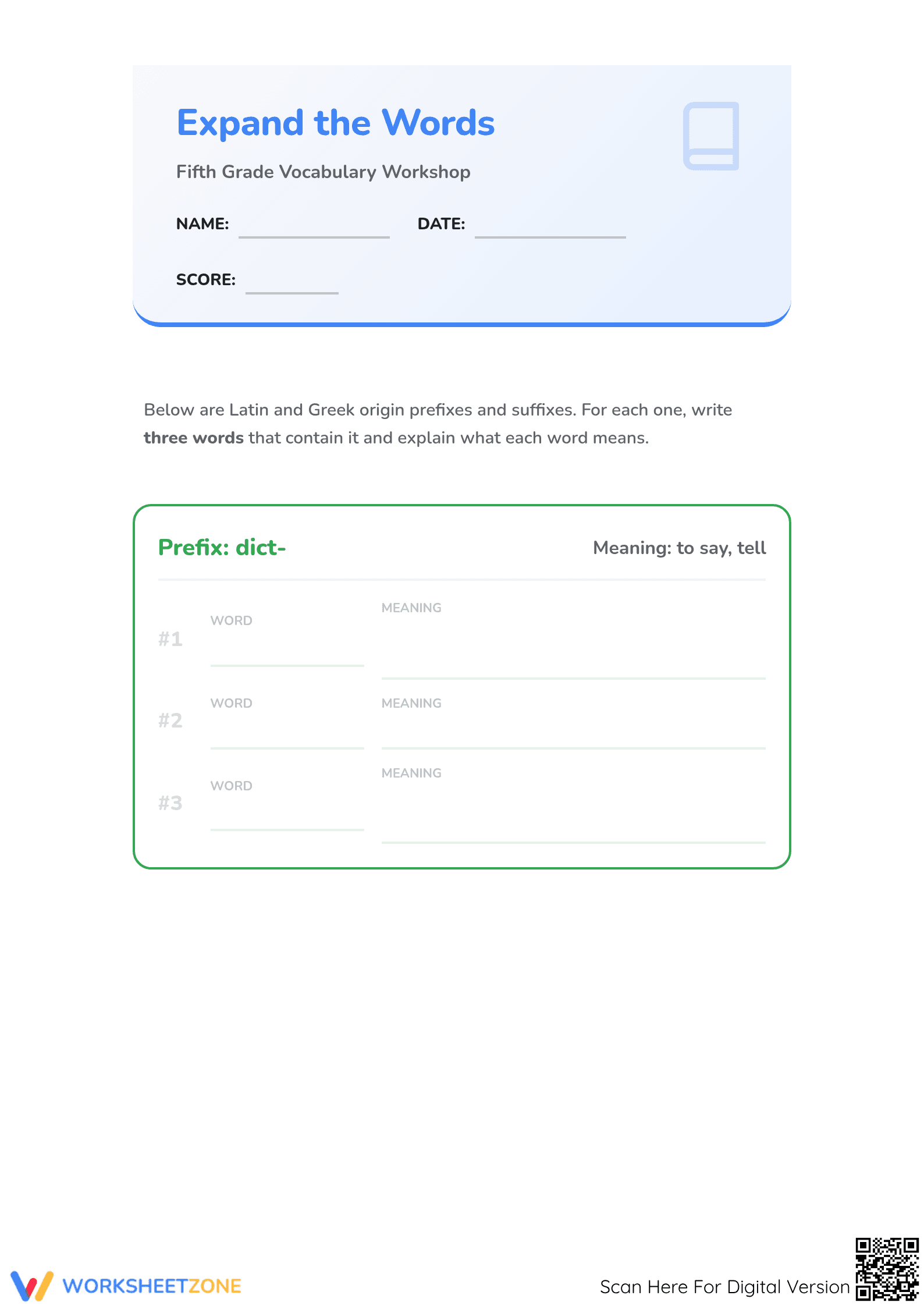
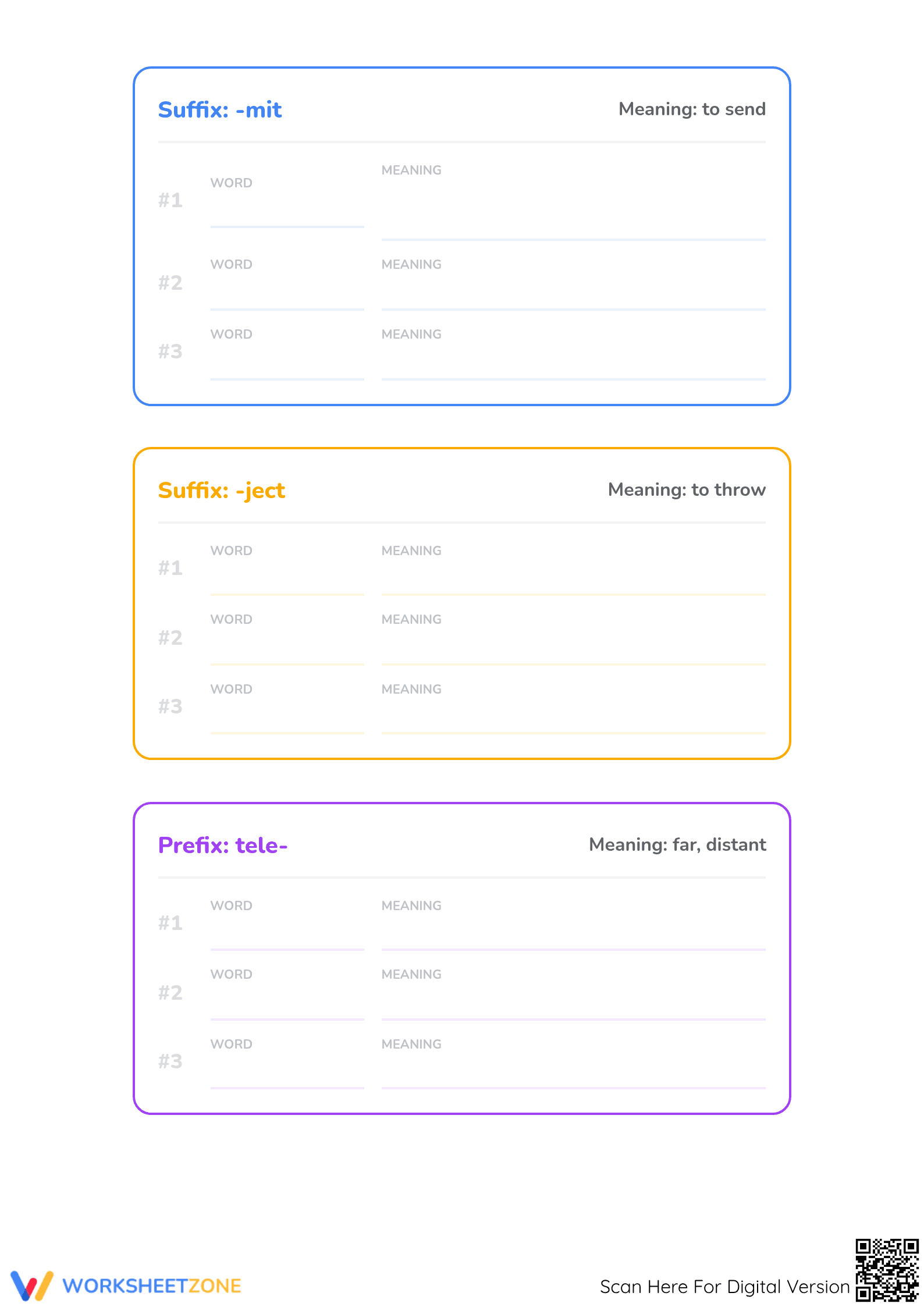
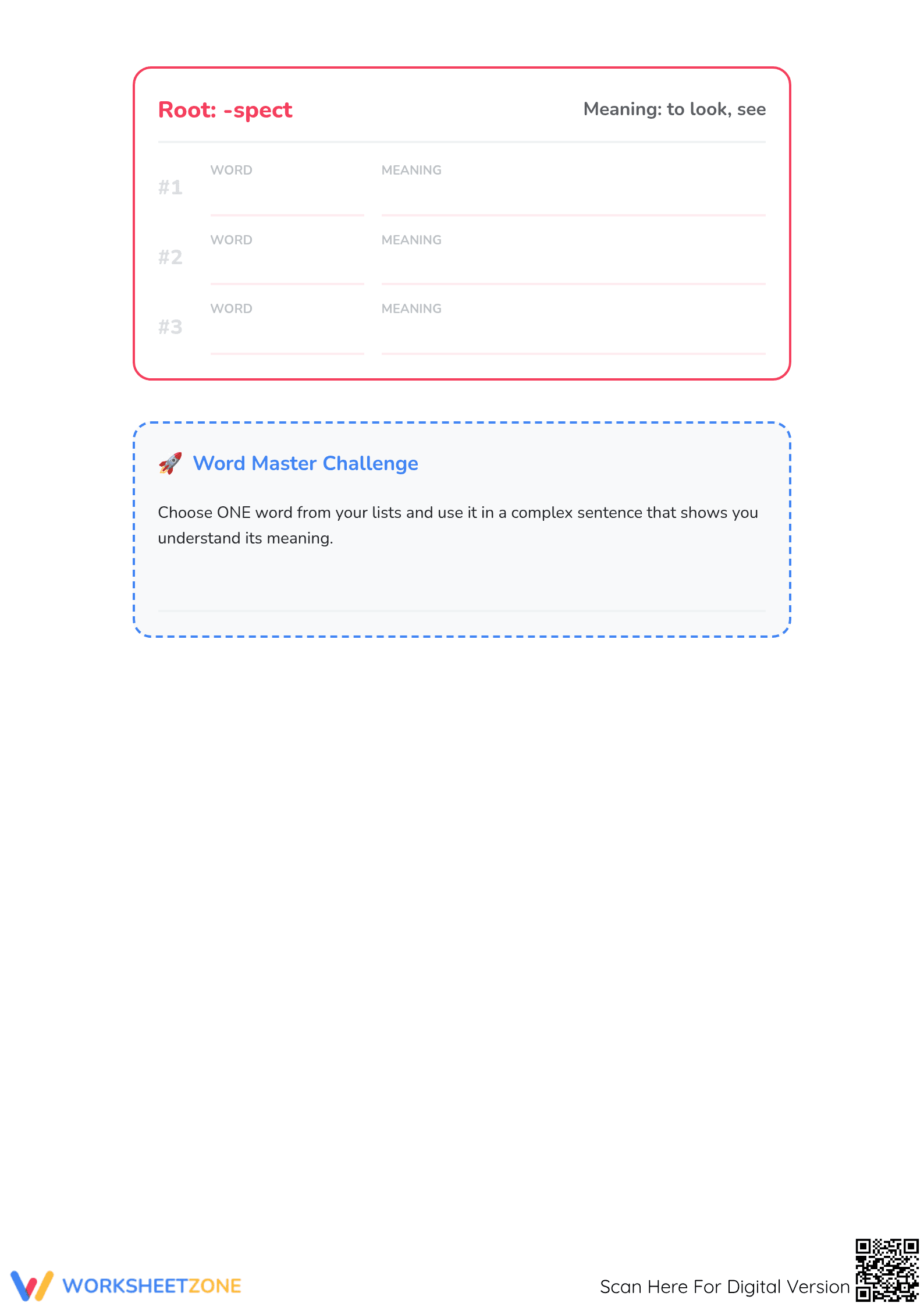
This comprehensive 3-page printable PDF is designed as a vocabulary workshop. Each page focuses on specific affixes: "dict-" (to say/tell), "-mit" (to send), "-ject" (to throw), "tele-" (far/distant), and "-spect" (to look/see). The packet includes 15 word-generation tasks along with their definitions. The final page concludes with a "Word Master Challenge" requiring vocabulary application in a complex sentence. A full answer key is included for teacher or self-correction.
Skill Progression
- Guided practice: The initial sections provide the affix and its meaning, prompting students to recall associated words within a familiar frame.
- Supported practice: As students move through the word-building slots, they connect structural components to semantic definitions without additional scaffolds.
- Independent practice: The final "Word Master Challenge" requires students to demonstrate synthesis by integrating a multi-morphemic word into a complex sentence.
This sequence follows a gradual-release model, transitioning students from identification to application of academic vocabulary.
Standards Alignment
The primary focus is CCSS.ELA-LITERACY.L.5.4.B: "Use grade-appropriate Greek and Latin affixes and roots to determine meanings." This resource also supports L.5.4.C by encouraging the use of reference materials to verify definitions. Both standard codes can be copied directly into lesson plans, IEP goals, or district curriculum mapping tools to ensure instructional alignment.
How to Use It
Use this worksheet as a focused "Vocabulary Workshop" after a direct instruction lesson on morphology. It is ideal for independent practice during ELA rotations. For formative assessment, observe students as they complete the second page; struggling to find words for "-mit" or "-ject" may indicate a need for more exposure to academic word lists. Expected completion time is 30 minutes, making it a perfect mid-week vocabulary booster.
Who It's For
This resource is tailored for Grade 5 but serves as enrichment for Grade 4 or review for Grade 6. It is particularly effective for English Language Learners (ELLs) who benefit from explicit instruction in cognates and structural analysis. Pair this with a root word anchor chart for maximum instructional impact.
Systematic instruction in roots is a foundational pillar of literacy, as approximately 60-70% of academic English is derived from these sources. Research by Fisher & Frey (2014) emphasizes that teaching morphology allows students to "multiply" their vocabulary; they learn a tool that decodes dozens of related terms. This Grade 5 worksheet aligns with CCSS.ELA-LITERACY.L.5.4.B by focusing on high-utility roots like "spect" and "dict." By requiring students to define terms and apply them in complex sentences, this resource moves beyond rote memorization. Educational analyses from EdReports 2024 suggest that structured morphological practice significantly improves reading comprehension scores on standardized assessments by reducing the cognitive load required to decode unfamiliar multi-syllabic words in informational and literary passages.


