


























Views
Downloads


Printable Grade 3-5 Greek and Latin Roots Worksheet
Paste this activity's link or code into your existing LMS (Google Classroom, Canvas, Teams, Schoology, Moodle, etc.).
Students can open and work on the activity right away, with no student login required.
You'll still be able to track student progress and results from your teacher account.
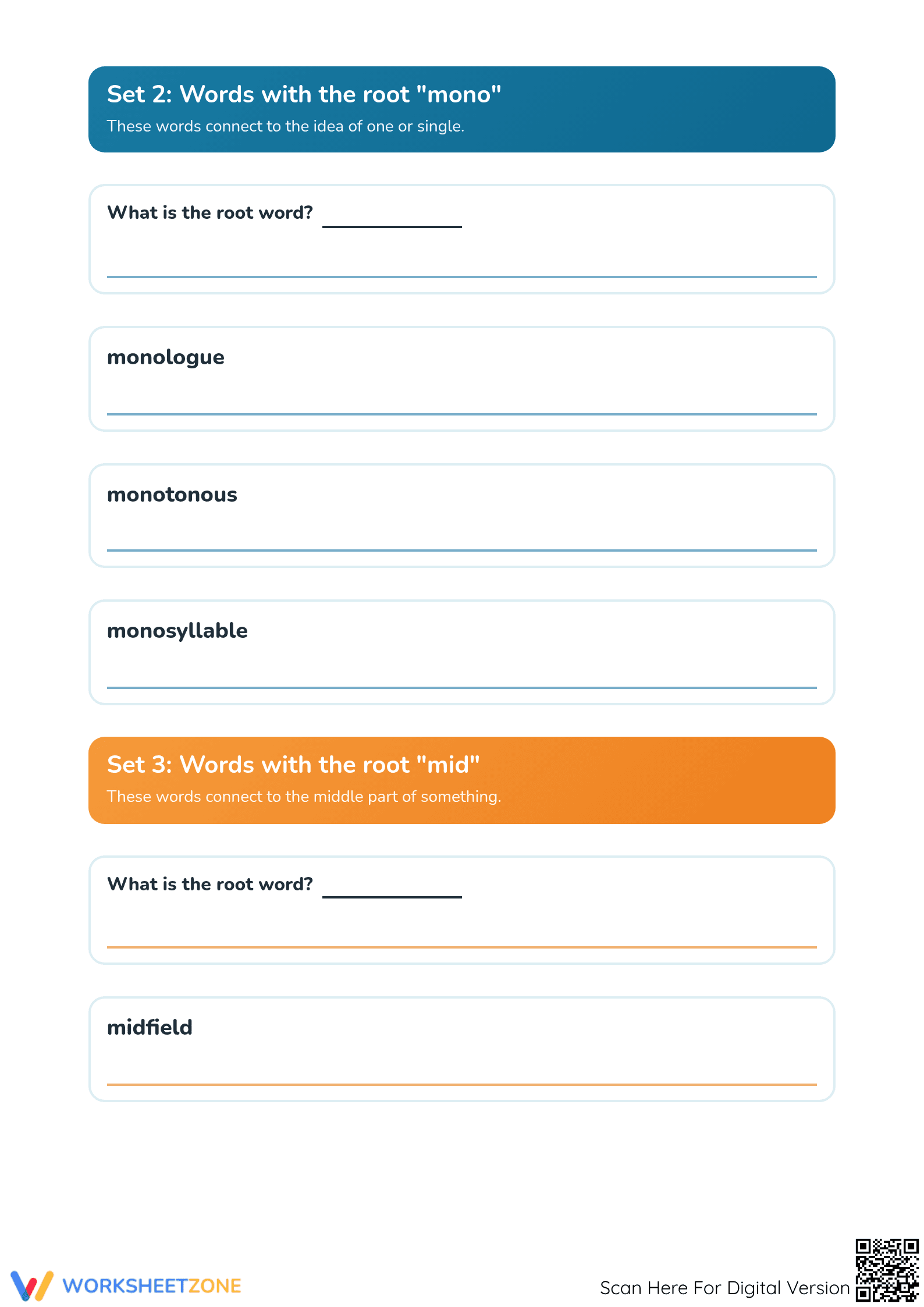
Mastering Greek and Latin roots is a foundational step in expanding a student's vocabulary and decoding complex academic texts. This worksheet guides Grade 3-5 learners through 12 focused exercises, requiring them to identify core meanings and define words like photograph, monologue, and midair. Students build linguistic flexibility by analyzing how a single root transforms multiple vocabulary terms across different contexts.
At a Glance
- Grade: 3-5 · Subject: English Language Arts
- Standard:
CCSS.ELA-LITERACY.L.4.4.B— Use common Greek and Latin affixes and roots as clues to word meaning- Skill Focus: Greek and Latin Roots Identification
- Format: 3 pages · 12 problems · Answer key included · PDF
- Best For: Independent vocabulary practice or sub plans
- Time: 20–30 minutes
This comprehensive three-page PDF contains three distinct word sets, each organized around a specific high-utility linguistic root: "photo" (light), "mono" (one/single), and "mid" (middle). Every section prompts students to isolate the root word before drafting clear definitions for three related vocabulary terms. A complete answer key is provided to facilitate rapid grading or student self-correction during independent study sessions.
Educators can integrate this resource into their daily routine with minimal effort. The three-step workflow starts with Printing (30 seconds), followed by Distributing the clear, scaffolded pages to students (30 seconds), and finally Reviewing the work using the provided answer key (1 minute). Total teacher preparation time is under two minutes, making it an ideal choice for high-pressure instructional days or emergency substitute folders.
The primary alignment is to CCSS.ELA-LITERACY.L.4.4.B, which tasks students with using common, grade-appropriate Greek and Latin affixes and roots as clues to the meaning of a word. By isolating "photo," "mono," and "mid," students develop the morphological awareness necessary for high-level reading comprehension. This standard code can be copied directly into lesson plans, IEP goals, or district curriculum mapping tools.
Assign this worksheet as a follow-up to direct instruction on affixes or as a formative assessment during a vocabulary unit. While students work, observe if they can explain the connection between the root and the final definition; for instance, identifying the concept of "light" in the word "photocopier." The 30-minute completion window makes it a perfect fit for literacy centers or morning bell-ringers.
This resource is designed for students in grades 3 through 5 who are beginning to explore complex word structures and morphological patterns. It serves as an excellent support for English Language Learners (ELL) through its consistent formatting and predictable tasks. Pair this worksheet with a root-word anchor chart to provide additional visual scaffolding during independent practice or small-group interventions.
Research from EdReports (2024) emphasizes that explicit instruction in morphology, specifically targeting Greek and Latin roots like those found in this 12-task worksheet, significantly improves long-term vocabulary retention for elementary students. By engaging with CCSS.ELA-LITERACY.L.4.4.B, learners develop a systematic approach to decoding unfamiliar multi-syllabic words across various domains. This structured practice reinforces the "morphological bridge" identified in literacy studies, allowing students to transition from simple word recognition to deep semantic analysis. The inclusion of common roots ensures that students are practicing with high-utility prefixes that appear frequently in informational texts and academic literature. This resource provides a practical application of the gradual release model, ensuring students have enough repetition to master the specific skill focus before moving to more abstract linguistic concepts.


