




























Views
Downloads


Greek and Latin Roots Worksheet for Grade 4-5: Essential

Paste this activity's link or code into your existing LMS (Google Classroom, Canvas, Teams, Schoology, Moodle, etc.).
Students can open and work on the activity right away, with no student login required.
You'll still be able to track student progress and results from your teacher account.
This Greek and Latin roots worksheet for Grade 4 and Grade 5 students focuses on identifying common root words and applying that knowledge to define related vocabulary. By recognizing shared linguistic foundations, students can decode complex academic terms and improve overall reading comprehension. This resource provides structured practice for essential morphological skills.
At a Glance
- Grade: 4–5 · Subject: English Language Arts
- Standard:
CCSS.ELA-LITERACY.L.4.4.B— Use grade-appropriate Greek and Latin roots as clues to word meanings- Skill Focus: Morphology and Root Identification
- Format: 3 pages · 20 problems · Answer key included · PDF
- Best For: Vocabulary expansion and morphological analysis
- Time: 20–30 minutes
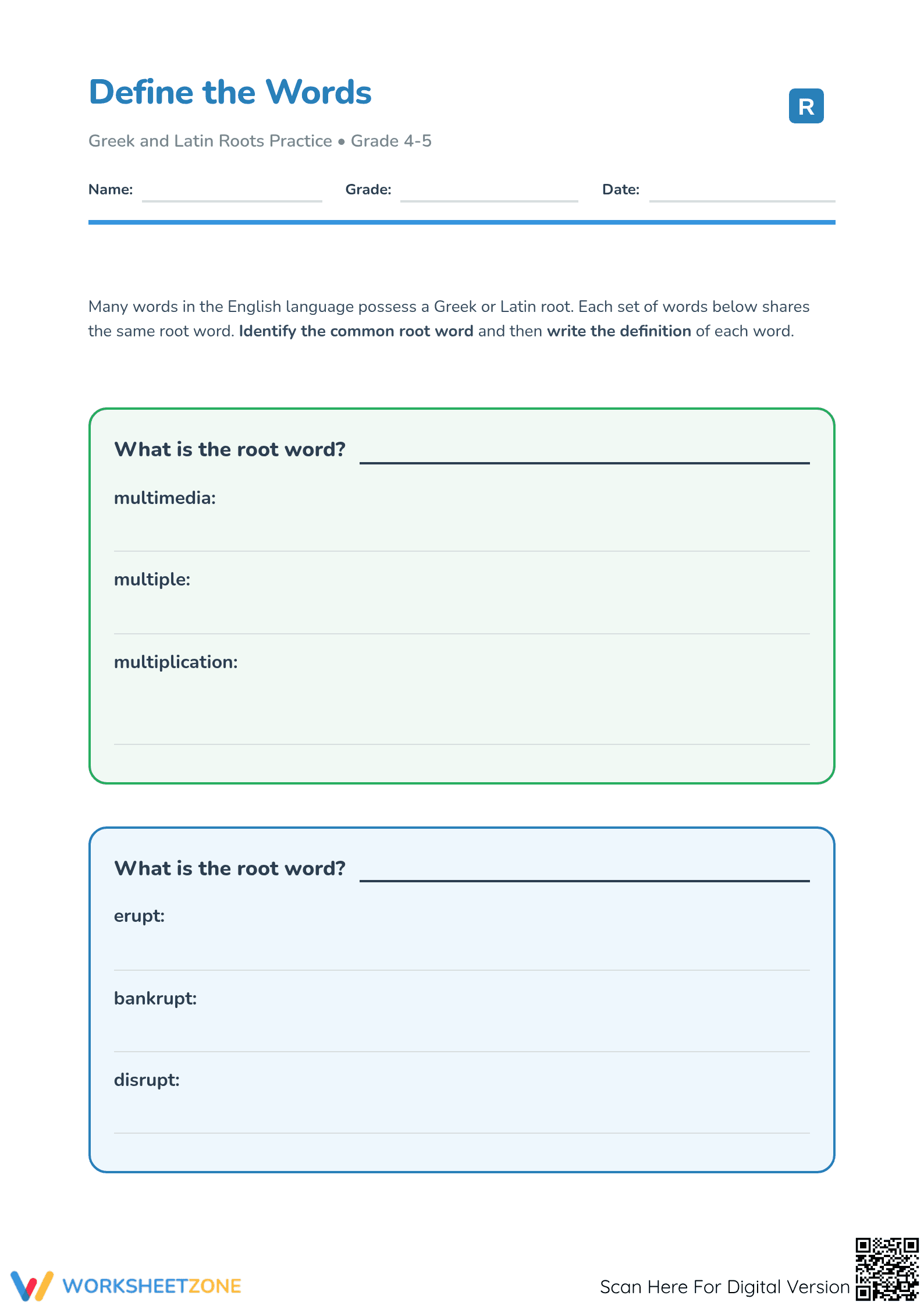
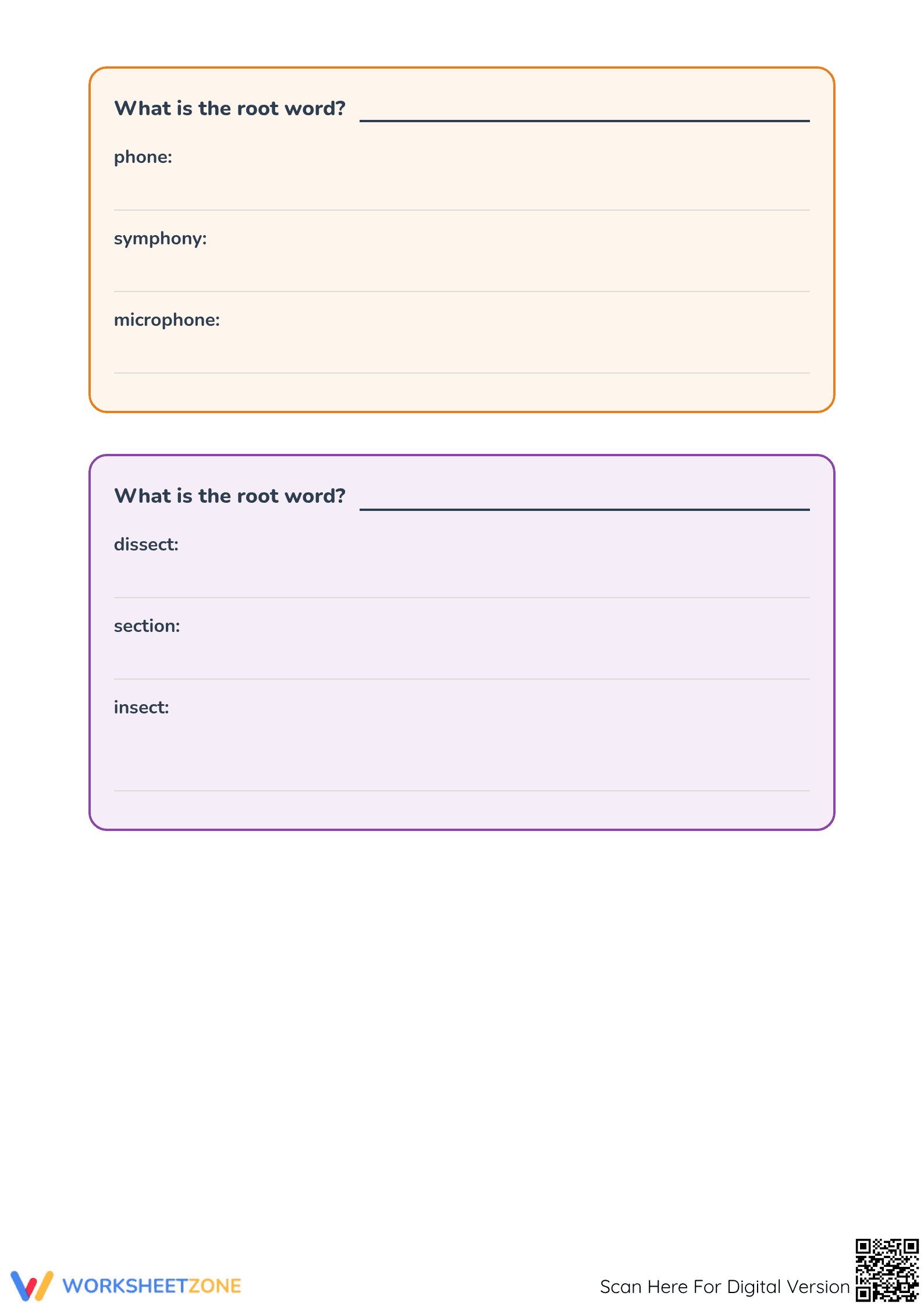
The three-page PDF contains five distinct sets of practice exercises. Each set presents three words sharing a common root—such as "multimedia," "multiple," and "multiplication"—and requires students to identify the shared root and write a concise definition for each word. A comprehensive answer key is included for immediate verification.
Zero-Prep Workflow
Educators can implement this resource with minimal effort. First, print the three-page set for each student in approximately thirty seconds. Second, distribute the materials and provide a brief model using the first box to clarify expectations. Third, review the completed definitions as a whole group or using the provided answer key to address any misconceptions.
Standards Alignment
This resource is aligned with CCSS.ELA-LITERACY.L.4.4.B, which requires students to use common, grade-appropriate Greek and Latin affixes and roots as clues to the meaning of a word. It also supports L.5.4.B objectives. Both standard codes can be copied directly into lesson plans, IEP goals, or district curriculum mapping tools.
How to Use It
Use this worksheet as a formative assessment after an introductory lesson on morphology. It works well during a literacy station rotation or as a homework assignment to reinforce classroom learning. Teachers should observe if students can identify the root "rupt" in "bankrupt" to gauge their ability to break down unfamiliar multisyllabic words.
Who It's For
This practice is designed for upper elementary students, particularly those in Grade 4 and Grade 5, who are transitioning to more complex academic vocabulary. It provides excellent support for English Language Learners and can be paired with a Greek and Latin roots anchor chart for additional scaffolding during independent work.
Understanding Greek and Latin roots is a critical component of lexical development in the upper elementary years. According to Fisher & Frey (2014), morphological awareness significantly contributes to reading proficiency by providing students with a systematic approach to decoding unknown words. This worksheet targets CCSS.ELA-LITERACY.L.4.4.B by requiring students to isolate roots and synthesize meanings across related word families. By engaging with twenty specific tasks, learners build the structural knowledge necessary for academic success in middle school and beyond. Research from NAEP indicates that students who possess strong root identification skills perform better on standardized comprehension assessments. This resource ensures that students move beyond rote memorization toward a functional understanding of word parts. This citation capsule provides a concise summary of the worksheet's instructional value and its alignment with established pedagogical frameworks for literacy development.


