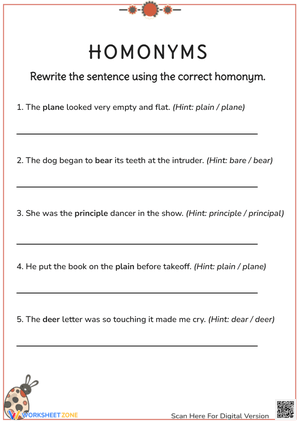
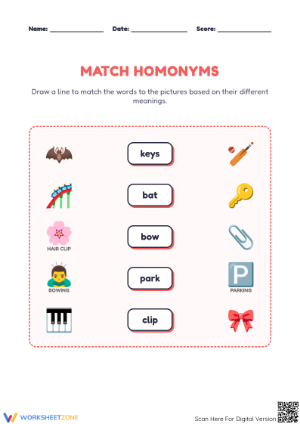
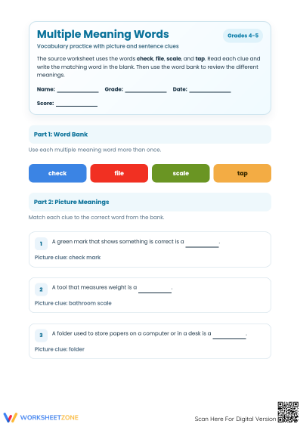
These 4th grade homonyms worksheets resources zero in on the word pairs that appear most often in 4th grade writing — and get marked wrong just as reliably. The set covers both homophones and homographs, with exercises built around reading context clues so students are making meaning rather than pulling answers from a memorized list.
The Specific Skills Each Worksheet Targets
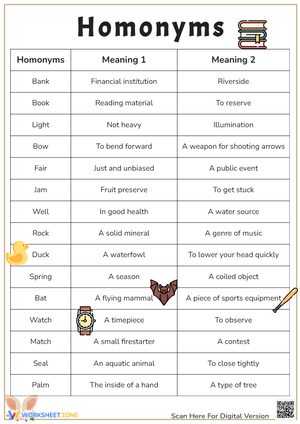
Homophones — words that sound identical but carry different spellings and meanings — make up the core of the set. The pairings prioritized here are the ones that surface constantly in independent writing: their/there/they're, to/too/two, your/you're, accept/except, and peace/piece. Homograph worksheets work with words like lead, wind, bow, and bat — words where correct meaning depends entirely on the surrounding sentence.
Exercise types vary across the set to keep practice from becoming mechanical:
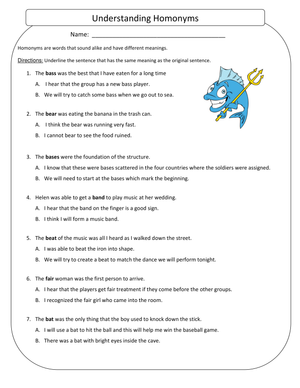
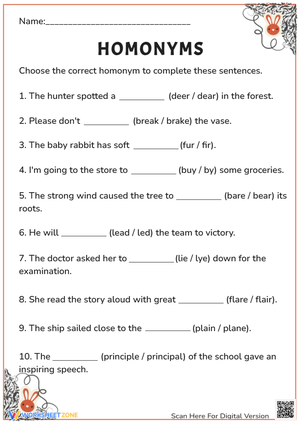
- Fill-in-the-blank prompts where students read the full sentence before selecting the correct word
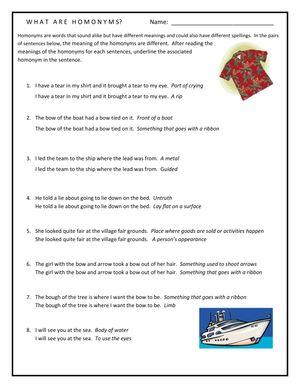
- Rewrite tasks asking students to fix an incorrect usage and identify the specific words in the sentence that signal the right choice
- Sorting activities that require students to group homophones separately from homographs and explain their reasoning
- Original sentence writing where students compose their own examples that make both meanings of a target pair unambiguous through context
Where These Words Consistently Trip Students Up
The most persistent homonym error in 4th grade writing isn't there/their/they're — it's its and it's. Students spend most of 3rd grade learning that possessives take apostrophes (the dog's leash, Maria's backpack). They've applied that rule correctly dozens of times, so when they write "The turtle returned to it's shell," they aren't ignoring grammar — they're following a rule they genuinely learned. Pointing out that its behaves like his and her (possessive pronouns carry no apostrophe) tends to break the habit faster than restating the contraction explanation a fourth time.
For homographs, the error usually surfaces in reading rather than writing. A student who silently reads lead in a science passage often defaults to the "leed" pronunciation — guiding or directing — and misses the reference to the metal entirely. That student looks fluent by all surface measures. The comprehension gap only becomes visible when you ask them to explain what the sentence meant. Exercises that require students to write two distinct definitions for a single homograph — and underline the words that signaled each meaning — make that reasoning visible rather than assumed.
Where These Worksheets Fit in the Teaching Week
The most effective placement isn't a standalone lesson block — it's the editing and revision stage of writing workshop. When students have a draft in front of them, using one worksheet as a scan checklist ties the exercise directly to real writing decisions. "Underline every there/their/they're in your draft and check each one against what you practiced" creates the transfer that isolated exercise rarely achieves on its own.
A 4th grade homonyms worksheets set also works cleanly as a Monday warm-up during a vocabulary unit. Three fill-in-the-blank sentences, five minutes, whole-class debrief — students talk through which context words made the answer clear. Running that routine for four consecutive weeks, each week targeting a new homonym cluster, builds word awareness steadily without pulling a full lesson period. One worksheet used as a formative check at the end of that week gives a clear picture of who still needs more practice before the next writing assignment is due.
Standard Alignment
These 4th grade homonyms worksheets resources address CCSS.ELA-LITERACY.L.4.4, which places vocabulary acquisition — and specifically the use of context to determine word meaning — at the center of 4th grade language work. Homonyms make this standard concrete in a way that few other word study topics can match: the word bark is completely indeterminate without the surrounding sentence. Students cannot rely on letter patterns, root words, or prior encounters with the word in isolation. They have to read the full context. L.4.4a narrows the standard further by naming sentence-level context as a primary strategy, which maps directly to the fill-in-the-blank and rewrite exercises here.
Adjusting the Work for Different Learners in the Room
Students who consistently mix up homophones in writing often find these exercises frustrating when the sentence lacks enough surrounding information. A small adjustment helps: before students attempt the fill-in-the-blank questions, provide two labeled model sentences — one for each meaning of the target pair — that they can reference during the task. That support structure reduces memory load without simplifying the core skill of reading for meaning. It takes about two minutes to write and makes the same worksheet accessible without altering its demands.
For students who move through the exercises accurately and quickly, recognition is no longer the right challenge. Ask them to write a short paragraph — four to six sentences — that correctly uses three homonym pairs from memory, with no word bank available. A partner then reads the paragraph and marks each homonym pair they can identify. The writer's job is to create context that makes every correct meaning unambiguous. That is a genuinely harder task than choosing between two given options, and it mirrors the actual demand of independent writing.
Frequently Asked Questions
What is the difference between a homophone and a homograph, and do I need to teach both terms explicitly?
Yes — at 4th grade, the distinction is worth teaching directly because it tells students where to focus their attention. Homophones require spelling accuracy: sea and see sound identical, so students must rely on meaning to choose correctly. Homographs require attention to context for both meaning and sometimes pronunciation: wind the noun and wind the verb look the same on the page but sound different when read aloud. Once students can name which type of confusion they're dealing with, the fix becomes easier to find.
How do I handle "affect" and "effect" given that adults mix them up too?
Directly — and with honesty about why the words are difficult. They cause confusion in part because both appear in similar grammatical positions in a sentence. The most reliable anchor for 4th graders: effect is almost always a noun (try putting "the" in front of it — "the effect was immediate" works). Affect is almost always a verb (something affects something else). That covers the vast majority of cases students encounter at this grade level, and these 4th grade homonyms worksheets resources include sentences specifically built to practice that distinction in context rather than through definition alone.
Can students reading below grade level access these worksheets without extra preparation?
Students reading significantly below grade level may struggle when a context clue depends on understanding the full grammatical structure of the sentence. The adjustment described in the differentiation section above — providing labeled model sentences before each exercise — helps most students enter the task. For students who need more than that, a brief oral preview works: read two example sentences aloud, ask students to explain the difference between the two meanings in their own words, then have them attempt the worksheet independently. That two-minute exchange reduces the barrier enough to make the practice productive rather than discouraging.












 Interactive Worksheet Maker
 Quiz Maker
 Word Search Maker
 Crossword Puzzle Maker
 Word Scramble Generator
 Sentence Scramble Generator
 Handwriting Worksheet Generator
 Name Tracing Generator
 Fill In The Blank Generator