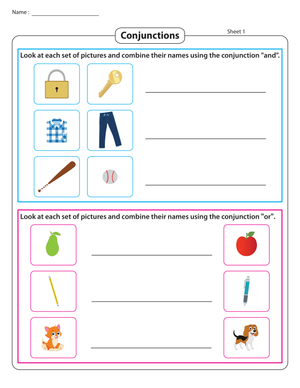
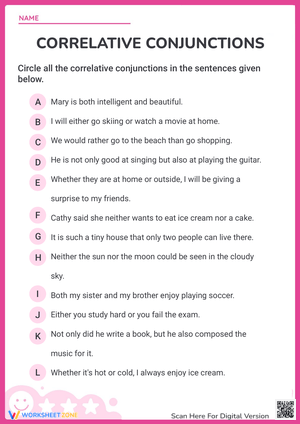
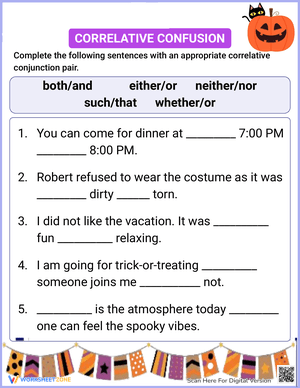
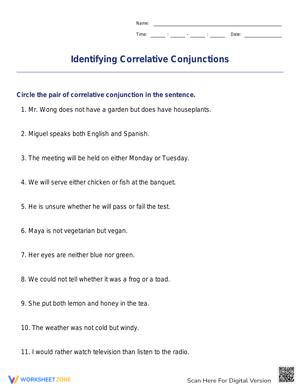
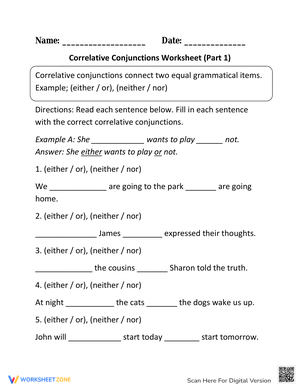
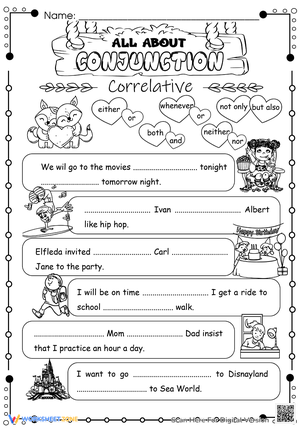
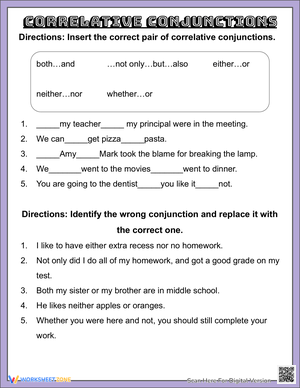
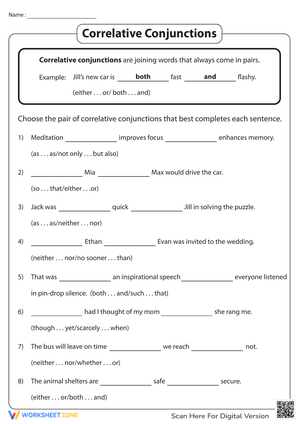
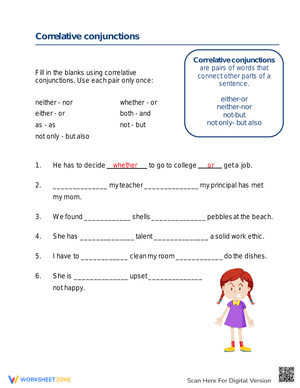
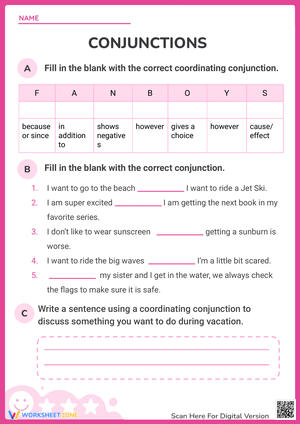
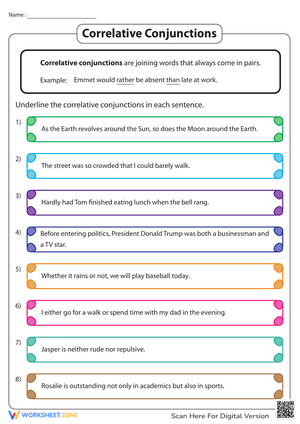
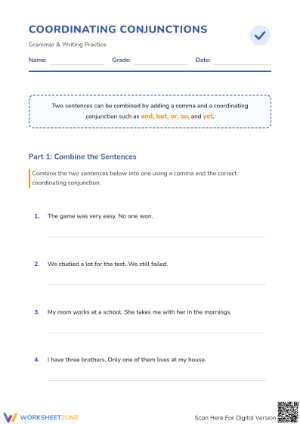
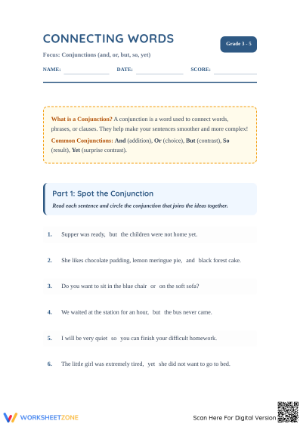
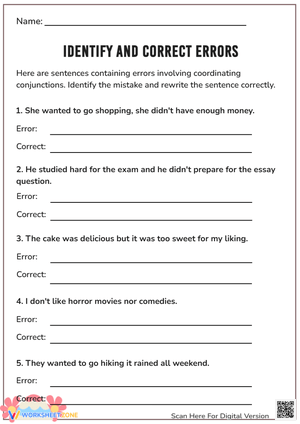
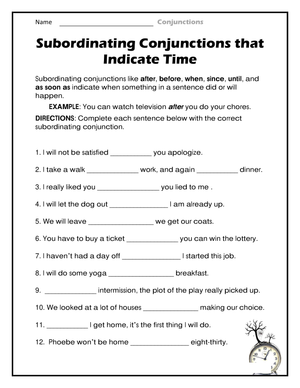
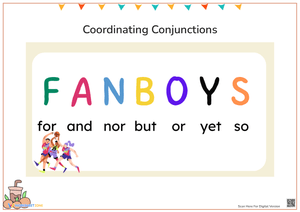
These conjunctions worksheets for 4th grade address the exact grammar transition the grade-level standards require: moving students from simple, disconnected sentences to compound and complex constructions that show cause, contrast, and condition. The set covers all seven coordinating conjunctions, a core group of subordinating conjunctions, and the comma rules that apply to both sentence types. Task formats include identification, error correction, and sentence combining — each targeting a different layer of the skill.
What's Inside the Set
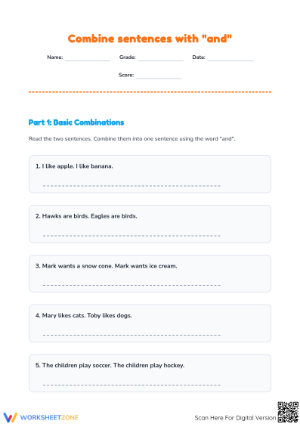
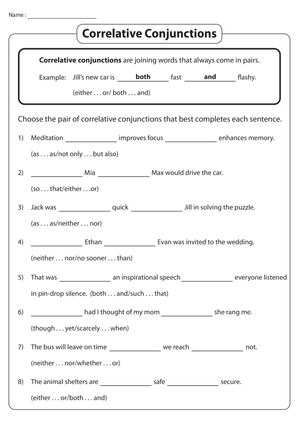
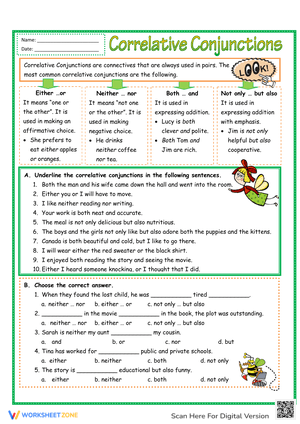
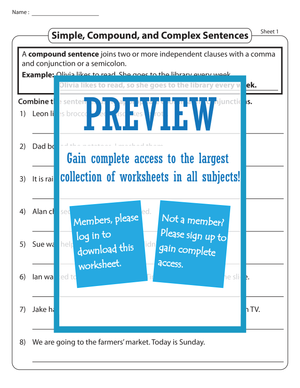
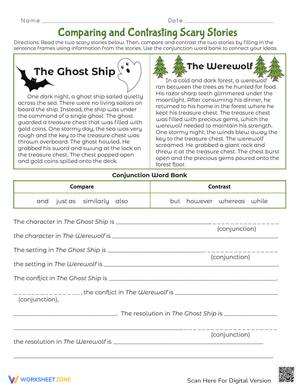
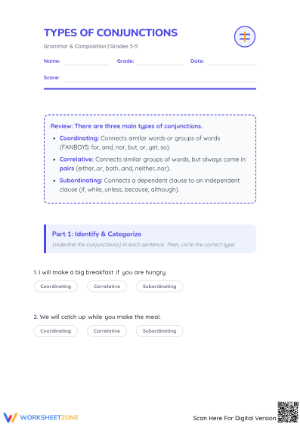
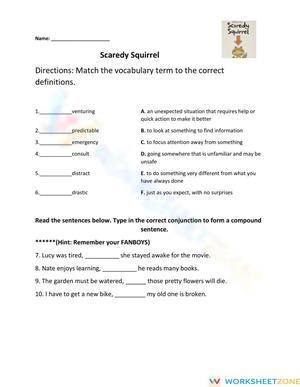
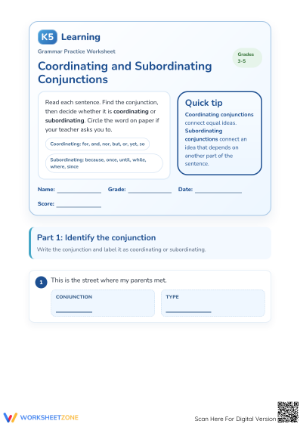
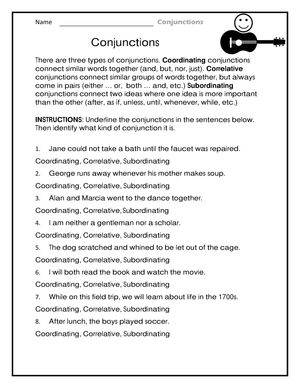
The task formats in conjunctions worksheets for 4th grade fall into three categories: identification and selection, sentence repair, and open-ended combining. Identification exercises ask students to read two related sentences, determine the logical relationship between them — addition, contrast, cause, condition — and choose the conjunction that expresses that relationship. Repair tasks present run-on sentences and comma splices; students insert a conjunction and correct punctuation to fix them. Sentence-combining tasks give students two simple sentences and ask them to produce one compound or complex sentence, choosing both the conjunction and the punctuation themselves.
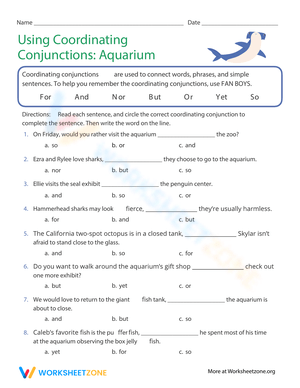
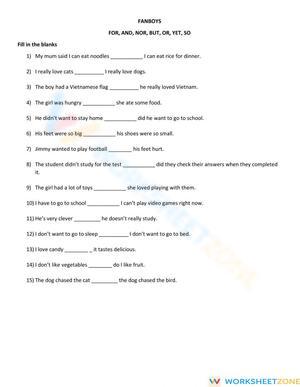
The coordinating conjunctions receive the most coverage. FANBOYS — for, and, nor, but, or, yet, so — are practiced in isolation and in longer passage contexts. One conjunction deserves particular attention from teachers: "nor" is the only FANBOYS word that forces subject-auxiliary inversion in the clause that follows it. Students who handle "and," "but," and "or" without trouble will still write "nor he liked broccoli" because they apply the same word-order logic they use everywhere else. Worksheets that isolate this pattern and show the corrected form — "nor did he like broccoli" — give students time to absorb it before they need to produce it independently.
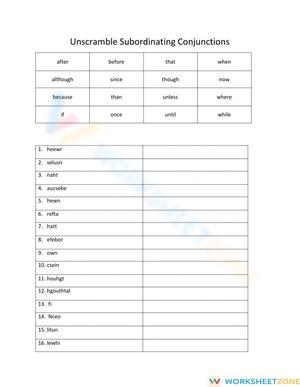
Subordinating conjunctions — because, although, if, since, when, while — have dedicated worksheets as well. Students mark the dependent clause, rewrite sentences to shift the dependent clause from the end to the front of the sentence, and apply the comma rule each position requires. The movement exercise earns its time: students who only ever see dependent clauses at the end of sentences never develop an intuition for why the fronted version needs a comma, and that gap shows up in their writing for years.
Student Errors Worth Anticipating and Addressing
The most predictable error in fourth-grade compound sentence work is the missing comma before a coordinating conjunction. Students absorb the conjunction choice fairly quickly but drop the comma — producing "She wanted to stay but she had to leave" — because they are managing three things at once: which conjunction fits, what each clause means, and how long the sentence is becoming. Worksheets that isolate the comma decision by presenting already-joined sentences and asking only for the missing punctuation reduce that load. Students practice the rule without the distraction of the other choices.
A second pattern appears with subordinating conjunctions: the fragment. Once students learn that "because" answers a "why" question, they begin writing "Because she was tired." as a complete sentence and moving on. On student papers, these fragments almost always appear directly after a full statement — the dependent clause got separated from the sentence it belongs to. Worksheets that ask students to underline the independent clause and circle the dependent clause make the structural dependency visible in a way that teacher markup in a draft rarely does. Students can see the orphaned clause.
There is also a third pattern — an overcorrection — that surfaces after students learn the comma-before-FANBOYS rule. Some students start inserting commas before "but" or "or" even when the conjunction is only joining two words or phrases, not two full clauses. "She packed a sweater, but not a raincoat" is the result. The comma does not belong there. This is a sign the rule was learned by surface pattern rather than by understanding what the conjunction is actually connecting, and it is worth addressing directly when it appears in student work.
Fitting These Worksheets Into Your Weekly Instruction
These work best immediately after direct instruction, not as a standalone homework task or a warm-up the day after a lesson. A 15-minute lesson on coordinating conjunctions and comma placement — two worked examples on the board, a short discussion of why the comma is there — followed immediately by the sentence-combining worksheet produces better retention than assigning it the next day. Students forget the comma rule overnight; the immediate practice anchors it.
Subordinating conjunction worksheets integrate well into writing workshop. When students are drafting informational or narrative paragraphs, they produce a steady stream of "because" fragments without noticing. Pausing the workshop for 10 minutes to work through a dependent-clause exercise addresses the error students are making at that exact moment. The worksheet gives the error a name and a fix; the draft gives students a place to apply the correction immediately.
For Monday morning warm-ups, the sentence-combining format requires no setup and still produces real practice. Students pick up a worksheet as they settle in, work through five or six sentence pairs, and discuss two or three as a class before the lesson begins. Returning to this format across three or four consecutive Mondays consolidates the conjunction rules without consuming full instructional blocks — and the repetition is where the retention actually comes from.
Standard Alignment
These worksheets address CCSS.ELA-Literacy.L.3.1h, the Grade 3 standard introducing coordinating and subordinating conjunctions, which Grade 4 teachers consistently reinforce because most students arrive needing more practice before they can apply these constructions reliably in their own writing. The comma and fragment work connects directly to CCSS.ELA-Literacy.L.4.1f, which requires students to produce complete sentences and correct inappropriate fragments and run-ons. In classroom terms, these two standards run alongside each other for most of the conjunction unit: students build on prior knowledge while also meeting the more exacting punctuation conventions Grade 4 demands. The worksheets address both without separating them into disconnected exercises.
Adapting the Set for Different Student Levels
Students who are still building fluency with simple sentences benefit from starting with the more structured exercises — those that provide both complete clauses and ask only for the conjunction and comma — rather than open-ended combining. For students who freeze on open-ended tasks, conjunctions worksheets for 4th grade that provide both clauses already written out keep the cognitive demand narrowly on the conjunction choice itself. When the only question is "which word goes in this blank," students can focus on meaning and logic rather than on generating language while simultaneously applying a rule they haven't yet internalized.
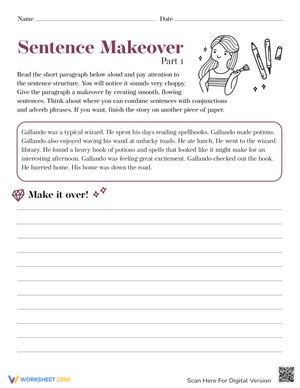
Students who handle the standard exercises quickly can be given a short paragraph written entirely in simple sentences with the instruction to reduce the sentence count by at least two, using a mix of coordinating and subordinating conjunctions. This revision task compresses meaning and requires holding the full paragraph in mind while making decisions — a different cognitive challenge from filling in blanks, and closer to the actual writing work the standard is building toward.
Frequently Asked Questions
Do these worksheets cover both coordinating and subordinating conjunctions?
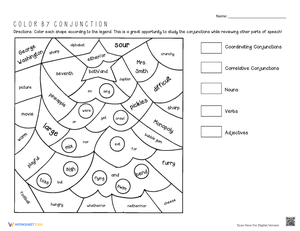
Yes. Each worksheet focuses on one conjunction type or one specific skill within that type. Coordinating and subordinating conjunctions are kept on separate worksheets so students aren't switching between two different rule sets within a single exercise.
How does conjunction practice connect to what students are writing in class?
The mechanics practiced here — combining clauses, placing commas correctly, recognizing fragments — appear directly in student drafts. After a student finishes a worksheet on "although," the productive follow-up is opening a writing journal and locating a place where "although" would replace a weak transition or two choppy sentences. Using conjunctions worksheets for 4th grade as a bridge between targeted grammar practice and actual drafting, rather than as a standalone exercise, is where the practice gains the most traction.
When in the year do teachers typically use these?
Most Grade 4 teachers introduce coordinating conjunctions in the first quarter alongside the compound sentence unit and move to subordinating conjunctions in the second quarter, when students are writing longer pieces and need more nuanced connectors. These worksheets fit both introduction points. They also hold up as review in the third or fourth quarter before state writing assessments, when brief, targeted grammar sessions produce more results than re-teaching full lessons from the start of the year.
Are answer keys included?
Yes. Each worksheet comes with a teacher answer key. For sentence-combining exercises where more than one correct version is possible, the key lists two or three acceptable answers so teachers can evaluate student responses without generating alternatives on the spot.












 Interactive Worksheet Maker
 Quiz Maker
 Word Search Maker
 Crossword Puzzle Maker
 Word Scramble Generator
 Sentence Scramble Generator
 Handwriting Worksheet Generator
 Name Tracing Generator
 Fill In The Blank Generator