




























Views
Downloads
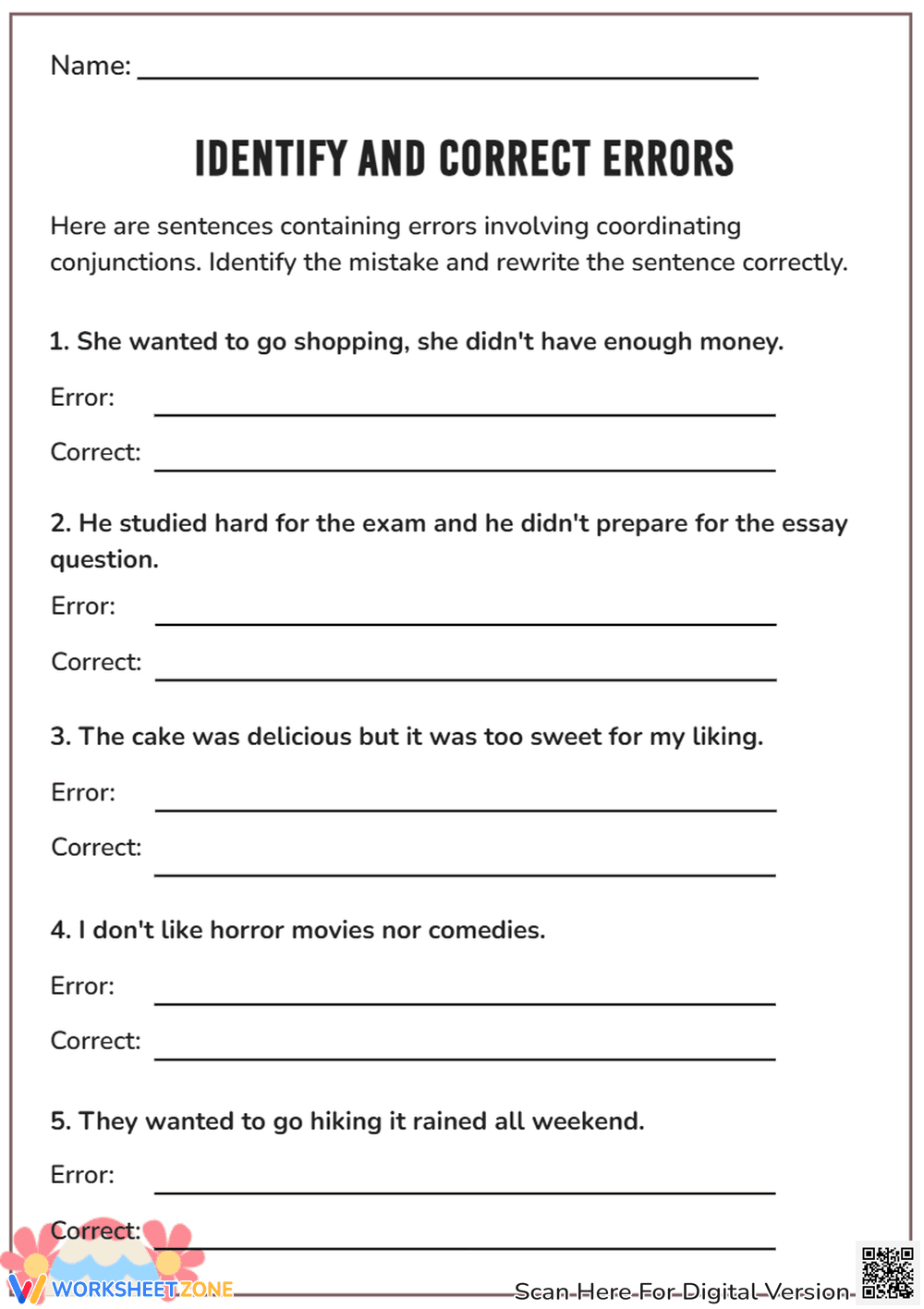

Grade 3 Coordinating Conjunctions — Printable Worksheet

Paste this activity's link or code into your existing LMS (Google Classroom, Canvas, Teams, Schoology, Moodle, etc.).
Students can open and work on the activity right away, with no student login required.
You'll still be able to track student progress and results from your teacher account.
Students master sentence structure by identifying and correcting errors in coordinating conjunctions. This worksheet targets common grammar mistakes, helping learners rewrite sentences with proper punctuation and conjunction usage. By analyzing incorrect sentences, students build the critical editing skills necessary for clear, effective writing.
At a Glance
- Grade: Grade 3 · Subject: English Language Arts
- Standard:
CCSS.ELA-LITERACY.L.3.1.H— Use coordinating and subordinating conjunctions correctly in sentences- Skill Focus: Coordinating conjunction error correction
- Format: 1 page · 5 problems · Answer key included · PDF
- Best For: Independent grammar practice and quick assessment
- Time: 10–15 minutes
What's Inside
This single-page resource features 5 structured sentence-correction tasks. Each task presents a sentence containing a specific error related to coordinating conjunctions, such as incorrect conjunction choice or missing punctuation. Below each sentence, dedicated lines prompt students to explicitly state the error before rewriting the corrected sentence, reinforcing active analysis and handwriting practice.
Zero-Prep Workflow
Implement this resource with a simple three-step workflow that requires under 2 minutes of teacher preparation. First, print the single-page PDF for your class. Second, distribute the sheets to students for independent work or a quick warm-up activity. Third, review the answers as a whole group using the included answer key. This straightforward design makes it an ideal option for emergency sub plans or morning work.
Standards Alignment
This worksheet aligns directly with `CCSS.ELA-LITERACY.L.3.1.H`, which requires students to use coordinating and subordinating conjunctions. Additionally, it supports foundational writing standards by encouraging students to recognize and correct run-on sentences and comma splices. Both standard codes can be copied directly into lesson plans, IEP goals, or district curriculum mapping tools.
How to Use It
Use this worksheet during the independent practice phase of your grammar lesson, immediately following direct instruction on coordinating conjunctions (AND, BUT, OR, SO). Alternatively, assign it as a formative assessment exit ticket to gauge student understanding before moving to complex sentences. While students work, observe whether they can explain why a conjunction is incorrect, which takes about 12 minutes.
Who It's For
This resource is designed for third and fourth-grade students learning basic sentence mechanics. It serves as excellent remediation for older struggling writers or as an enrichment activity for advanced second graders. Pair this worksheet with a coordinating conjunctions anchor chart or a short reading passage to help students identify conjunctions in context.
This educational resource targets the mechanics of sentence construction, specifically focusing on CCSS.ELA-LITERACY.L.3.1.H to help students identify and correct errors in coordinating conjunctions. According to research by Fisher & Frey (2014) on the gradual release of responsibility, structured error-correction tasks bridge the gap between guided instruction and independent writing mastery. By analyzing 5 distinct sentence errors, students develop metalinguistic awareness, learning to evaluate sentence cohesion and syntax. This analytical approach prevents common writing pitfalls like run-on sentences and comma splices. The worksheet provides a clear diagnostic tool for educators to assess student proficiency in grammar mechanics. Teachers can easily integrate this targeted practice into daily ELA routines to support writing development. This standalone tool ensures students build the foundational editing skills required for successful written communication.


