




























Views
Downloads

Essential Conjunctions Worksheet | Grade 3-5 ELA

Paste this activity's link or code into your existing LMS (Google Classroom, Canvas, Teams, Schoology, Moodle, etc.).
Students can open and work on the activity right away, with no student login required.
You'll still be able to track student progress and results from your teacher account.
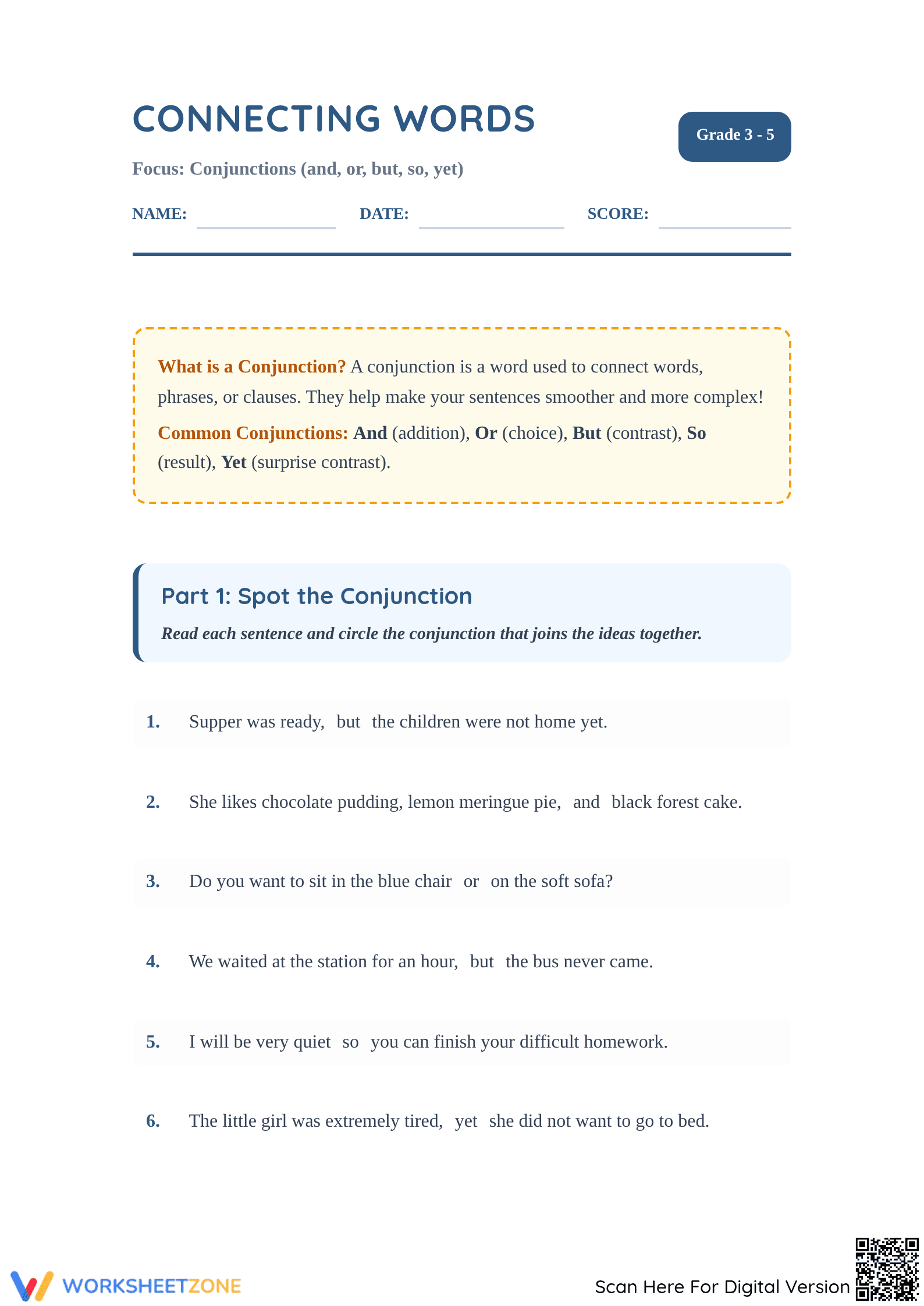
This comprehensive conjunctions worksheet for Grades 3, 4, and 5 provides students with targeted practice in identifying and using connecting words like "and," "but," "or," "so," and "yet." By completing these structured exercises, students master the ability to join phrases and clauses, resulting in smoother and more complex sentence structures.
At a Glance
- Grade: 3-5 · Subject: English Language Arts
- Standard:
CCSS.ELA-LITERACY.L.3.1.H— Use coordinating and subordinating conjunctions to produce simple, compound, and complex sentences.- Skill Focus: Coordinating Conjunctions
- Format: 4 pages · 28 problems · Answer key included · PDF
- Best For: Grammar reinforcement and sentence combining practice
- Time: 25–35 minutes
What's Inside
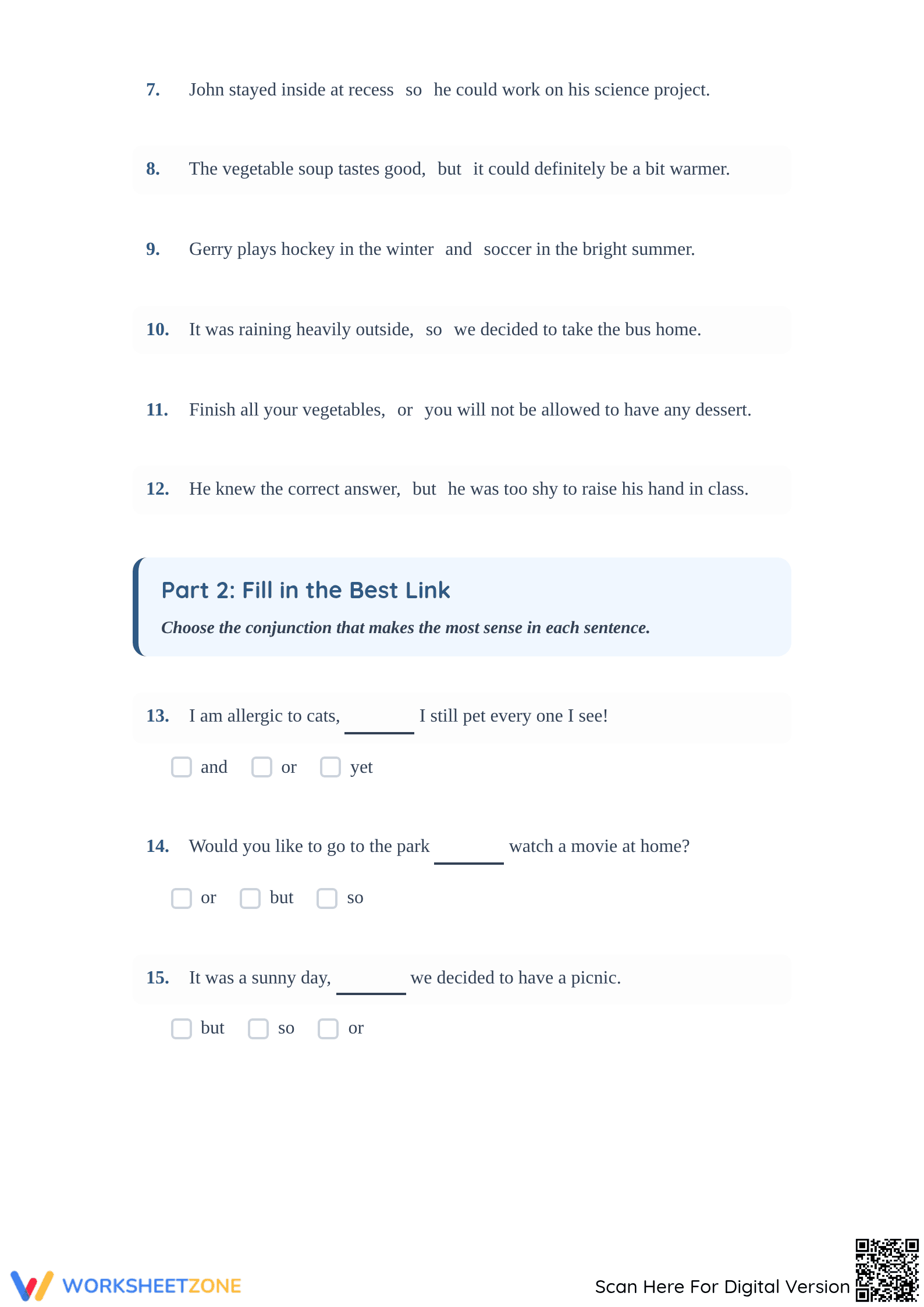
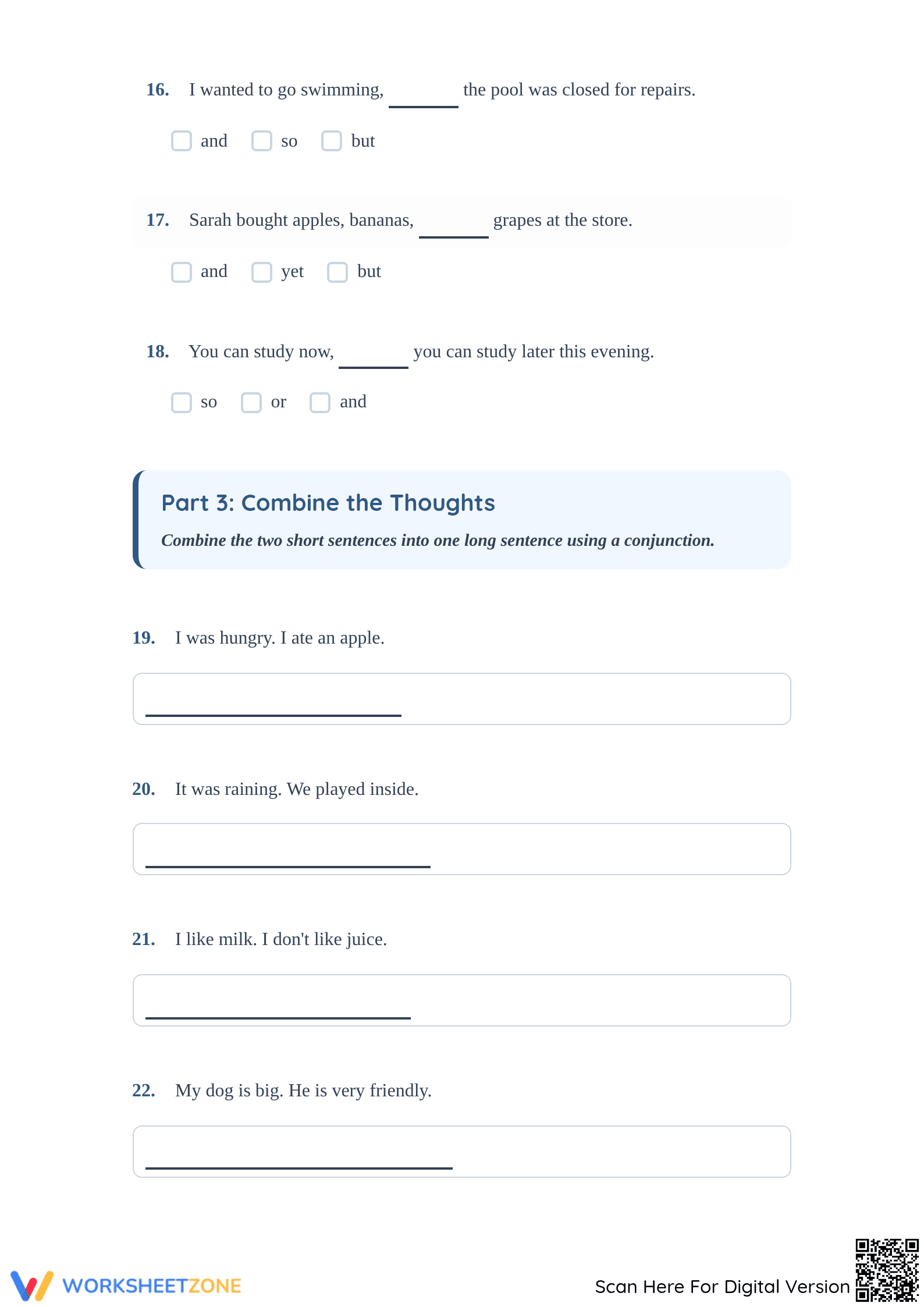
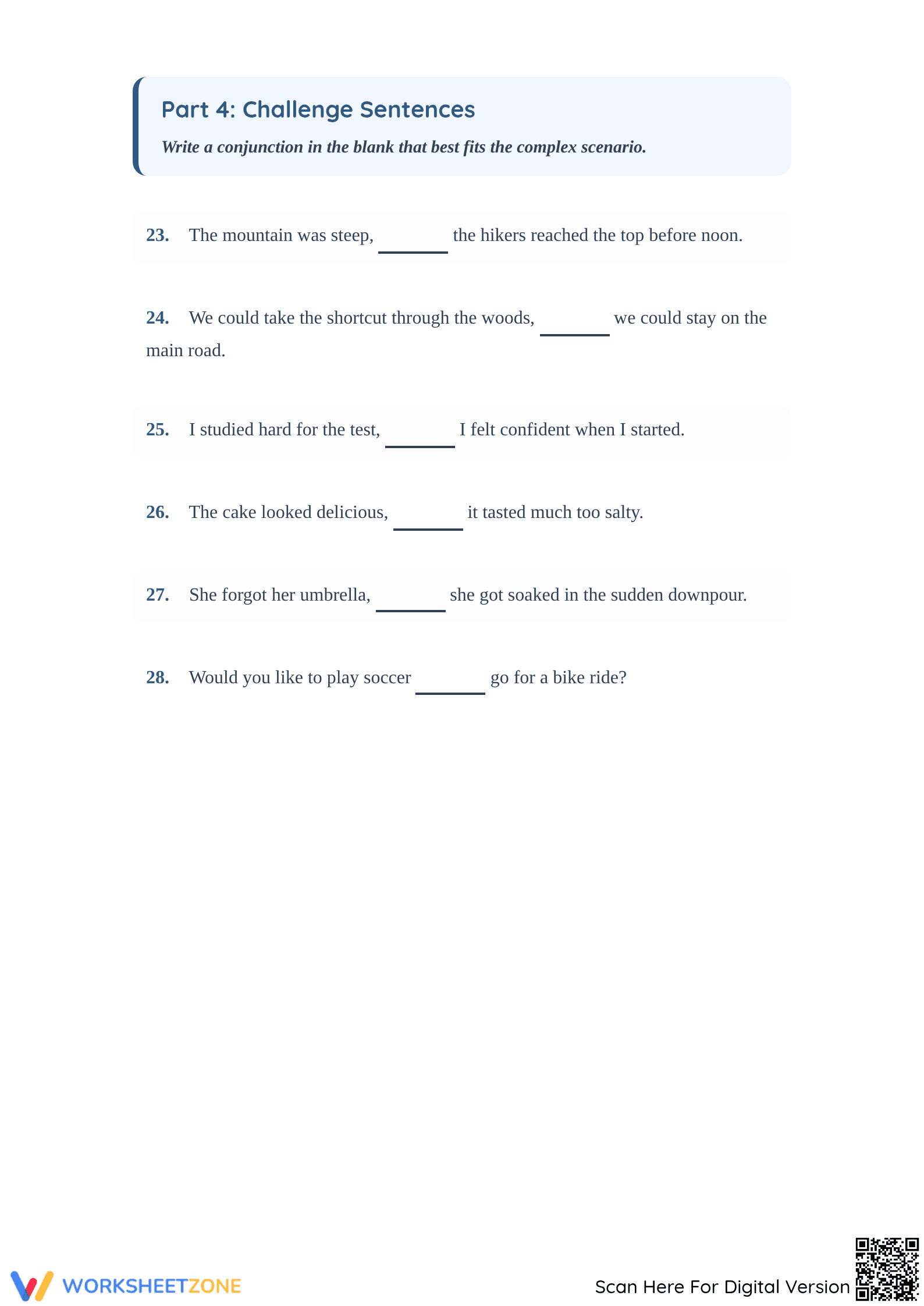
This four-page resource features 28 tasks in four sections. It begins with clear definitions and examples of common conjunctions. Part 1 covers identification; Part 2 uses multiple-choice selection; Part 3 requires sentence combining; and Part 4 offers complex "challenge" scenarios. A full answer key is provided for quick grading.
Skill Progression
The worksheet follows a scaffolded design. It begins with Guided Identification (12 problems) where students recognize conjunctions. It moves to Supported Selection (6 multiple-choice problems) choosing links for specific contexts. Finally, students reach Independent Application (10 problems) by combining thoughts and solving challenge blanks. This "I Do, We Do, You Do" approach ensures students build confidence as they move through the tasks.
Standards Alignment
This resource aligns with CCSS.ELA-LITERACY.L.3.1.H, focusing on coordinating conjunctions for compound sentences. It also supports the developmental progression toward CCSS.ELA-LITERACY.L.4.1.G and CCSS.ELA-LITERACY.L.5.1.A as students learn to manage more sophisticated relationships between clauses. Both standard codes can be copied directly into lesson plans, IEP goals, or district curriculum mapping tools for easy tracking.
How to Use It
This resource works best during the "You Do" phase of instruction. Use the identification section as a quick formative check before students attempt the sentence-combining section. For a more rigorous assessment, assign the "Challenge Sentences" in Part 4 to see which students can apply logical connectors like "yet" or "so" correctly. Completion usually takes 25 to 35 minutes depending on the instructional setting and student level.
Who It's For
Designed for Grades 3-5, this tool helps students transition to compound sentences. It is especially useful for English Language Learners (ELLs) requiring explicit practice with connectors. Pair this worksheet with an anchor chart or a short reading passage where students can see these words in a real-world context before applying them in the structured exercises provided here.
Mastering coordinating conjunctions is a critical milestone in writing development, as it allows students to move beyond repetitive simple sentences toward the syntactic complexity required for academic success. Research in the RAND AIRS 2024 study suggests that explicit instruction in sentence combining is one of the most effective ways to improve overall writing quality in the elementary grades. By practicing the identification and application of "and," "but," "or," "so," and "yet," students align with CCSS.ELA-LITERACY.L.3.1.H and build the foundational skills necessary for more advanced grammar in middle school. This 28-task worksheet provides the high-frequency practice needed to internalize these logical relationships, ensuring students can produce clear, cohesive prose. According to Fisher & Frey (2014), providing varied task types—from identification to creation—strengthens the neural pathways associated with linguistic precision and sentence variety in young writers. This resource bridges the gap between basic grammar and fluid student writing.


