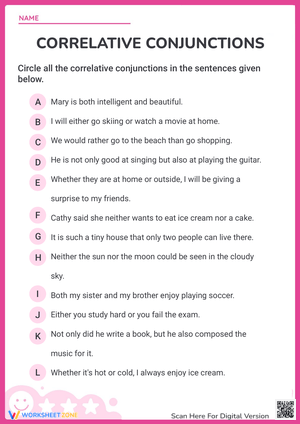
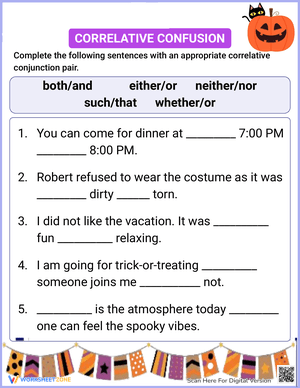
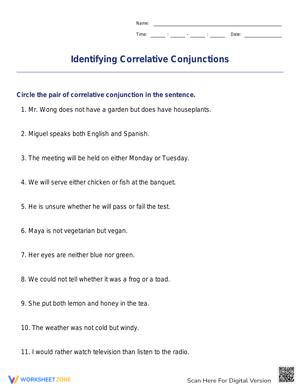
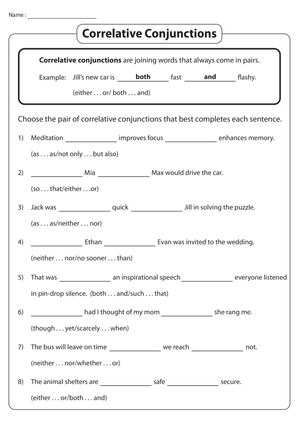
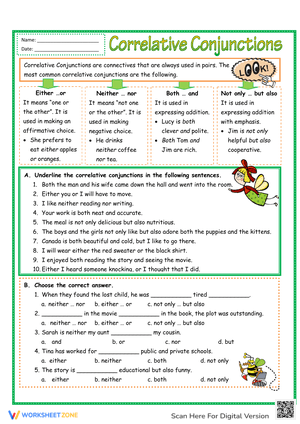
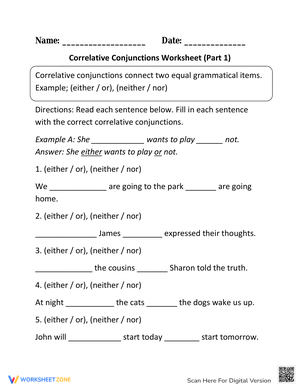
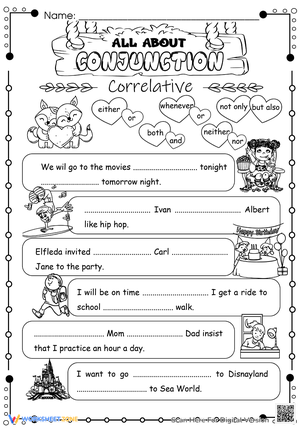
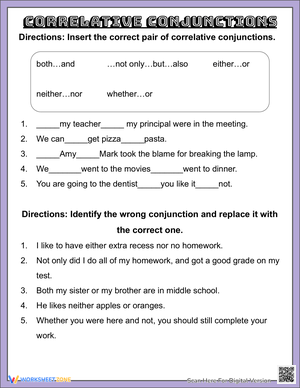
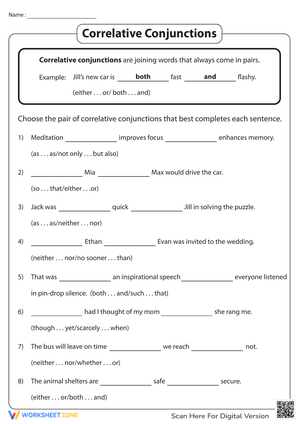
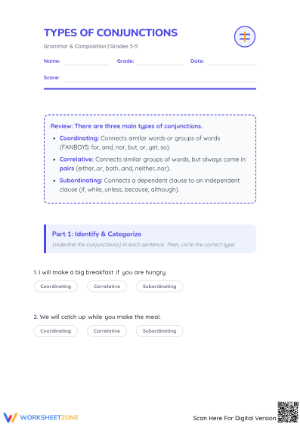
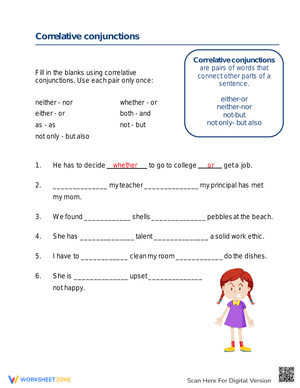
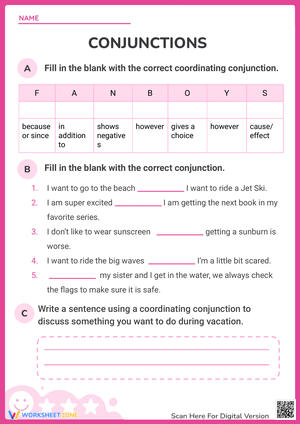
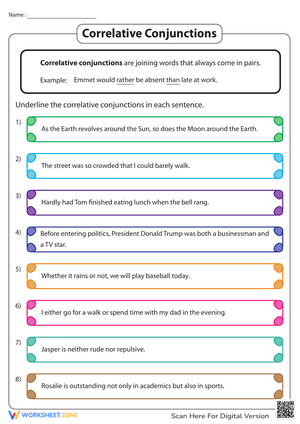
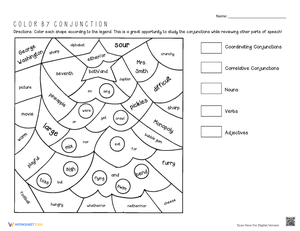
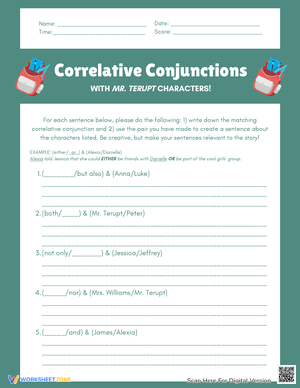
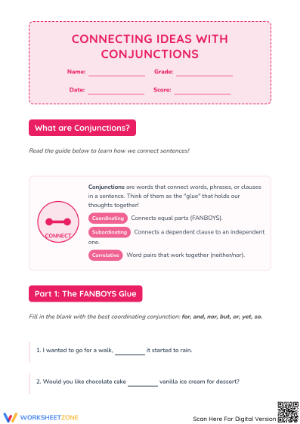
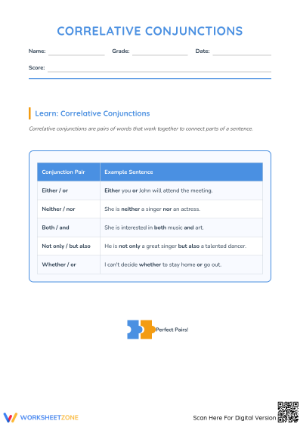
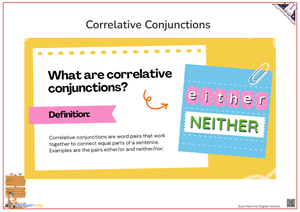
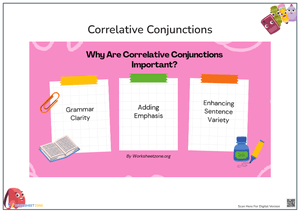
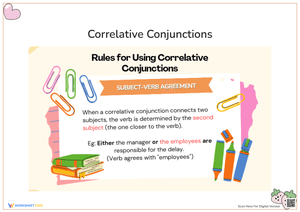
These 4th grade correlative conjunctions worksheets address the word pairs that cause the most confusion at this level — both/and, either/or, neither/nor, not only/but also, and whether/or — through exercises that push students past recognition into actual sentence construction. Each worksheet isolates a specific operation: identifying pairs in context, selecting the correct pair from a word bank, merging two simple sentences into one balanced sentence, and correcting broken or mismatched pairs. Teachers get a set that moves in a clear progression without needing to build that progression from scratch.
What Students Practice Across the Set
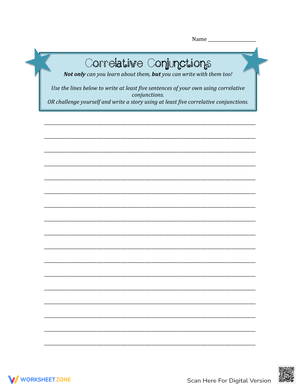
The exercises cover four distinct operations. Fill-in-the-blank items lead the progression — students read a sentence and choose between two possible pairs, which forces attention to meaning rather than memorized pattern. Sentence-combining tasks are where the real writing work happens: students take two grammatically correct simple sentences and merge them using a specified pair, which requires them to balance the grammatical structure on both sides of the conjunction. Error-correction exercises ask students to identify whether a pair is broken, mismatched, or has created a parallelism problem, then rewrite correctly. Open-response prompts close out the harder worksheets — no model sentence provided, just a target pair and a topic.
The 4th grade correlative conjunctions worksheets organizes practice so each worksheet focuses on one or two pairs rather than all five at once. Students who encounter neither/nor in isolation before seeing it mixed into review exercises perform noticeably better when the pairs are eventually combined. Separating the pairs across individual worksheets also makes it easier to track exactly which pair a student hasn't yet locked in.
Where Fourth Graders Go Wrong With These Paired Conjunctions
The most persistent error is pairing "neither" with "or" instead of "nor." Students write "Neither the dog or the cat was hungry" and feel confident about it, because "or" is what they associate with "either" and the two pairs feel interchangeable to them. They've internalized a shape — neither something or something — that sounds plausible even though it's wrong. Error-correction exercises address this directly: students see the mistake labeled, rewrite the corrected version, and hear the difference when they read both sentences aloud.
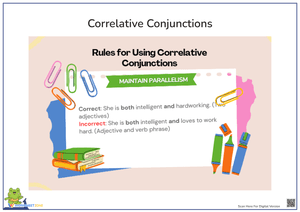
The second issue is broken parallel structure. A student writes "She is both talented and she works very hard at practice," using the pair correctly but destroying the grammatical balance that correlative conjunctions require. Most fourth graders cannot articulate why it's wrong, but they hear it when the sentence is read aloud. Building a quick read-aloud step into the routine — before papers are turned in — catches most of these before they become ingrained habits.
The third pattern is the dropped second conjunction. Students open with "both" and simply forget to include "and" before the second element, treating the first word of the pair as a standalone opener. A practical fix: have students underline the first conjunction the moment they write it, creating a visual cue that something must close the pair later in the sentence.
Fitting These Worksheets Into Your Instructional Week
A 4th grade correlative conjunctions worksheets works best in the eight to ten minutes after morning meeting, when students need a focused warm-up that doesn't require new instructions every day. One worksheet, students work independently, two or three volunteers share, and the class weighs in on the error-correction items together. The format becomes predictable quickly, which matters when you're building grammar routine alongside new content.
Small-group pullout is where targeted work happens fastest. When four or five students consistently mix up neither/nor and either/or, working through the error-correction worksheet together — narrating your reasoning aloud as you identify the problem — is more efficient than revisiting it in a whole-class lesson. The sentence-combining exercises also work well as an exit task at the end of writing workshop. Students who just merged two sentences using "not only/but also" are noticeably more likely to try that pair in their own draft that same day while the structure is still fresh.
Standard Alignment
Correlative conjunctions appear formally in the Common Core ELA framework at fifth grade under L.5.1.e, which requires students to use correlative conjunctions such as either/or and neither/nor. Most fourth-grade curricula introduce the concept a year early — particularly for students already comfortable with coordinating conjunctions and ready for more complex sentence construction. This set builds the foundational knowledge so that when L.5.1.e becomes the explicit grade-level target, students are not encountering the pairs for the first time. Teachers in states that front-load this skill at Grade 4 within the language conventions strand will find the exercises map directly to those expectations.
Meeting Different Skill Levels Within the Same Set
For students still building confidence with basic conjunctions, the fill-in-the-blank exercises with a word bank provide the most structured entry point — they select and place rather than generate from memory. A small reference card listing the five pairs helps those students stay focused on correct usage rather than recall. Reducing the number of items per session also helps students who are still building the automaticity needed to hold a grammar rule in working memory while constructing a sentence.
Students already comfortable identifying the pairs move directly to sentence-combining and open-response tasks. The challenge for them is not the pair itself — it's maintaining parallel structure across longer or more complex clauses. Requiring that their combined sentences also include a subordinate clause pushes them to manage two grammatical demands at once. The strongest extension task is asking those students to write a short paragraph using at least three different pairs, then checking that each pair doesn't land in the same syntactic slot. That task reveals whether a student is genuinely controlling the structure or just inserting pairs on autopilot.
Frequently Asked Questions
Do these worksheets align to fourth-grade or fifth-grade standards?
The content bridges both levels. Correlative conjunctions sit formally under the Common Core fifth-grade standard L.5.1.e, but many fourth-grade curricula introduce them as preview instruction or as extension work for students ready to move beyond coordinating conjunctions. If your Grade 4 scope and sequence includes conjunction pairs, these worksheets fit your instruction directly. If you teach Grade 5, the 4th grade correlative conjunctions worksheets works as solid review material before students move to fully independent application in their writing.
Which conjunction pairs does the set cover?
The five pairs are both/and, either/or, neither/nor, not only/but also, and whether/or. Each worksheet focuses primarily on one or two of these pairs so students build secure knowledge of each before encountering all five in mixed-review exercises.
What should I do when students keep confusing neither/nor and either/or even after completing the exercises?
The distinction usually needs a semantic anchor before grammar practice can hold it. Explain that either/or presents a genuine choice between two options that both remain available, while neither/nor eliminates both options entirely. A brief physical activity helps — pose questions using each pair so students feel the meaning difference before they write it. Return to the error-correction exercises afterward with that semantic frame in place. Students who still struggle after that usually need one-on-one attention to identify the exact substitution error they're making in context.












 Interactive Worksheet Maker
 Quiz Maker
 Word Search Maker
 Crossword Puzzle Maker
 Word Scramble Generator
 Sentence Scramble Generator
 Handwriting Worksheet Generator
 Name Tracing Generator
 Fill In The Blank Generator




 BACK TOSCHOOL