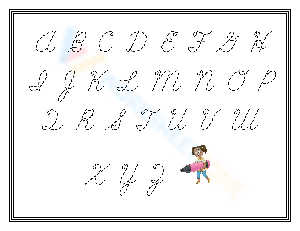
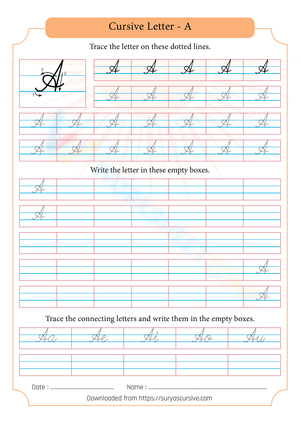
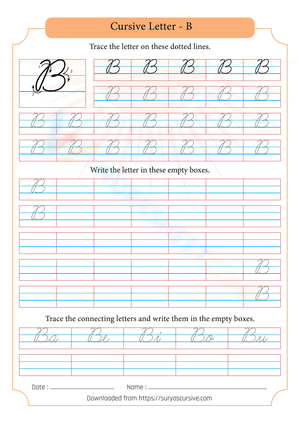
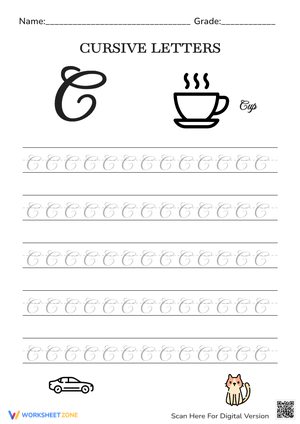
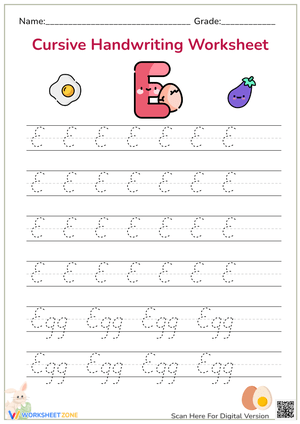
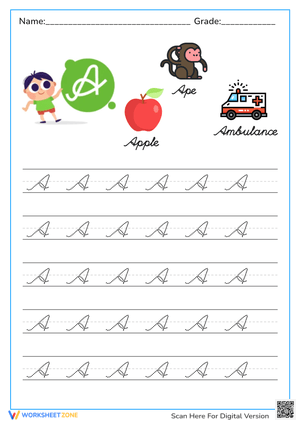
These cursive capital letters handwriting worksheets for 3rd grade give teachers a print-ready set covering all 26 uppercase letter forms, moving each letter from guided tracing through independent production on three-line ruled paper. The set is built around the developmental reality that third graders entering cursive instruction usually have solid print experience and often some lowercase cursive work behind them — but uppercase forms bring new stroke demands that need deliberate, letter-by-letter attention before students can use them in real writing.
The Specific Skills Each Worksheet Builds
The cursive capital letters handwriting worksheets for 3rd grade in this set organize letters by stroke family rather than alphabetical order — a sequencing decision that substantially reduces confusion when students encounter a new motor pattern. Letters sharing an initial oval or curve, such as A, C, and E, appear as a group. Letters built on a tall entry loop — L, B, H — follow together. This grouping lets teachers build on a motor pattern students already know rather than starting from zero with each new letter.
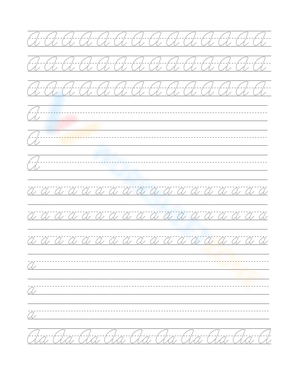
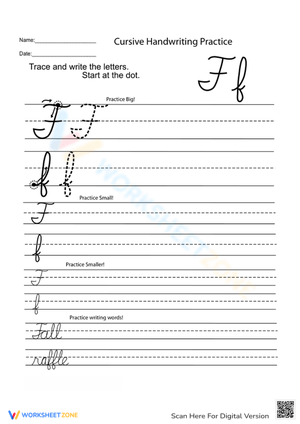
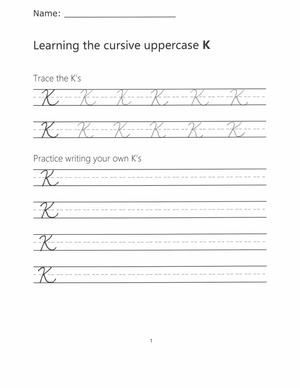
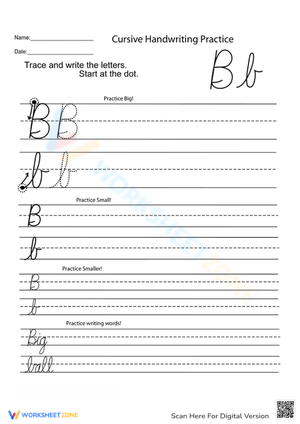
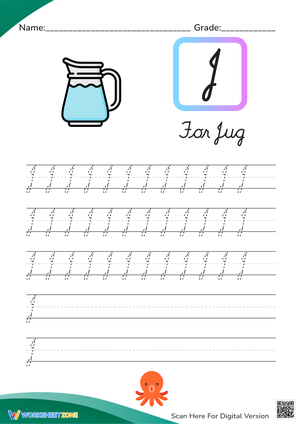
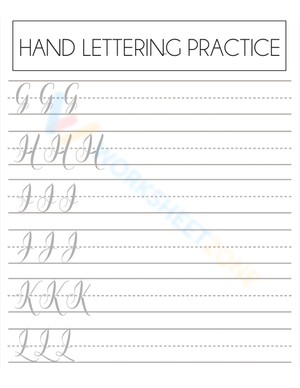
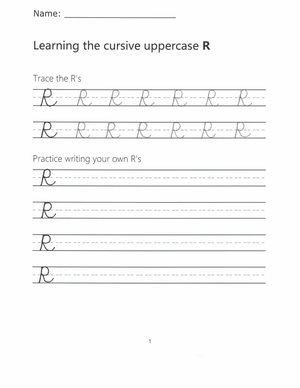
Within each worksheet, practice moves through three stages: traced letter with numbered stroke cues and directional arrows, lightly dotted prompt where students reconstruct the form with less visual support, and open ruled lines for independent production. Several worksheets pair the target capital with a content-area word — Ecosystem, River, Monarch — so students encounter correct proportion in context rather than treating the letter as a standalone drawing task. Each worksheet also addresses connection rules directly, flagging capitals like D, F, O, P, T, and W that require a pen lift before the following lowercase letter.
Student Error Patterns Worth Addressing Early
The most consistent error with cursive capitals is starting at the wrong entry point. Capital Q trips up almost every student in Zaner-Bloser style: the cursive form opens with a small clockwise loop at the top that feeds into the oval — the opposite of how students print a Q. Without stroke-direction cues, most students draw a print Q, add a tail, and repeat that exact form indefinitely because nothing in the physical act of writing tells them they're wrong. The directional arrows on each worksheet make that error visible before it becomes a habit.
Proportion is a close second. Third graders coming from print handwriting tend to write cursive capitals at the same height as their lowercase letters, collapsing the three-line distinction entirely. The baseline-midline-headline guideline on each worksheet does real work here — but teachers still need to walk the room during the first few sessions, because students who trace correctly will often revert to short letters the moment they hit the independent lines.
Connection errors are less about carelessness and more about missing information. Students who haven't been explicitly taught which capitals don't connect will attempt to connect all of them. A student writing Frank will drag a stroke out of the F and into the r, producing something unrecognizable. These worksheets address this by including a short practice phrase with each non-connecting capital, so students encounter the pen-lift rule in context rather than as a chart to memorize.
Fitting These Worksheets Into Your Lesson Plans
The most reliable placement for cursive capital letters handwriting worksheets for 3rd grade is the first eight to ten minutes of the language arts block, before the main reading or writing task begins. Students are settled, hands are ready, and the brief focused repetition works as a motor warm-up that doesn't cut into core instructional time. Introduce two to three new capitals per session and keep previously taught letters in rotation through short review rows at the bottom of each new worksheet.
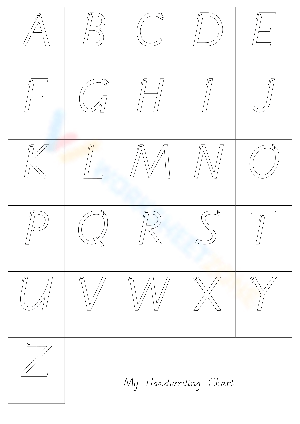
A station-rotation model works well too. Print a stack and set up a handwriting station with pencil grips, a slant board, and a laminated uppercase alphabet reference card. During literacy centers, students complete one worksheet per rotation visit, which keeps practice consistent through the week without requiring whole-group time every day.
One pairing worth trying: match each new capital to a vocabulary word from the current content unit. If the class is studying weather, students trace and then write Weather and Wind while practicing W. The handwriting work doubles as vocabulary reinforcement, with no extra prep required on either side.
Standard Alignment
Cursive instruction falls outside the Common Core State Standards, which addressed handwriting only through Grade 2 and never specified cursive. More than 20 US states have since passed mandates requiring cursive instruction in elementary grades, with Grade 3 as the most common starting year. Teachers in mandated states document cursive capital practice under their state's language conventions or handwriting standard — the specific code varies enough by state that pulling up your state's ELA framework directly is more reliable than working from a generic citation. In states without a formal mandate, most teachers align this practice with the conventions strand, treating it as a natural extension of the written expression work students do at this level.
Making the Set Work for Every Student in the Room
For students with strong fine motor control who move through the tracing stage quickly, use the independent lines on each worksheet as a launch point for sentence writing. A student who has practiced M writes a sentence or two — My dog is named Max. — rather than filling every line with the isolated letter. This keeps advanced writers moving toward the authentic use of cursive that makes the motor practice meaningful and prevents the disengagement that repetitive letter-filling causes.
Students with limited fine motor development often benefit from a brief gross-motor warm-up before seated practice: air-writing the target letter in large arm movements primes the shoulder and elbow muscles that feed down into pencil control. For students who consistently lose the letter form on the independent lines, stay at the dotted-prompt stage for a full session rather than pushing forward — accurate production matters more than pace of progression through the worksheet.
Left-handed students need two specific adjustments. Tilt the paper slightly to the right rather than the left, and when possible use a version of each worksheet that places the model letter on the right side of the practice row so students don't cover the example with their writing hand as they work across the line. Pencil grips made for left-handed writers also reduce hand fatigue that builds noticeably over a ten-minute session.
Frequently Asked Questions
Which cursive capital letters don't connect to the next letter?
In standard Zaner-Bloser and most D'Nealian-style programs, the capitals D, F, O, P, Q, T, and W do not connect to the following lowercase letter. Students lift the pen after completing these capitals before writing the next letter. Each relevant worksheet in the set calls this out directly in the practice phrase rather than leaving students to discover the rule mid-word.
How do Zaner-Bloser and D'Nealian uppercase forms differ?
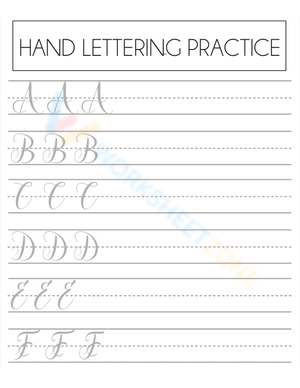
Zaner-Bloser cursive uses more pronounced loops and flourishes on capital letters — the F and G in particular look more formal and stylized. D'Nealian capitals are simpler, bridging more closely from manuscript printing, and have fewer decorative elements. Check which style your school or district uses before printing in bulk; the stroke sequences differ enough that mixing styles mid-year creates real confusion for students who are still building motor memory for each form.
How many letters should I introduce per week?
Two to three new capitals per week is a workable pace for most third-grade classes, especially when grouping by stroke family. Introducing more than four in a week leaves students without enough repetition to automate the motor pattern, and teachers end up re-teaching letters that were technically covered two weeks earlier. The cursive capital letters handwriting worksheets for 3rd grade in this set support a pacing of roughly nine to ten weeks for the full uppercase alphabet at that rate.
Can these worksheets be sent home for practice?
Yes. The stroke-direction arrows give students enough visual information to practice accurately without a teacher present. A brief parent note the first time — explaining what the numbered arrows indicate and which direction the strokes run — prevents the common situation where a student practices the wrong stroke sequence forty times at home and arrives having reinforced the error rather than corrected it.