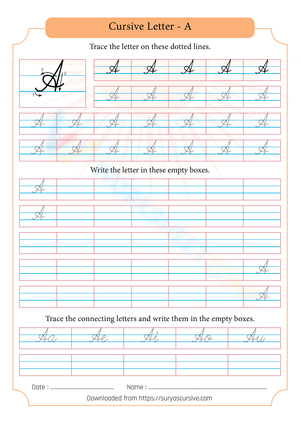
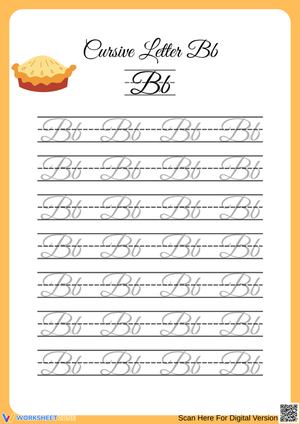
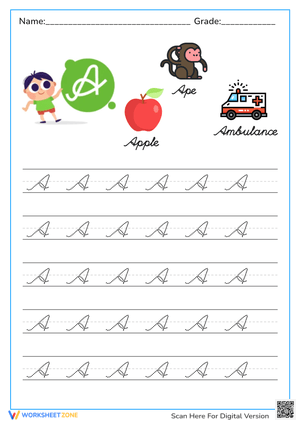
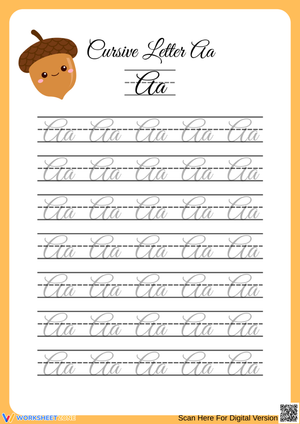
These cursive a handwriting worksheets for 3rd grade give teachers ready-to-print practice that separates the uppercase and lowercase forms — and then connects them to real words before students ever have to produce them independently in paragraph writing. Each worksheet targets one specific phase: directed tracing with stroke-order arrows, open-line reproduction, or letter-connection practice within high-frequency words students can already read.
The Skills These Worksheets Build
Lowercase a belongs to the clock-face family — letters whose formation starts at roughly the 2 o'clock position, curves left and down to the baseline, closes the loop, and exits with an upward tail that bridges into the next letter. Students practice each stage before combining them into a full stroke. Uppercase A work focuses on the entry curve, the angled descent to the baseline, and crossbar placement, with particular attention to the slant consistency that programs like Zaner-Bloser treat as a legibility requirement rather than a stylistic preference.
Letter connections get dedicated practice rather than being assumed. The connection from a to l requires a long upward sweep above the midline. The a-to-n connection is a shorter, more level push. The a-to-t connection requires a crossbar at mid-letter height. Students who can form a clean standalone lowercase a sometimes fall apart the moment a connecting stroke is required, so isolating these movements on a separate worksheet makes the gap visible and fixable.
Errors Worth Anticipating Before You Hand These Out
The hooked top on the lowercase a is the most common third-grade error with this letter. It happens when students start above the 2 o'clock position — the curve overshoots, producing a shape that looks like a lowercase d or a malformed g. Verbal correction rarely sticks. Marking a starting dot at the correct position directly on the worksheet does more than any reminder, because students are looking at the paper, not at the board.
Uppercase A errors cluster around the crossbar. Students frequently place it too high — near the closing loop rather than across the middle of the letter — turning the letter into something that reads as a cursive O. A worksheet that shows the correct form next to the typical misformed version gives students a reference they can use independently instead of raising a hand for each repetition.
The cursive a handwriting worksheets for 3rd grade include sight words like and, at, and all for a specific reason: the exit stroke on the lowercase a disappears first in connected writing. When a student writes and and the a stands disconnected from the n, you know immediately that the exit stroke is not yet automatic. Using familiar words as the practice context turns every completed worksheet into a readable diagnostic.
Building These Worksheets Into the Instructional Week
Ten to twelve minutes is about the right window for focused cursive work at third grade — enough time to complete a worksheet carefully, short enough to keep hand fatigue from degrading the last few lines. Morning work is a natural fit: students arrive at staggered times, and a cursive worksheet gives early arrivers a productive task that doesn't require teacher facilitation to begin. The worksheets also work well as an opener on days when a longer writing assignment follows — running through letter formations first primes motor memory before students move into paragraph-level work, the same principle behind a musician running scales before performing.
The cursive a handwriting worksheets for 3rd grade format makes it straightforward to print exactly the copies needed — thirty for a full class, eight for a small-group reteach session, or a single copy for a student who needs extra days of practice. In literacy centers, posting a cursive alphabet strip next to the worksheet station lets students self-check their letter shapes, which cuts down on the steady stream of "does this look right?" interruptions during independent rotation time.
Standard Alignment
CCSS does not mandate a specific script, but grade 3 writing standards require students to produce legible text across their written work. Several states that supplement CCSS with handwriting-specific frameworks — including California, Texas, and Louisiana — explicitly require cursive introduction at third grade. The letter formation, stroke consistency, and exit-stroke fluency practiced in this set directly address the legibility and continuity benchmarks that most districts place in their third-grade handwriting scope and sequence when they designate grade 3 as the formal entry point for cursive instruction.
Adjusting the Set for Different Writers in the Room
Students still developing fine motor strength benefit from wider lines and more tracing repetitions before they move to blank-line reproduction. Printing a tracing-heavy worksheet at 115 percent gives those students extra room without distorting the letter proportions. For students who pick up the form quickly, the connection worksheets serve as an extension — asking them to compose short original phrases using only the connections they've practiced, rather than filling a pre-printed line, adds a production challenge without requiring new material.
These cursive a handwriting worksheets for 3rd grade also translate cleanly to pull-out settings. An occupational therapist or reading specialist can use the tracing worksheet as a targeted motor task without adapting anything for a small-group session. Left-handed students need one consistent physical adjustment: the paper angled to the right rather than the left. That posture change, combined with a reminder that the writing hand moves away from the body during cursive rather than hooking beneath the line, addresses most of the legibility problems left-handed third graders encounter early in cursive instruction.
Frequently Asked Questions
Should I introduce the uppercase or lowercase form first?
Lowercase first for almost all students. The lowercase a is higher-frequency in written English, and its clock-face stroke teaches a movement pattern that transfers directly to c, d, g, and q. Once the lowercase form is stable, the uppercase A registers as a distinct letter rather than a confusing variation, and the crossbar instruction makes more sense in isolation.
My students write print fluently. Will cursive a feel harder than expected?
Usually yes, and specifically because of the exit stroke. Print writers lift the pencil after each letter — that habit is well-established by third grade. The continuous-motion requirement of cursive directly conflicts with it. The exit stroke is the one genuinely new element on the lowercase a, since the clock-face circle portion feels familiar from print. Students who stall on the exit stroke respond well to practicing just that motion — the pull-and-exit repeated across a line — before attaching it to a full letter.
How do I correct a student whose lowercase a looks like a printed version inside a cursive word?
The exit stroke is missing. A manuscript a ends at the baseline with no tail. A cursive a ends with a curved upswing toward the midline that launches into the next letter. Have the student write the exit portion five times in isolation, then attach it to a complete letter. Making the new movement conscious first — before expecting it to become automatic — is the step most students who stall on this specific issue are skipping.