


























Views
Downloads

Printable Cursive Letter F Worksheet | Grade 3 Ready
Paste this activity's link or code into your existing LMS (Google Classroom, Canvas, Teams, Schoology, Moodle, etc.).
Students can open and work on the activity right away, with no student login required.
You'll still be able to track student progress and results from your teacher account.
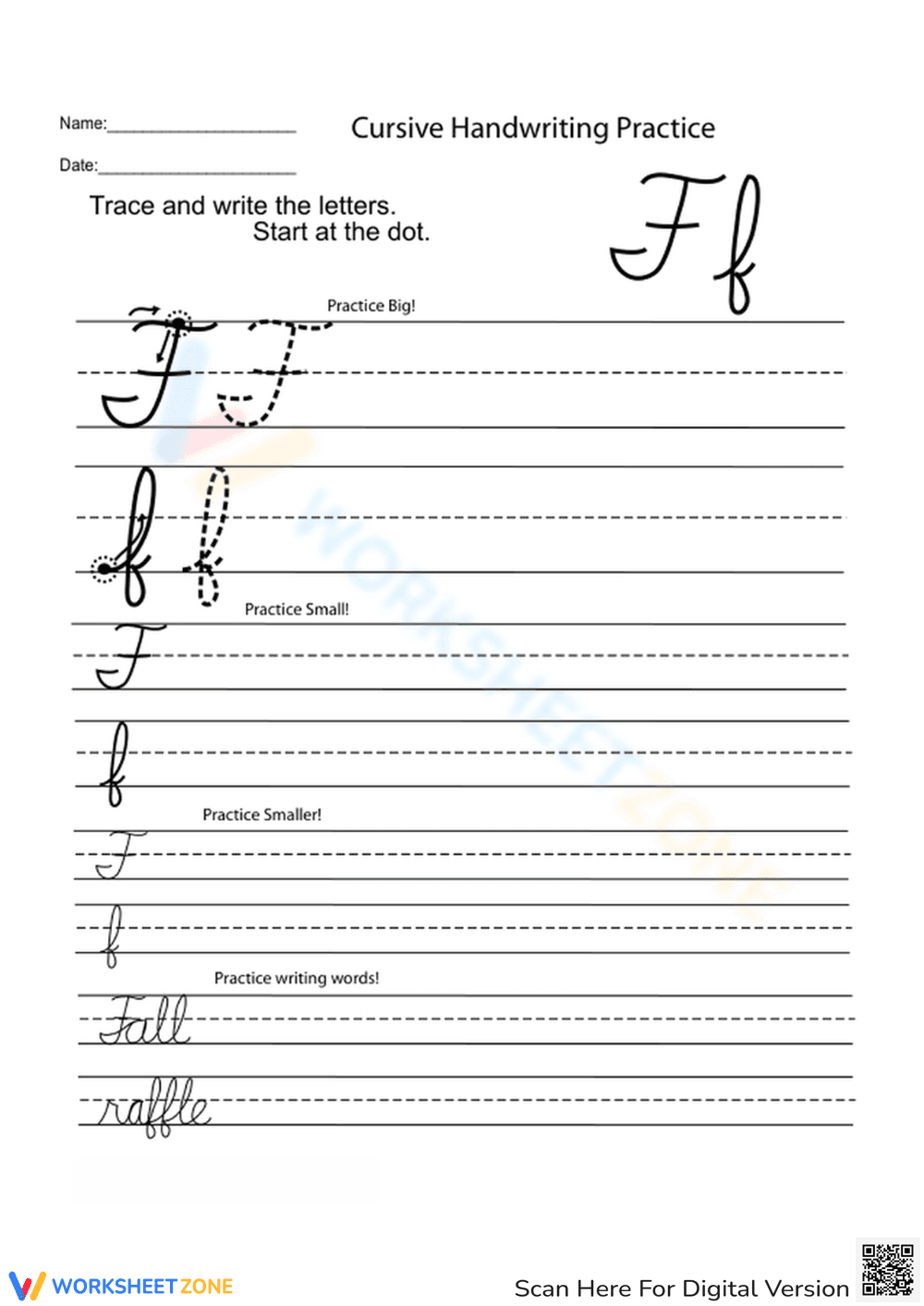
This printable cursive letter F worksheet helps second and third-grade students master proper letter formation and fluid handwriting. By tracing and writing both uppercase and lowercase F, learners develop the essential fine motor control needed for legible, confident cursive writing across all subjects.
At a Glance
- Grade: 3 · Subject: ELA
- Standard:
CCSS.ELA-LITERACY.L.3.1— Write legibly and demonstrate command of standard English conventions.- Skill Focus: Cursive Letter F Formation
- Format: 1 page · 8 practice lines · No answer key needed · PDF
- Best For: Independent practice and morning work
- Time: 10–15 minutes
Inside this single-page resource, students will find a structured progression of handwriting exercises. The page features eight distinct practice lines, starting with large, guided tracing models that include directional arrows for the starting dot. It then transitions to smaller practice lines for both uppercase and lowercase F, and concludes with word-level practice using the words "Fall" and "raffle" to connect letters.
This resource is designed for an efficient, zero-prep classroom experience:
- Print (1 minute): Simply download the PDF and print a class set. The black-and-white design is highly ink-friendly.
- Distribute (1 minute): Hand out the worksheets during morning work or literacy centers. The visual cues make it entirely self-explanatory for students.
- Review (3 minutes): Quickly check student letter formation and spacing as they work independently.
Total teacher prep time is under two minutes, making this an ideal activity for emergency sub plans or quick instructional transitions.
This worksheet aligns with CCSS.ELA-LITERACY.L.3.1, ensuring students demonstrate command of the conventions of standard English grammar and usage when writing. While cursive is often a state-specific addition to the core standards, mastering fluid letter formation supports broader writing fluency and stamina. Both standard codes can be copied directly into lesson plans, IEP goals, or district curriculum mapping tools.
Teachers can integrate this cursive practice into daily routines in multiple ways. Use it as a focused morning work activity to settle students before direct instruction begins. Alternatively, place it in a literacy center for independent skill reinforcement. As a formative assessment tip, observe students while they trace the initial large letters to ensure they are starting at the correct dot and following the directional arrows, rather than forming the letters backward. Expected completion time is 10 to 15 minutes.
This worksheet is primarily designed for second and third-grade students who are being introduced to cursive writing or need targeted remediation on the letter F. The gradual reduction in letter size provides built-in scaffolding for learners developing fine motor skills. It pairs perfectly with a visual cursive alphabet anchor chart or a direct instruction mini-lesson on connecting cursive strokes.
Research underscores the cognitive benefits of explicit handwriting instruction in early elementary grades. According to a comprehensive EdReports 2024 analysis, structured cursive practice significantly improves spelling retention and overall writing fluency by automating fine motor execution. This critical automation allows students to allocate much more of their working memory to content generation, vocabulary selection, and complex syntax formulation. By targeting the specific motor pathways required for the cursive letter F, this targeted resource directly supports these essential developmental milestones. Aligned with CCSS.ELA-LITERACY.L.3.1, the worksheet requires students to write legibly and demonstrate command of standard English conventions. Consistent, guided repetition—moving carefully from isolated letter tracing to connected word writing—ensures that students build the muscle memory necessary for long-term retention and fluid, legible communication across all of their daily academic subjects.


