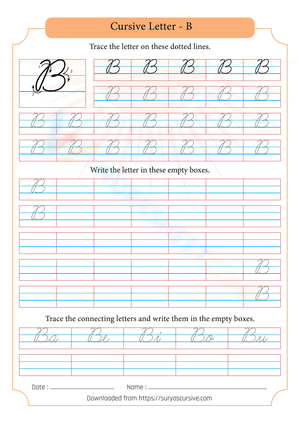
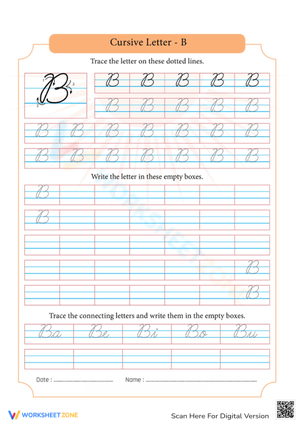
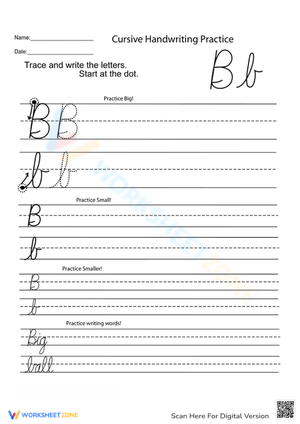
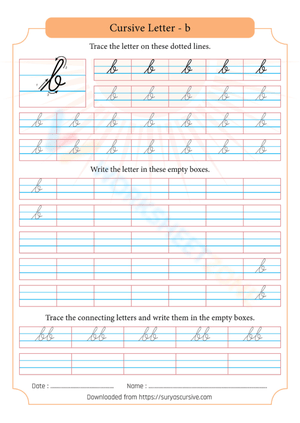
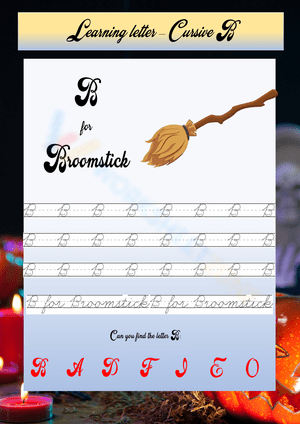
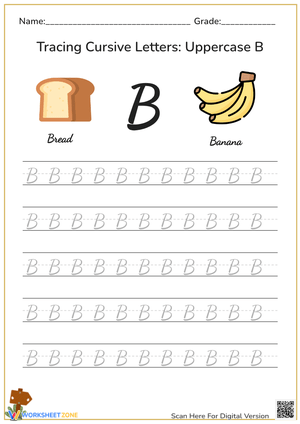
These 3rd grade cursive b handwriting printable worksheets give teachers a focused resource for one of the more demanding formation challenges in the Grade 3 cursive sequence — covering both uppercase B and lowercase b through a clear order of tracing, independent letter rows, and word-level copywork. They fit naturally into the short handwriting block most teachers hold at the start of the literacy period.
What Each Worksheet Covers
Each worksheet opens with clean uppercase B and lowercase b models at the top of the ruled section. From there, the work moves through three stages:
- Tracing lightly printed guide letters to internalize the stroke path
- Independent letter rows where formation has to stand without visual support
- Word copywork using familiar B vocabulary — bear, blue, book, bright — followed by a short sentence
That full path, from modeled letter to independent sentence, is what separates strong 3rd grade cursive b handwriting printable worksheets from resources that only drill isolated strokes. Primary ruled lines run throughout each worksheet. At Grade 3, students writing without guidelines frequently let uppercase B drift above the midline or let the lowercase bowl drop under the baseline — the visual boundary of a ruled line keeps letter size in range without requiring constant teacher correction.
Formation Errors That Show Up in Almost Every Class
Uppercase B and lowercase b fail in different ways, and the failure points are consistent enough to anticipate before passing out a worksheet. For the capital form, the most reliable problem is treating the two bumps as separate gestures rather than one connected stroke — the result looks like a printed B rather than a cursive one because students essentially stop and restart between the upper and lower curve. For lowercase b, the failure almost always happens at the ascender stroke: students rush from the baseline straight up to the top line, collapsing the loop before the bowl even starts. On a finished worksheet, this produces what looks like a rounded stick with a flattened top rather than a clean, closed loop.
A pattern worth watching: students who trace lowercase b correctly will still drop the loop when writing without the guide. Tracing carries them through the physical motion; independent rows reveal whether the stroke has become automatic. Correcting row by row — not after the whole worksheet is done — prevents that error from settling in as a habit.
Building These Worksheets Into Your Weekly Lesson Plans
A five-day structure spreads practice without making handwriting feel heavy. On day one, model uppercase B at the board with sequential stroke language — "start at the top line, pull straight down, curve right, bump, bump" — then have students complete only the tracing section and the first independent row before stopping for a whole-group check. Holding back the rest of the worksheet stops the rush-to-finish habit that defeats careful formation.
By midweek, word copywork takes over. Writing bear or blue three or four times keeps the target letter in a real spelling context, which reinforces word recognition alongside handwriting fluency. Friday works well for a quick close: one neat row of uppercase B, one of lowercase b, one sentence. Before students turn in the worksheet, ask them to circle their best-formed letter — that small self-check turns the task from repetition into something closer to formative self-assessment, and it gives teachers a fast read on whether students can actually recognize legible work.
For centers, a basket with worksheets and a one-question self-check card ("Did you close your lowercase b loop?") runs without teacher direction. For intervention, fold each worksheet so only one row is visible at a time. For homework, attach a brief note telling families to watch for correct letter shape rather than speed — without that direction, most students at home will rush, reinforcing exactly the habits the practice is meant to fix.
Adjusting the Work Across Different Student Levels
Students still building fine motor control do better with less writing volume, not more. Reduce the assignment to one tracing row and one independent row, and aim for those two rows to be done well. A useful technique: have the student trace in highlighter first, then write directly below the traced letter so the model stays visible during the independent attempt. For students who freeze when they see a full worksheet, folding it to expose only one section at a time makes a real difference.
Students ready for more challenge can substitute their own B words in place of the printed copywork — especially effective when a current read-aloud contains strong B vocabulary like boundary, beneath, or burrow. The open practice lines on 3rd grade cursive b handwriting printable worksheets have enough room for substituted words without any reprinting. For students with persistent fine motor difficulty, a larger-ruled version and a reduced row count are worth trying before concluding the letter simply hasn't clicked. Grip, posture, and writing stamina affect cursive accuracy more than many teachers expect, and one worksheet per session is often already at the limit of what these students can complete with quality.
Standard Alignment
These worksheets address CCSS Language standard L.3.2, which covers conventions of standard English and includes producing legible writing with consistent letter formation and spacing. The instructional reasoning goes beyond compliance: when students have to consciously reconstruct every letter stroke, they carry higher working memory load during composition, and sentence-level thinking suffers for it. Building reliable formation of B and b through focused repetition reduces that cognitive load so students can direct attention toward composing rather than letter-making. That is the practical case for continuing handwriting instruction into Grade 3 rather than treating it as a finished K–2 topic — and it is why 3rd grade cursive b handwriting printable worksheets fit into the literacy block without displacing time from other writing work.
Frequently Asked Questions
Do these worksheets cover both uppercase B and lowercase b?
Yes. Each worksheet includes models and practice for both forms in the same session. Working through uppercase B and lowercase b together helps students recognize the proportion differences between the two — a distinction that carries over into all their cursive writing.
How many sessions should students practice a single cursive letter before moving on?
Three to five short sessions spread across a week produce more lasting results than one long sitting. Distributing the practice — a short row each day rather than the entire set at once — builds motor memory without fatiguing the hand or losing student attention to the task.
What should teachers do when a student traces correctly but the formation falls apart on independent rows?
That gap is common and almost always means the student is relying on the visual guide rather than internalizing the stroke sequence. Have the student write the letter in the air with a full arm sweep before picking up the pencil, then immediately write one independent letter. That kinesthetic preview often bridges the gap faster than more tracing does.
Can these worksheets support small-group intervention?
Yes. Folding each worksheet to expose only one section at a time reduces visual clutter and keeps intervention groups focused on a single row or word set before moving forward. Teachers can also assign only the letter rows in one session and only the word copywork in the next, depending on exactly where the breakdown is occurring.