


























Views
Downloads
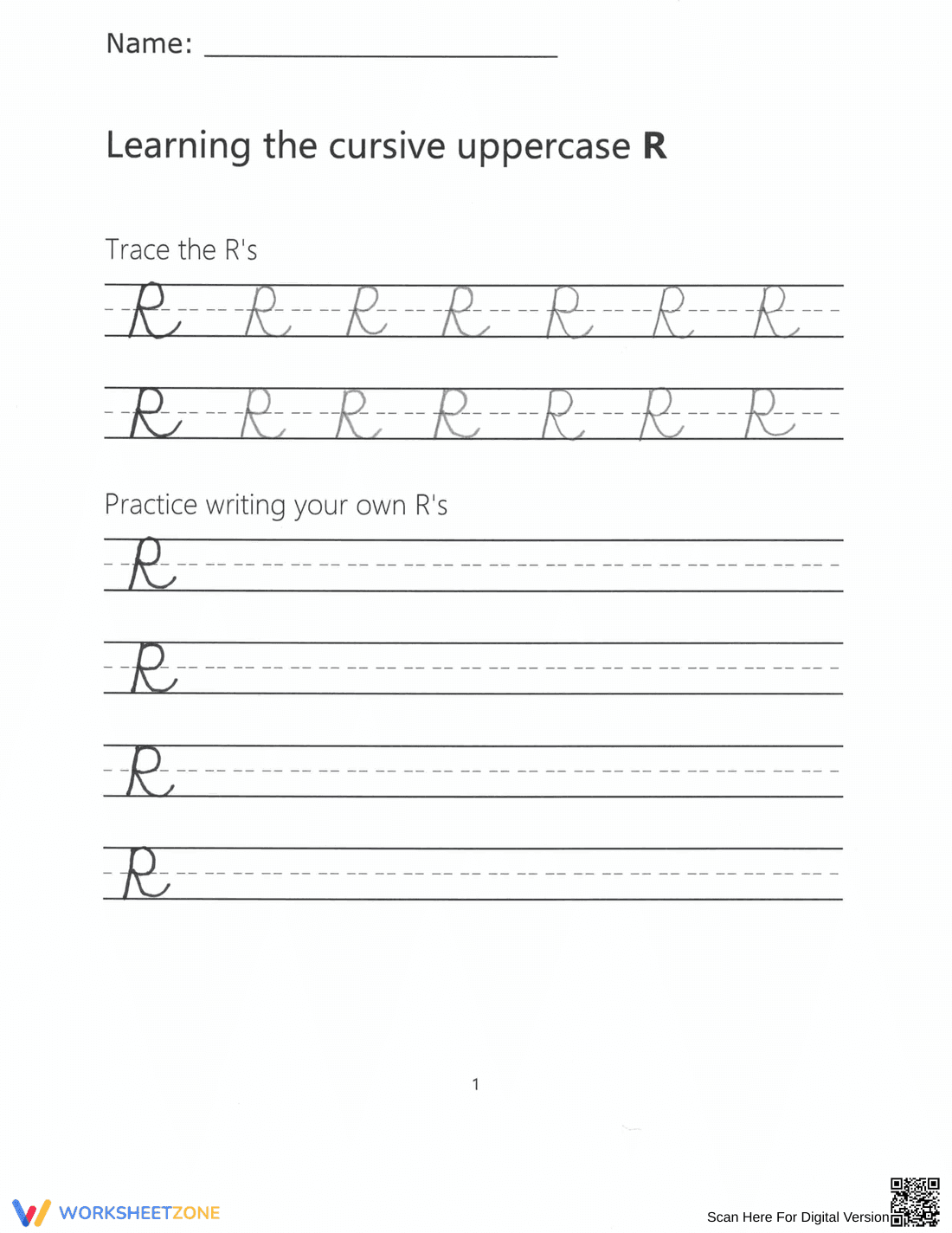

Cursive Uppercase R Worksheet | Grade 3 Printable
Paste this activity's link or code into your existing LMS (Google Classroom, Canvas, Teams, Schoology, Moodle, etc.).
Students can open and work on the activity right away, with no student login required.
You'll still be able to track student progress and results from your teacher account.
This Grade 3 cursive uppercase R worksheet provides students with structured practice to master the fluid motion of capital letter formation. By focusing on a single character, learners develop the muscle memory required for legible handwriting. This resource ensures students transition from guided tracing to independent writing with confidence and precision.
At a Glance
- Grade: 3 · Subject: Handwriting
- Standard:
CCSS.ELA-LITERACY.L.3.1.j— Write legibly in cursive or joined italics to produce clear text- Skill Focus: Cursive uppercase R formation
- Format: 1 page · 18 tasks · Answer key included · PDF
- Best For: Morning work or handwriting centers
- Time: 10–15 minutes
This single-page PDF features a clean, distraction-free layout designed for elementary learners. It includes two distinct practice zones: a tracing section with 14 dotted-line templates and a free-writing section with 4 dedicated lines for independent execution. The worksheet utilizes standard three-line handwriting guides to help students maintain proper letter height and slant. A completed reference letter is provided at the start of each row.
Teachers can integrate this resource into their daily routine in under two minutes. First, print the required number of copies for the class or a specific small group. Second, distribute the sheets during a handwriting block or as a quiet transition activity. Finally, review student work by checking for consistent slant and proper connection points. This worksheet is an ideal solution for substitute folders or unexpected schedule gaps.
The primary focus is `CCSS.ELA-LITERACY.L.3.1.j`, which requires students to write legibly in cursive. This worksheet specifically targets the complex curves and loops of the uppercase R, a letter that often poses challenges for beginning cursive writers. By mastering this specific character, students build the foundational skills necessary for the broader language standard. This standard code can be copied directly into lesson plans, IEP goals, or district curriculum mapping tools.
Use this worksheet as a formative assessment after a direct instruction lesson on the letter R. Observe students as they trace the first row to ensure they are starting their strokes at the correct baseline or midline point. Alternatively, assign this as a fast-finisher task for students who complete their ELA assignments early. The 10-15 minute completion time makes it a perfect tool for maintaining handwriting stamina without overwhelming the student.
This resource is designed for second and third-grade students who are beginning their cursive journey. It is particularly helpful for learners who require extra fine-motor practice or those following a homeschooling curriculum. It pairs naturally with an alphabet anchor chart or a cursive stroke-order video to provide a multi-sensory learning experience for diverse classroom populations.
Handwriting instruction remains a vital component of literacy development, as evidenced by recent research. According to Fisher & Frey (2014), the physical act of writing letters by hand supports orthographic mapping and word recognition in ways that typing cannot replicate. This worksheet aligns with CCSS.ELA-LITERACY.L.3.1.j by providing the repetitive, focused practice necessary for students to achieve legibility in cursive. The transition from tracing 14 guided letters to 4 lines of independent practice follows the gradual release of responsibility model, ensuring that students are not merely copying but internalizing the letter's structure. By dedicating 10 to 15 minutes to specific character formation, educators can prevent the development of poor handwriting habits that often hinder written expression in later grades. This resource serves as a practical application of evidence-based handwriting instruction within the modern elementary classroom.


